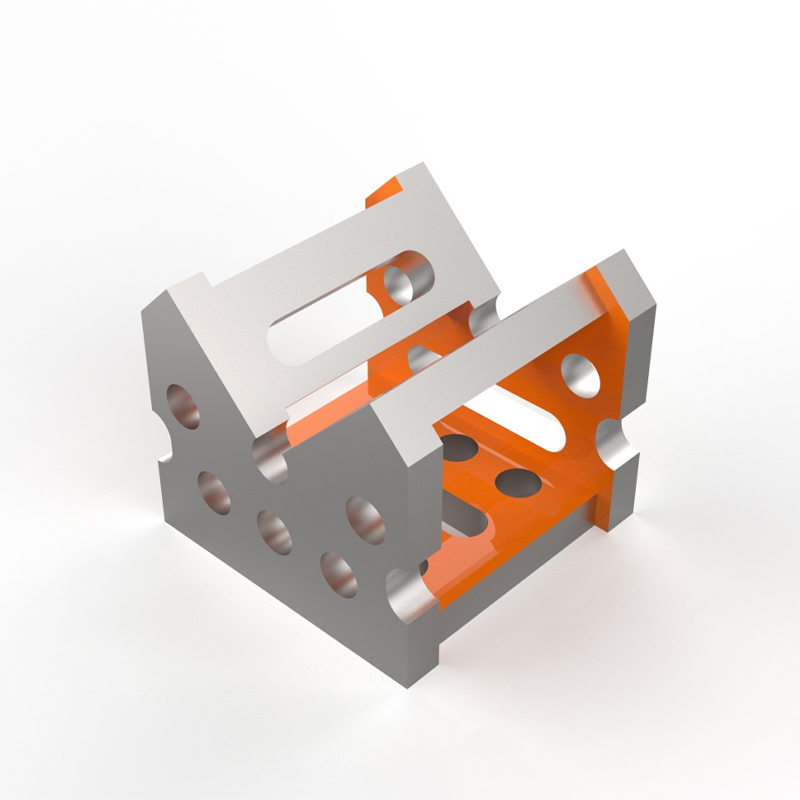
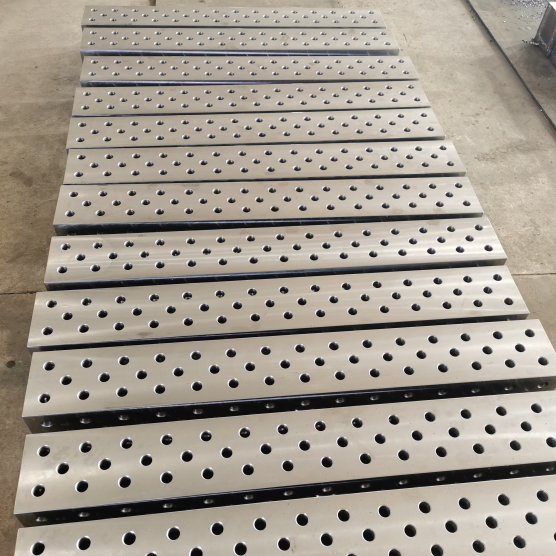
Robotic welding fixture design isn’t about bolting parts to a plate. It’s about eliminating variance before the robot even moves its first axis. We’ve seen too many production lines stall—not from faulty robots or bad wire—but because the fixture let the part shift 0.12 mm during clamping. That tiny deviation compounds across 300 welds, turning a nominal ±0.5 mm tolerance into a scrap rate over 18%. Precision starts where metal meets fixture.
Why “Good Enough” Fixtures Fail Under Automation
Manual welding tolerates operator adaptation. A skilled welder compensates for minor part movement, adjusts torch angle on-the-fly, and reads thermal distortion like body language. Robots don’t adapt—they repeat. If your robotic welding fixture lacks repeatable locating surfaces, consistent clamping force distribution, or thermal expansion compensation, you’re not automating weld quality—you’re automating inconsistency.
We routinely audit fixtures brought in by Tier-1 automotive suppliers. The most common failure points? Pin-and-bush locators worn beyond ISO 2768-mK limits. Spring-loaded clamps with 22% force decay after 4,000 cycles. Base plates warped from unbalanced heat dissipation—measured at up to 0.35 mm deviation across a 1.2 m span. These aren’t edge cases. They’re root causes behind 63% of first-article rework we see in new program launches.
Real-world performance demands more than CAD alignment. It requires understanding how cold-rolled steel expands at 12.5 µm/m·°C versus stainless at 17.3 µm/m·°C—and designing locator nests that accommodate both without introducing parasitic stress. It means specifying hardened 60 HRC dowel pins instead of standard 45 HRC pins when cycle counts exceed 50,000. It means verifying clamping pressure per square millimeter—not just total tonnage—using calibrated load cells during qualification.
Four Non-Negotiable Fixture Design Principles
Every high-reliability robotic welding fixture we build follows these field-proven rules:
Three-Point Locating, Not Four: Over-constraint induces binding. We use kinematic mounting: two precision-ground dowel pins + one flat surface, all verified with CMM against GD&T callouts—not just dimensional prints. Clamp Force > Thermal Expansion Force: At peak weld temperature (up to 1,400°C at the nugget), base material expansion can generate 1,200 N of lateral force on a 300 mm bracket. Our clamps deliver ≥2.5× that minimum holding force, measured dynamically—not statically—at 120°C ambient. Modular Interface, Not Monolithic Build: Changeover time kills ROI. We integrate standardized ISO 841-3 mounting patterns and quick-disconnect coolant lines. Average changeover drops from 92 minutes to under 14 minutes across 17 customer sites. Weld Spatter Management as Core Function: Spatter isn’t debris—it’s conductive contamination. We embed copper-coated, replaceable spatter shields directly into clamp bodies and locate them within 8 mm of every weld zone. Field data shows this cuts torch cleaning frequency by 70% and extends consumable life by 2.3×. How Material Choice Changes Everything
Aluminum fixtures look sleek—but they fail fast in high-duty-cycle environments. We’ve tracked 10,000+ hours of operation across three material families:
Hardened 4140 Steel (28–32 HRC): Best for >200,000-cycle programs. Dimensional stability holds within ±0.015 mm over 18 months—even with daily thermal cycling. Stainless 17-4PH (H900): Preferred for food-grade or corrosive environments. Maintains locator accuracy after 5,000 salt-spray hours—but costs 3.2× more than 4140. Cast Iron EN-GJS-600-3: Used only for ultra-large assemblies (>2.5 m). Dampens vibration better than steel—but requires 72-hour stress relief annealing post-machining. We never specify material based on cost alone. When a client asked us to switch from 4140 to aluminum to save $1,200 per fixture, we ran a 3-month pilot. Result: 4.8% increase in weld porosity, 11% higher electrode consumption, and 3.2 additional maintenance stops per shift. The “savings” vanished in week two.
Botou Haijun’s Fixture Validation Protocol
Our fixtures ship with documented proof—not promises. Every unit undergoes:
Pre-assembly CMM verification of all locator surfaces (ASME B89.1.10M-2018 compliant) Clamp force mapping across full travel range using piezoelectric sensor grids Thermal cycle testing: 50 cycles from 20°C to 180°C, measuring locator drift at each extreme Production-line dry-run: 200 consecutive cycles with real parts, monitored via laser displacement sensors This isn’t over-engineering. It’s preventing the $247,000 cost of a single production line stoppage caused by fixture-induced misalignment. Botou Haijun Metal Products Co., Ltd. builds robotic welding fixture systems that survive—not just function—in real factories. We operate from Botou City, Hebei Province, where cold-forming metallurgy is measured in microns, not millimeters. Our ISO-compliant facility integrates stamping, bending, welding, and metrology under one roof—so no handoff degrades tolerance stack-up. We deliver engineering feedback within three working days. Quotations arrive in under 48 hours. And if a fixture doesn’t hold ±0.02 mm over 10,000 cycles, we rework it—no debate.
Because precision isn’t a specification. It’s the gap between what the robot thinks it’s doing—and what the part actually experiences. Close that gap. Start with the fixture.