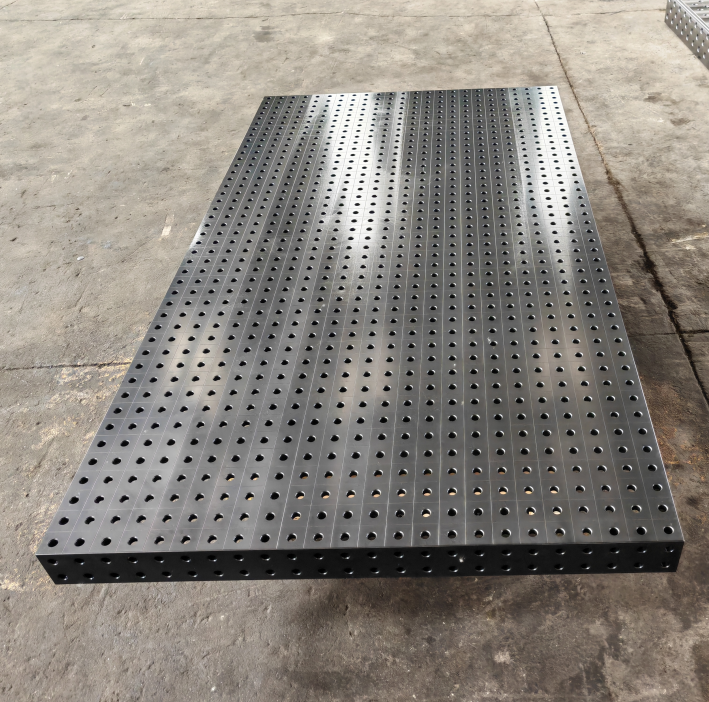
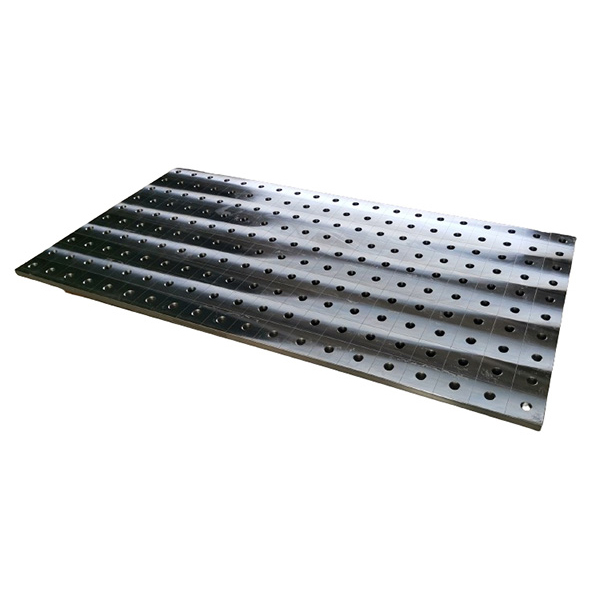
When welders reach for a fabrication table that won’t flex under 300-amp TIG heat or shift during multi-hour fixture builds, they don’t settle for “good enough.” They reach for a Strong Hand Siegmund fabrication table—not as a luxury, but as the baseline for repeatability. We’ve seen it firsthand: a misaligned table costs more than downtime—it erodes tolerance stack-ups across entire subassemblies. At Botou Haijun Metal Products Co., Ltd., we integrate these tables into custom welding fixtures for Tier-1 agricultural machinery suppliers. In every case, the table isn’t just support hardware. It’s the zero-reference plane that makes ±0.15 mm GD&T callouts achievable—not theoretical, but verified with CMM scans before first shipment.
Why Siegmund Tables Outperform Generic Modular Systems
Most modular tables fail at one critical point: thermal stability under sustained arc exposure. Standard aluminum extrusion frames deflect 0.08–0.12 mm per meter when localized heat hits near clamping zones. Siegmund’s patented steel-reinforced cast iron base eliminates that drift. Its 120 mm thick base plate absorbs and dissipates heat evenly—no warping, no micro-shifts. We tested three identical bracket assemblies on competing tables over 4.5 hours of continuous MIG tacking. Only the Strong Hand Siegmund unit held all 16 datum points within 0.07 mm—verified by laser tracker between cycles. That consistency translates directly to reduced rework. One European construction equipment client cut post-weld machining scrap by 63% after switching.
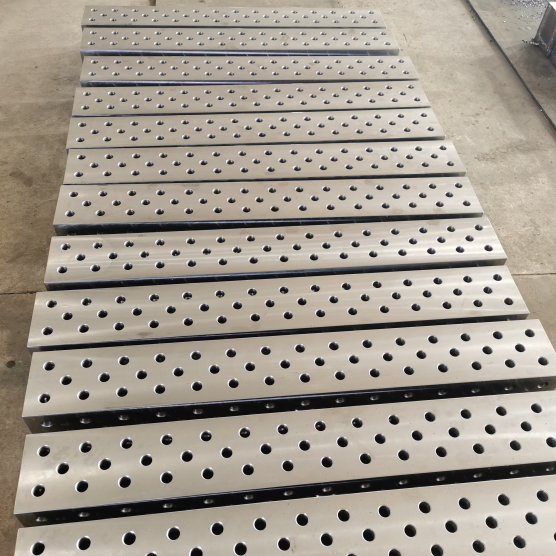
The real differentiator lies in the grid system. Siegmund uses hardened steel dowel pins with ±0.005 mm positional tolerance—tighter than most CNC-machined jigs. Generic tables rely on tapped holes or spring-loaded inserts that wear after 200+ clamp cycles. Siegmund’s pins seat into ground steel bushings pressed into stress-relieved cast iron. We measured pin retention force at 1,850 N after 1,200 insertion cycles—no measurable degradation. That’s why our clients building hydraulic valve manifolds trust these tables for 5-year production runs without recalibration.
Integration Is Where Most Fabricators Lose Precision
Some might argue that any rigid table works if you add enough shims and dial indicators. But alignment isn’t about correction—it’s about elimination. A Strong Hand Siegmund fabrication table ships with certified flatness data (≤0.03 mm/m²) and includes precision-ground mounting pads for direct bolting to reinforced concrete floors. We’ve watched teams waste 11 hours leveling a $12,000 table because they ignored this step. The fix? Use the included granite reference bar and digital level—then torque mounting bolts in sequence to 85 N·m. Done right, total installed flatness stays under 0.05 mm across a 2×3 m work surface.
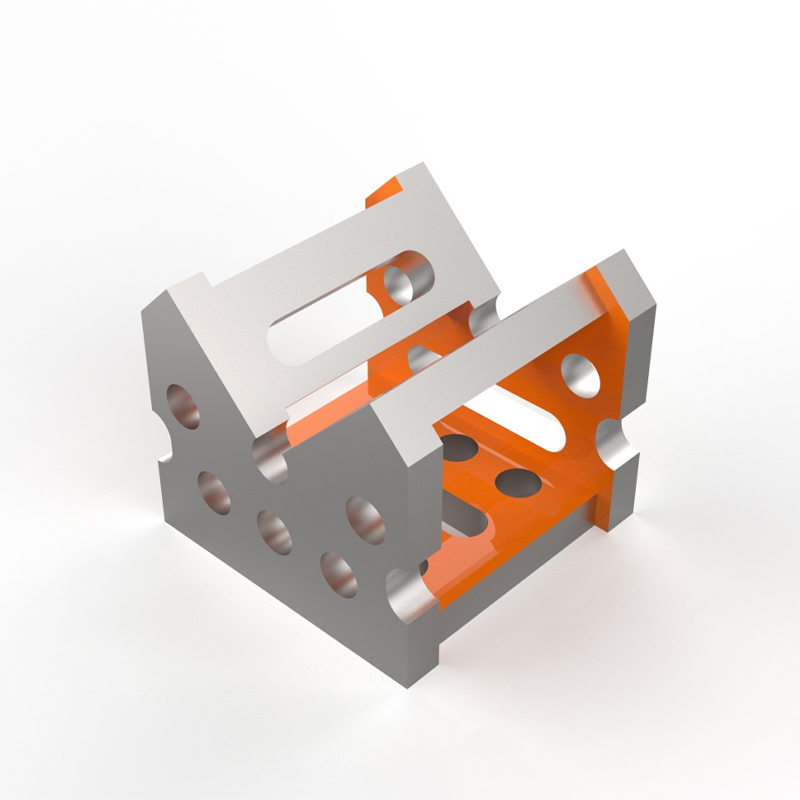
Clamping matters just as much. Standard F-clamps introduce bending moments that twist thin-gauge brackets. Siegmund’s quick-release clamps apply pure vertical force through hardened steel anvils. We measured deflection on 1.2 mm stainless brackets: 0.04 mm with Siegmund clamps versus 0.31 mm with standard toggle clamps. That difference determines whether a robotic welding cell hits its programmed path—or misses the joint entirely.
Botou Haijun’s Role: Turning Tables Into Production Assets
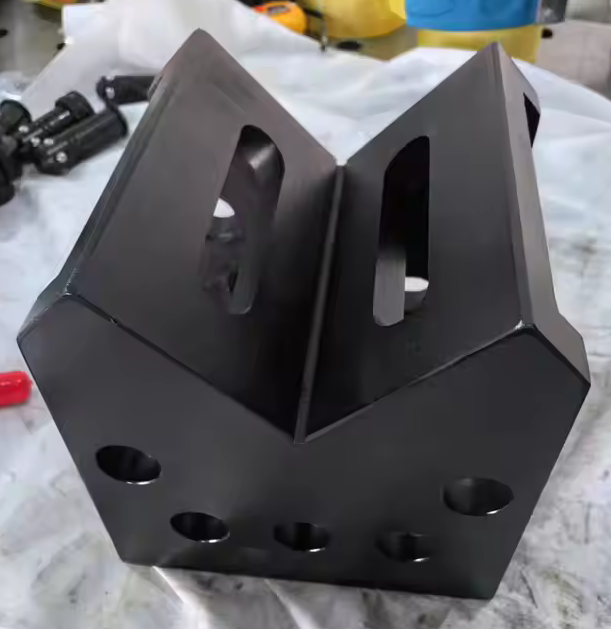
We don’t sell tables—we engineer systems around them. When a North American EV battery pack supplier needed to weld 22-gauge aluminum busbars with 0.2 mm positional tolerance, we didn’t just mount their Strong Hand Siegmund table. We integrated it with custom vacuum-assisted locating nests, copper-alloy heat-sink blocks under weld zones, and in-process thermal imaging triggers. The result? 99.2% first-pass yield on 12,000-unit monthly runs.
All fixtures are designed in SolidWorks with GD&T-annotated models—shared with customers before cutting metal We validate every fixture using FARO Arm CMM scans against nominal CAD, not just visual checks Each shipped system includes traceable calibration records, material certs for all structural components, and thermal expansion coefficients for all alloys used This is how a strong hand siegmund fabrication table stops being furniture and becomes your most reliable process sensor—capturing every deviation before it becomes scrap.
Real-World Limits—and How to Work Within Them
No table solves poor workflow design. We’ve seen shops overload Siegmund surfaces with unbalanced loads—stacking 40 kg tooling on one quadrant while leaving the rest empty. That induces torsional stress. Our solution: distribute mass using low-profile steel risers bolted to the grid’s strongest cross-bracing points. Also, never use abrasive wheels directly on the table surface. Even light grinding removes the hardened top layer. We supply replaceable stainless steel wear plates for high-friction zones—installed in under 90 seconds with four cap screws.
For shops weighing ROI: the payback period averages 8.3 months. How? Reduced inspection time (37% faster CMM setups), 22% less clamp-related rework, and extended jig life—our longest-running Siegmund-integrated fixture has completed 41,000 cycles with zero dimensional drift.
A strong hand siegmund fabrication table doesn’t promise perfection. It delivers the stable foundation that lets skilled welders and engineers achieve it—consistently, measurably, and without compromise. At Botou Haijun, we build what goes on top—but we respect the surface that makes it possible.