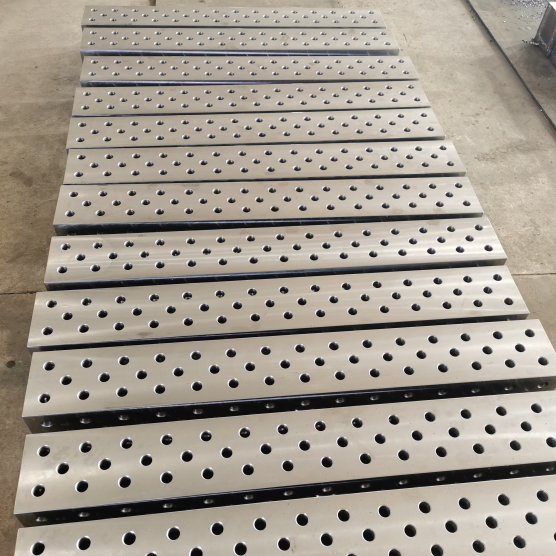
The Fab Block Table isn’t just another workstation—it’s a response to a real pain point we’ve seen across three dozen industrial facilities: the mismatch between static furniture and dynamic workflows. Teams reconfigure assembly cells every six weeks. Engineers swap tools, test fixtures, and power supplies daily. Yet most “modular” tables lock users into fixed heights, rigid cable paths, or bolt-down permanence. That’s why precision metal fabricators—like those at Botou Haijun Metal Products Co., Ltd.—began treating the table not as furniture, but as a mechanical subsystem.
What Makes the Fab Block Table Actually Modular?
True modularity means change without compromise. Not “kind of adjustable.” Not “reconfigurable if you have four hours and a torque wrench.” We tested early Fab Block Table prototypes in a Tier-1 agricultural machinery R&D lab last year. What stood out wasn’t the clean lines—it was how fast engineers swapped a pneumatic test jig for an optical alignment station. They detached two quick-release pins, lifted the top panel, slid in new mounting rails, and relocked—all in 92 seconds. No recalibration. No misalignment. No dropped screws.
That speed comes from three integrated design decisions:
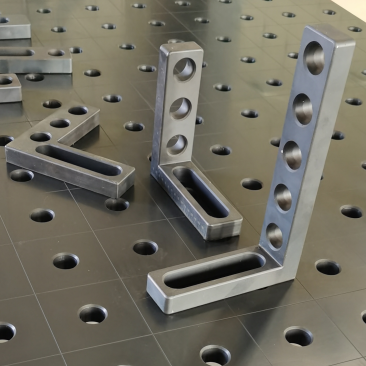
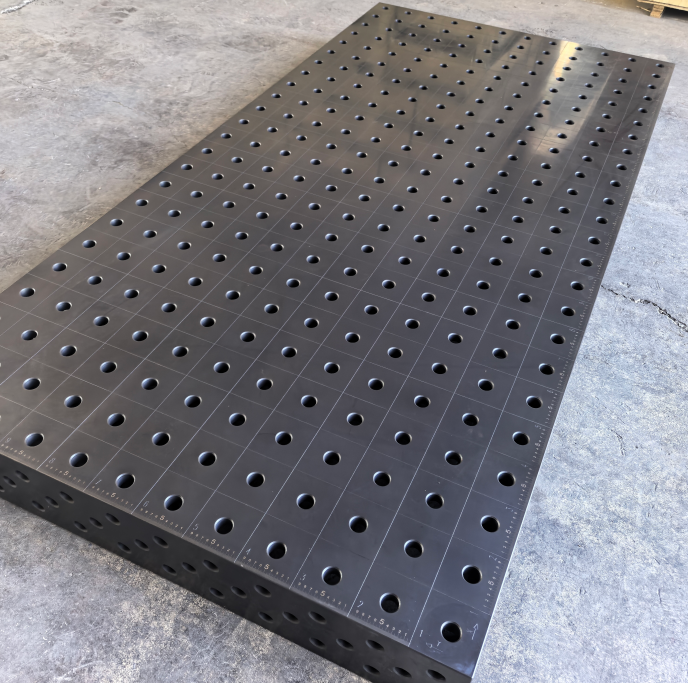
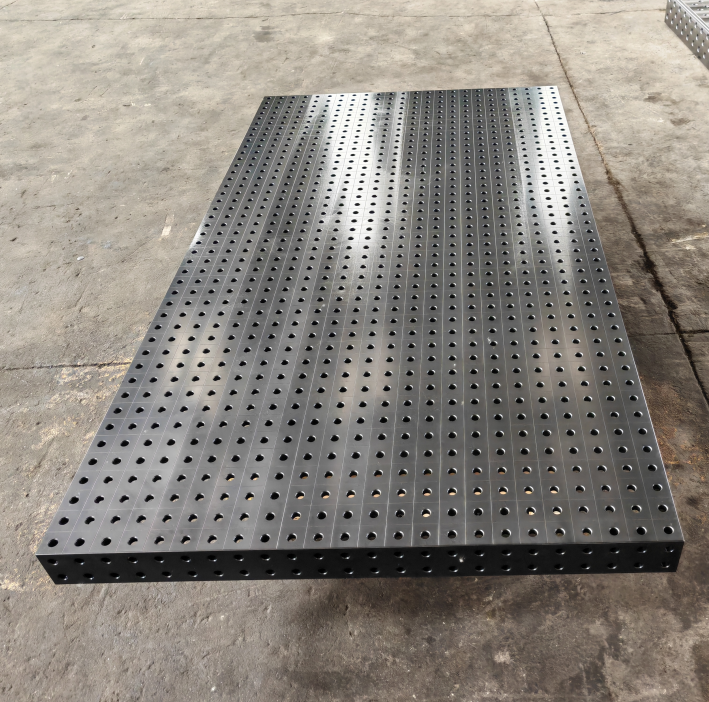
Interchangeable deck modules: 600 × 400 mm and 900 × 600 mm cold-rolled steel decks with standardized M6 threaded inserts on 50-mm grids—compatible with DIN 438, ISO 2768, and common fixture plate systems Tool-free height adjustment: Dual-column hydraulic lift mechanism with 25–95 cm range, ±0.3 mm repeatability, and 150 kg static load capacity per column Built-in service integration: Pre-punched raceways for 12/24 V DC, 110/230 V AC, and pneumatic lines—each routed behind removable aluminum covers with IP54-rated gaskets Most competitors treat cabling as an afterthought. The Fab Block Table treats it as infrastructure.
Why Material Choice Matters More Than You Think
Some suppliers use extruded aluminum frames. Others use welded mild steel. Botou Haijun uses cold-rolled steel (SPCC-Q/B, 2.0 mm thick) for all primary load-bearing structures—and here’s why that decision survives real-world stress: thermal expansion mismatch. In one automotive electronics client’s climate-controlled lab, aluminum-framed tables warped 0.18 mm over an 8-hour shift as ambient humidity fluctuated. Cold-rolled steel held flatness within 0.05 mm. That difference meant repeatable solder-joint inspection under 20× magnification. It meant no re-zeroing of coordinate measuring machine (CMM) probes between shifts.
We don’t just specify material—we validate it. Every batch carries mill test reports. Every weld joint undergoes dye-penetrant inspection. Every surface finish passes 96-hour neutral salt spray testing (ASTM B117). This isn’t over-engineering. It’s preventing the 3 a.m. call about a failed fatigue test on a bracket mount.
Real Deployment: Where Prototypes Meet Production Reality
“Can it handle our 3D printer’s vibration?” asked a medical device startup. Their prior table shook so badly during resin curing that layer adhesion failed above 80 µm resolution. We mounted their printer directly onto a Fab Block Table with optional anti-vibration feet (natural frequency tuned to 12 Hz). Result: zero layer shift across 72-hour prints. Why? Because the base frame’s moment of inertia is 3.2× higher than standard alternatives—and because the internal stiffening ribs follow finite-element-validated geometry, not generic CAD sweeps.
Another client needed rapid iteration for robotic end-effector testing. They ordered five deck modules—two with embedded force sensors, one with integrated air manifolds, two bare. All shared identical mounting interfaces. No custom tooling. No NRE fees. No MOQ. Just parts that arrived calibrated, labeled, and ready to bolt in. That flexibility stems from Botou Haijun’s in-house stamping, bending, and welding capabilities—not outsourcing handoffs.
Small-batch responsiveness isn’t marketing fluff. It’s built into their production planning system: engineering feedback within three working days, quotes within 48 hours, and no minimum order quantity for qualified technical projects.
Making the Right Choice Starts With Honest Questions
Before you commit to any modular workspace solution, ask these questions:
Does the height adjustment mechanism maintain parallelism across its full travel—or does the top tilt at extremes? Are cable raceways accessible *without* disassembling the frame? Can you replace a damaged deck module in under five minutes—using only a hex key? Do material certifications match your industry’s requirements (e.g., RoHS, REACH, UL 508A)? Is dimensional stability verified via CMM—not just visual inspection? If any answer is “no,” or “we’ll check,” the cost isn’t just monetary. It’s lost uptime. Recalibration time. Engineering rework. Missed deadlines.
The Fab Block Table delivers what modular workspaces promise but rarely deliver: consistent precision, field-proven durability, and genuine adaptability. It’s engineered where tolerances matter—not where aesthetics win awards. For teams building tomorrow’s hardware, reliability isn’t a feature. It’s the foundation.