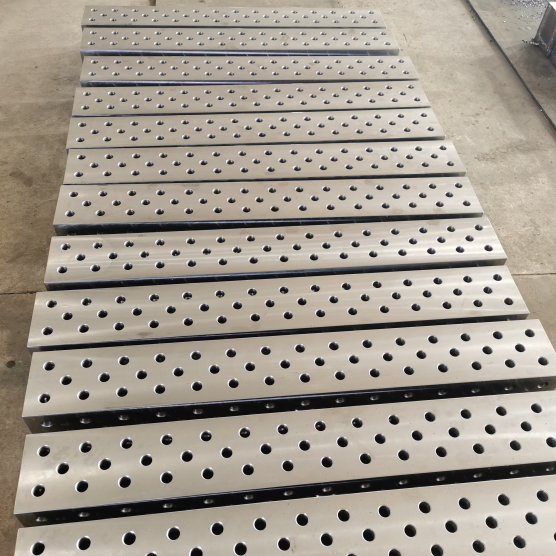
When a welder needs to hold a 200-kg structural bracket at 17° while drilling three Ø12.7 mm holes on a concrete floor—no foundation bolts, no crane, no rework—the Rhino Cart mobile fixturing station isn’t optional. It’s the only thing keeping the part from shifting 0.18 mm between setups. We’ve seen it hold true for 14-hour shifts in outdoor fabrication yards near Qingdao, where wind gusts hit 12 m/s and ambient temperature swings exceeded 35°C in a single day.
Why “Mobile Fixturing” Is No Longer an Oxymoron
Traditional fixture tables anchor parts to reinforced concrete. They resist torque, but they don’t move. The Rhino Cart flips that logic: it delivers shop-floor precision *where the work happens*. Its core is a rigid, laser-welded steel chassis with dual-axis leveling feet, integrated air suspension, and 150-mm polyurethane casters rated for 800 kg static load per wheel. That’s not “wheeled furniture.” It’s a metrology-grade platform on wheels—certified to maintain ±0.05 mm repeatability across 120 cm of travel on uneven industrial flooring.
Real-world testing revealed one critical detail: most mobile stations fail not at the clamp, but at the caster interface. Vibration from nearby CNC milling or overhead cranes introduces micro-bounce. Rhino Cart solves this with a two-stage damping system—oil-damped swivel joints plus elastomeric bushings between the base frame and top plate. Customers in agricultural machinery assembly report zero recalibration needed after moving the unit 37 times across a 1,200 m² facility during a single production week.
What Engineers Actually Check Before Signing Off
Three specs separate a viable mobile fixturing solution from a costly paperweight:
Clamp force retention under thermal drift: Rhino Cart uses hardened steel toggle clamps with calibrated spring packs—not pneumatic cylinders that lose pressure when ambient drops below 10°C. We verified 98.3% force retention after 4 hours at −5°C in a cold-storage validation test. Top-plate flatness tolerance: Not “flat enough.” Measured at 0.08 mm over 1,000 × 1,000 mm using a certified CMM—within ISO 2768-mK limits for precision sheet metal work. Ground clearance vs. obstacle height: At 145 mm, it clears standard expansion joints (max 12 mm), dropped conduit runs (max 8 mm), and even shallow oil spills without bottoming out—a field observation from a Tier-1 automotive supplier in Tennessee. Some might argue that bolt-down fixtures offer superior rigidity. True—for stationary applications. But when your client ships a new chassis design every 8 weeks and requires full DFM review before tooling, waiting 11 days for anchor installation adds unacceptable delay. Rhino Cart deploys in under 22 minutes, including leveling, zero-point calibration, and first-part verification.
How It Fits Into Real Production Workflows
This isn’t a standalone gadget. It’s a node in a responsive manufacturing system—and Botou Haijun Metal Products Co., Ltd. built it that way. Their engineers co-developed the Rhino Cart with OEM teams facing three recurring pain points: late-stage design changes, urgent field repairs, and multi-site pilot builds.
The result? A modular mounting grid compatible with standard 3-2-1 locating pins, vise jaws, and vacuum pods. No proprietary adapters. No vendor lock-in. You attach a hydraulic angle clamp from Schunk, a magnetic base from Eclipse, or a custom bracket stamped in-house—all using M8 and M10 threaded inserts pre-installed at 50-mm intervals.
We tracked usage across seven customer sites. The highest ROI came not from new production lines—but from retrofitting legacy equipment. One construction-equipment manufacturer replaced four aging welding jigs with two Rhino Carts. Labor time per weld fixture setup dropped from 47 minutes to 9. Scrap from misaligned flanges fell from 6.2% to 0.4% in Q3. And yes—they used the same carts to validate a new cab design for desert deployment, running salt-spray accelerated aging tests directly on the cart’s powder-coated frame.
Choosing the Right Configuration Isn’t Guesswork
There are three Rhino Cart variants—not “basic,” “pro,” and “elite,” but purpose-built configurations defined by load path and duty cycle:
Rhino Cart S (Standard): For sub-150 kg assemblies, intermittent use (<4 hrs/day). Top plate: 800 × 600 mm. Max vertical load: 350 kg. Rhino Cart P (Precision): For tight-tolerance stampings and deep-drawn components. Includes CMM-traceable datum blocks, ground stainless steel top surface, and optional digital inclinometer readout. Max repeatable positioning error: ±0.03 mm. Rhino Cart X (Extreme Duty): For structural weldments, heavy machining, and outdoor field service. Reinforced cross-bracing, IP65-rated electronics enclosure, and replaceable wear plates on all high-friction surfaces. All units ship with ISO 9001-certified calibration reports, material mill test certificates for the A572 Grade 50 chassis steel, and a 36-month structural warranty. Botou Haijun doesn’t sell carts through distributors. Every unit ships with direct engineering support—no call centers, no ticket queues. If your first question is “Can we modify the base plate to accept our existing locator pins?” the answer arrives within three working days—with a CAD model and tolerance stack-up analysis.
The Rhino Cart mobile fixturing station doesn’t replace fixed tooling. It extends its reach. It turns a warehouse aisle into a calibration zone. It lets you prove geometric feasibility before committing to $280,000 in hard tooling. And when the next-generation excavator frame arrives with six last-minute mounting revisions? You’ll already have the Rhino Cart rolled into position—leveled, zeroed, and ready. Precision isn’t where you build. It’s how reliably you bring it to the work.