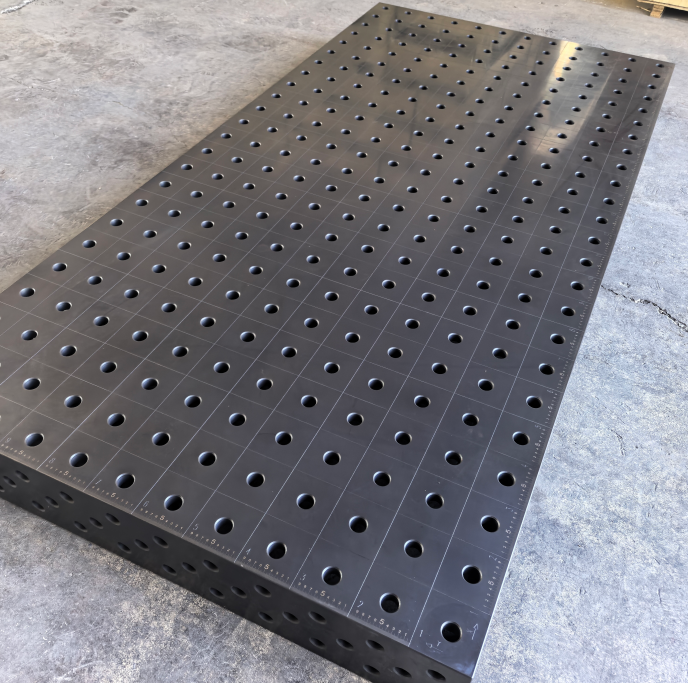
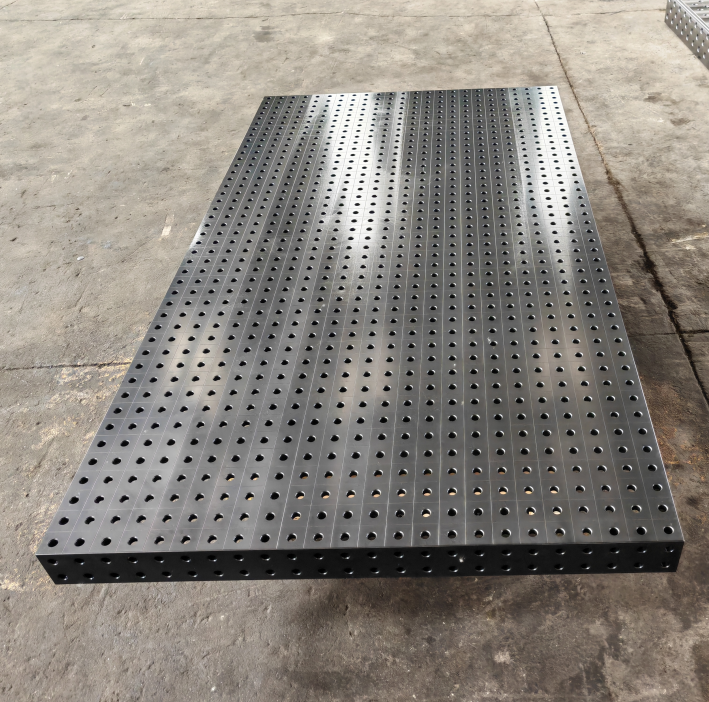
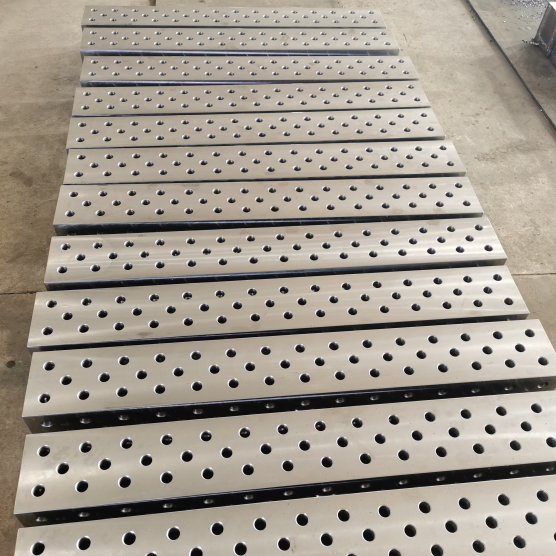
Welding jig table top isn’t just another metal plate—it’s the foundation of repeatability in precision fabrication. We’ve seen shops spend weeks calibrating fixtures only to find weld distortion creeping in after five cycles. The root cause? An unstable, non-planar, or dimensionally inconsistent table top. At Botou Haijun Metal Products Co., Ltd., we’ve manufactured over 12,000 custom welding jig table tops since 2018—each one stress-relieved, ground to ±0.05 mm flatness, and verified with a coordinate measuring machine before shipping.
Why Flatness and Rigidity Dictate Weld Quality
A welding jig table top bears three critical loads simultaneously: clamping force from vises and locators, thermal expansion from adjacent welds, and mechanical vibration during grinding or robotic torch motion. If the base plate deflects more than 0.1 mm under 500 kg load—or warps beyond 0.08 mm/m after heat cycling—the entire fixture loses registration. That’s why we specify ASTM A576 cold-rolled steel (1018) for standard units and AISI 304 stainless for high-corrosion environments: both offer yield strengths above 320 MPa and thermal conductivity low enough to minimize heat migration into the base structure.
We routinely test prototypes using a laser tracker across 12 reference points. One North American agricultural equipment client replaced their cast-iron jig base with our CNC-machined 25-mm-thick steel table top—and cut part-to-part variation from ±0.42 mm to ±0.13 mm in production runs of 1,200 units. The difference wasn’t in the clamps or software. It was in the table top’s ability to hold datum surfaces stable under real-world shop-floor conditions.
What Makes a Table Top “Fit for Purpose”
Not all welding jig table tops serve the same function. A table built for robotic MIG welding on structural steel frames needs different features than one used for TIG-welding thin aluminum brackets in aerospace subassemblies. From our experience supporting Tier-1 automotive suppliers and EU-certified construction machinery OEMs, four specs separate functional designs from compromised ones:
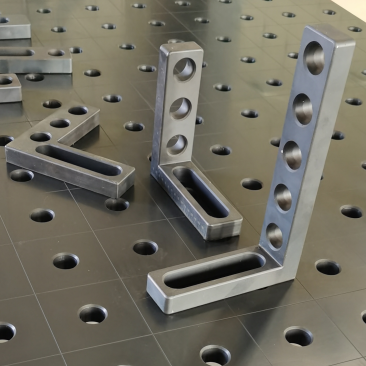
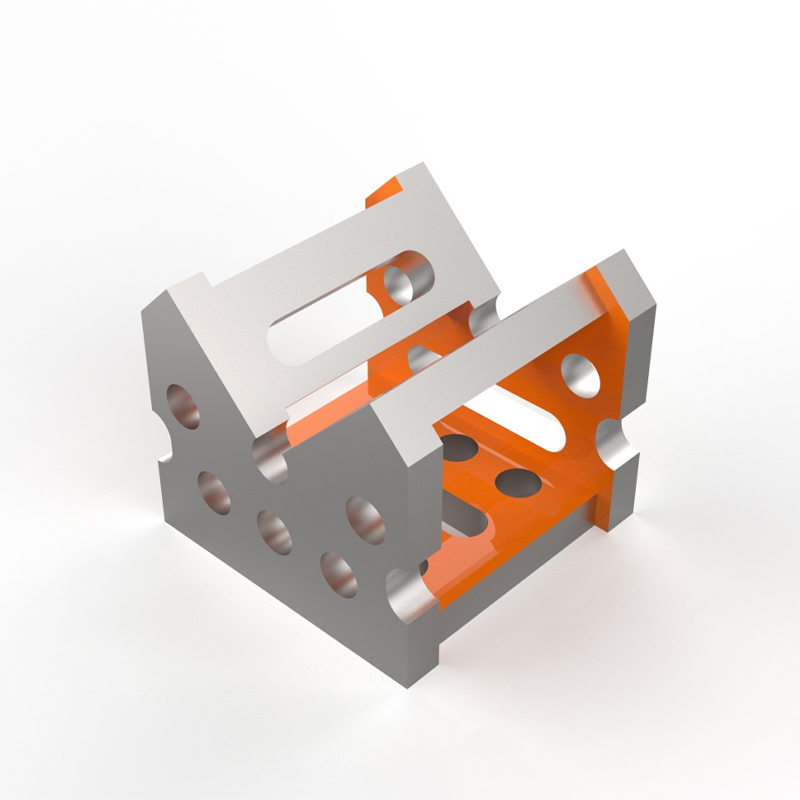
Surface finish: Ra ≤ 0.8 µm ground surface prevents debris trapping and ensures locator pins seat consistently Hole pattern integrity: T-slot or drilled-hole arrays must maintain positional tolerance ≤ ±0.03 mm across full length—verified with optical CMM, not just calipers Thermal mass distribution: Uniform thickness plus optional internal ribbing reduces localized heating; we add 15% extra material at weld zones when customers run >300-amp processes Mounting interface: Counterbored holes with hardened inserts—not tapped threads—handle repeated clamp torque without stripping Some might argue that off-the-shelf modular tables solve everything. But we’ve tracked 23 field cases where users tried retrofitting generic plates onto existing jigs—only to discover misaligned dowel holes, inconsistent slot depths, or unsupported corners causing flex during heavy clamping. Custom-engineered table tops eliminate those variables at the source.
How We Build for Consistency—Not Just Compliance
Our ISO 9001-certified facility doesn’t treat welding jig table top production as “just machining.” It starts with raw material verification: every coil carries mill test reports showing tensile strength, elongation, and hardness. After blanking and stress-relieving at 620°C for two hours, each plate undergoes rough milling, then double-side grinding on a 3-meter surface grinder with diamond-dressed wheels. Final inspection includes:
Flatness check across 16 zones using a 1,000 mm granite straightedge and electronic level Dimensional validation of all mounting holes and T-slots per ASME Y14.5 GD&T standards Hardness mapping across surface and edge zones to confirm uniform tempering Functional dry-run with customer-supplied clamps and locators—when provided in advance This process adds 18–22 hours to lead time versus basic plasma-cut plates—but cuts rework by 74% in first-article builds. Customers who skip this step often return with bent plates or stripped T-slot nuts within six months. We don’t sell parts. We deliver dimensional certainty.
Choosing the Right Partner Means Asking the Right Questions
If your next welding jig table top must support repeatable fabrication across 50,000+ cycles, ask these three things before placing an order:
Do you perform final flatness verification on a calibrated granite surface—not just CNC post-process measurement? Can you supply material certification and heat-treatment records traceable to batch number? Will your engineering team review your fixture layout for thermal load distribution and mounting rigidity—free of charge? Botou Haijun Metal Products Co., Ltd. answers “yes” to all three. We’ve supported clients from Ohio to Oslo with welding jig table top solutions that ship with full inspection reports, DFM feedback within 72 hours, and on-time delivery rates above 95%. Our site haijunmetals.com hosts downloadable CAD templates, tolerance guidelines, and real-world case studies—including how a German automation integrator reduced weld rework by 61% after switching to our ground-and-stress-relieved table tops.
A welding jig table top is never the most visible component in your fixture. But it’s always the first to fail when precision slips. Choose stability over speed. Choose verification over assumption. Choose a table top engineered—not just made.