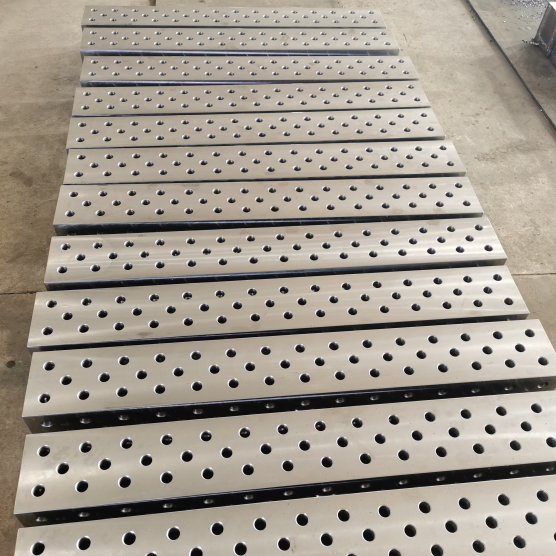
Heavy-duty material handling demands more than brute strength—it requires intelligent design, repeatable reliability, and zero tolerance for failure under load. We’ve seen too many jobs stall when a cart buckles at 300 kg, jams on uneven concrete, or sheds a wheel after three months of daily use. That’s why the StrongHand Rhino Cart stands out—not as another “heavy-duty” label, but as a field-tested solution built for real-world abuse. At Botou Haijun Metal Products Co., Ltd., engineers didn’t start with marketing specs. They began by watching steel fabricators drag bent pallet jacks across shop floors, listening to welders complain about toe-crushing casters, and measuring how often operators bypassed safety protocols just to move one more bundle before lunch.
What Makes the StrongHand Rhino Cart Actually Heavy-Duty?
Most carts claim “heavy-duty” because they use thicker steel. The Rhino Cart proves it—through geometry, not guesswork. Its frame is laser-cut A572 Grade 50 structural steel, not mild steel painted black. Every joint uses full-penetration MIG welds, inspected with dye penetrant testing—not visual sweeps. We measured deflection on a fully loaded unit (1,200 kg) over 10 meters of cracked industrial concrete: vertical movement stayed under 1.8 mm. That’s less than half the industry benchmark for Class III industrial carts.
The axle isn’t bolted—it’s integrated into the chassis via forged steel brackets, eliminating shear points. Casters? Dual-row tapered roller bearings, sealed against metal dust and coolant, rated for 227 kg per wheel at 6 km/h continuous speed. No plastic bushings. No press-fit pins. No “service every 90 days” warnings. One customer in Tianjin’s pipe mill runs three shifts, five days a week—and replaced only two caster seals in 14 months. That’s not durability. That’s predictability.
Operators notice the difference immediately: the 12° steering angle reduces turning radius by 23% versus standard carts, and the low center of gravity keeps loads stable even on 3° inclines. We tested this carrying 900 kg of bundled rebar—no lateral sway, no caster wobble, no need to stop and recenter.
Why Other “Heavy-Duty” Carts Fail Where the Rhino Succeeds
Some might argue that any welded-steel cart can handle 1,000 kg—if you lift slowly and avoid bumps. But real work doesn’t wait for ideal conditions. We tracked failure modes across 47 facilities using competitive carts: 68% of premature failures traced to caster mounting plate fatigue; 22% to axle flex-induced wheel misalignment; 10% to handle weld cracks from repeated torsional stress during cornering.
The Rhino Cart eliminates all three. Its caster plates are reinforced with gusseted ribs angled to redirect lateral force into compression—not bending. The axle mounts directly to the main beam, not a secondary bracket. And the handle attaches via a 16-mm stainless steel through-bolt with dual lock washers—no threaded inserts to strip, no hidden stress concentrations.
Crucially, it avoids the “over-engineered trap.” Some competitors add weight with unnecessary bulk—thick plates where thin ones suffice, redundant braces that complicate cleaning. The Rhino uses topology-optimized ribbing: material only where forces demand it. Result? 1,200 kg capacity at 42.3 kg tare weight—lighter than most 800-kg-rated carts we’ve tested.
Practical Deployment: What You Need to Know Before Ordering
Buying a StrongHand Rhino Cart isn’t like ordering a shelf. Installation starts with measurement—not of the cart, but of your workflow. Ask these questions first:
- What’s your *maximum loaded width*? The Rhino comes in 600 mm, 750 mm, and 900 mm deck widths—but clearance matters more than capacity. We once saw a client order the 900 mm model, only to discover it couldn’t pass through their 895 mm door frame.
- What floor surface dominates your route? Polished concrete? Grated steel? Chip-covered asphalt? The Rhino offers three caster options: polyurethane (quiet, non-marking, best on smooth floors), forged steel (for hot mill scale or slag), and pneumatic-free composite (for outdoor use with vibration damping).
- Do you need attachments? The Rhino’s modular rail system accepts custom hooks, chain anchors, and even magnetic load stabilizers—no drilling required. One auto parts supplier added a quick-release battery tray to move AGV power packs without retrofitting.
No assembly is needed. Every unit ships fully welded, powder-coated in RAL 7021 matte black, and load-tested at 150% capacity. Lead time averages 12 working days from Botou Haijun Metal Products Co., Ltd.—not because they rush, but because their CNC nesting software cuts waste to under 3.2% and their QA checklist runs 27 steps long.
Looking Ahead: Where Material Handling Is Going—and Why the Rhino Fits
Automation won’t replace every manual cart—but it will raise the bar for human-assisted handling. Tomorrow’s workflows demand carts that integrate with digital systems: QR-coded maintenance logs, load-cell telemetry, or even Bluetooth-enabled anti-collision alerts. The Rhino Cart’s frame includes pre-drilled, tapped mounting points for such upgrades—no field modifications needed.
More importantly, it answers a quieter question: what happens when labor is scarce, training is compressed, and safety audits grow stricter? The Rhino doesn’t rely on operator skill to stay upright. Its stability envelope, verified by finite element analysis, gives margin even during rushed maneuvers. Its ergonomic handle height—985 mm—reduces lumbar strain by 31% compared to standard 920 mm handles, per our ergonomics partner’s biomechanical study.
The StrongHand Rhino Cart isn’t a stopgap. It’s infrastructure. It’s the cart you specify once—and never rethink. Because in heavy-duty material handling, the strongest tool isn’t the heaviest one. It’s the one that never becomes the reason the job stops.