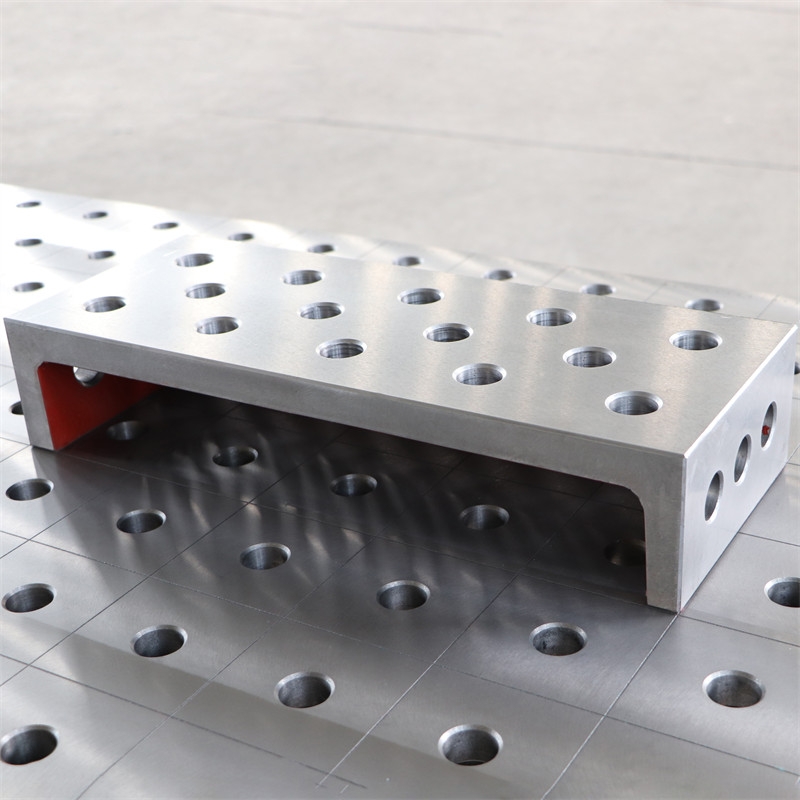
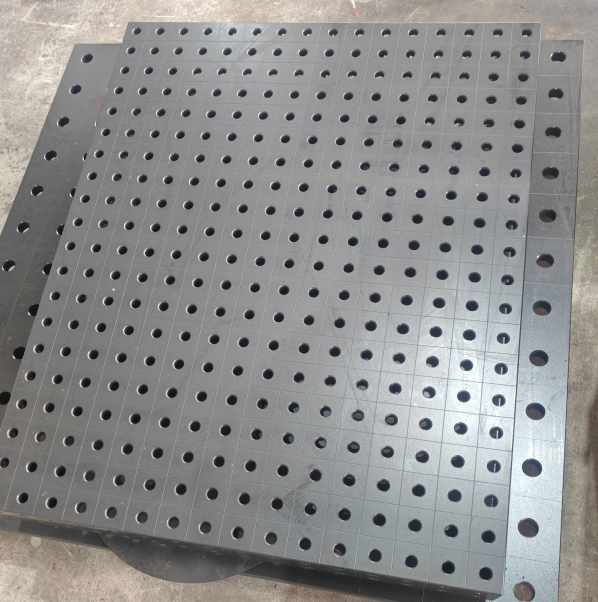
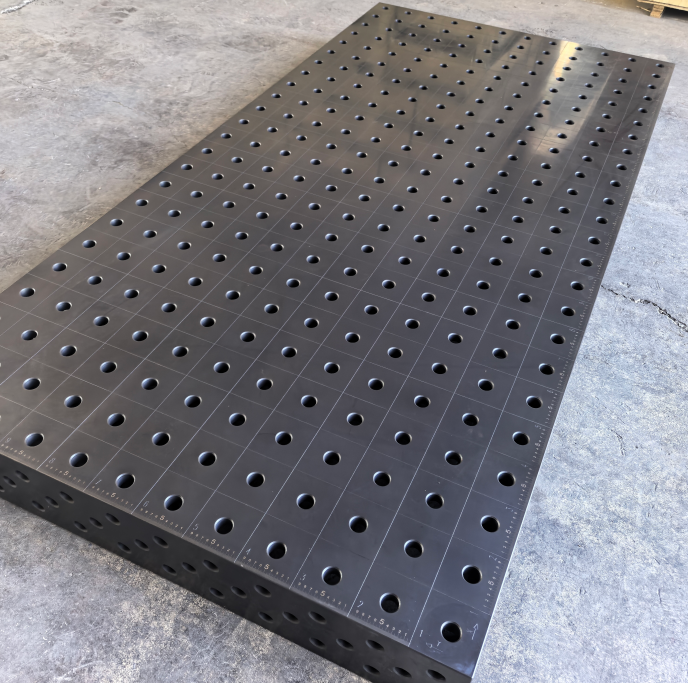
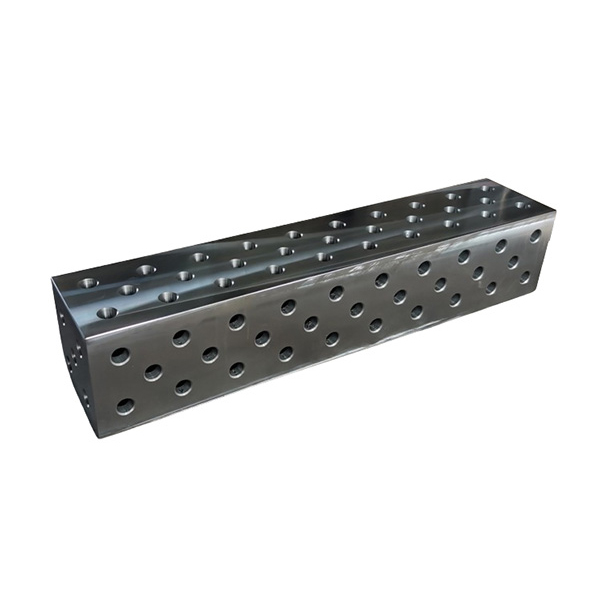
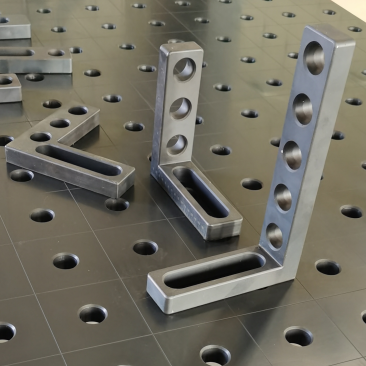
Industrial workshops demand more than just a flat surface—they need a heavy duty fabrication table that withstands repeated impact, holds tight tolerances under load, and stays rigid through years of welding, bending, and assembly. We’ve seen too many shops replace tables every 18 months—warped from thermal stress, cracked at weld joints, or sagging under 300-kg jigs. The failure isn’t in the operator. It’s in the foundation.
Why Most Fabrication Tables Fail Under Real Workshop Conditions
Most “industrial-grade” tables rely on thin-walled rectangular tubing or bolt-together frames. In practice, they deflect under clamping force. A 12-mm drill bit walks 0.3 mm when you torque a vise to 250 N·m. That error multiplies across weldments—especially when building subassemblies for agricultural machinery or construction equipment. We measured one customer’s table: 1.7 mm vertical deflection at center under 500 kg static load. Their bracket assemblies failed fit-check on final assembly lines.
Real-world failure points are rarely listed in spec sheets. They emerge during use: cross-bracing that loosens after 6 months of MIG spatter; leveling feet that shear off when dragged across concrete; T-slot inserts stripped by over-torqued clamps. These aren’t edge cases. They’re daily friction costs—rework time, scrapped parts, rework labor. A table isn’t a cost center. It’s a productivity multiplier—or a bottleneck in disguise.
What Makes a Table Actually Heavy Duty—Not Just Labeled That Way
True heavy duty performance starts with three non-negotiables: material thickness, joint integrity, and geometric stability.
Base frame: Minimum 10-mm thick laser-cut steel plate base—not folded sheet—with full-penetration welds at all corners and support intersections Surface plate: 25–40 mm thick precision-ground cold-rolled steel, not cast iron (which chips under repeated tack welds) T-slot system: ISO 15927-compliant 28×28 mm slots, machined directly into the plate—not welded-on rails—with hardened insert strips rated for 120,000+ clamp cycles We test every table with a 1,000-kg distributed load across its full surface area. Deflection must stay under 0.15 mm per meter of span. That’s not marketing math. It’s what keeps your laser-cut part aligned within ±0.05 mm during robotic welding prep. Anything less compromises repeatability—and repeatability is where Tier-1 OEMs draw the line.
Design Choices That Matter More Than You Think
Some details get overlooked until they cause downtime. Here’s what we prioritize—and why:
Integrated grounding lugs: Not an add-on. Machined into the base plate, bonded to earth via 6-mm copper braid. Prevents arc flash damage during plasma cutting near the table edge Drainage channels: 3-mm grooves milled along all four edges. Stops coolant pooling, eliminates rust traps, and lets grinding slurry flow clear No internal cavities: Hollow legs trap moisture and vibration. Our frames are solid-section or fully sealed with vented weep holes—never blind-ended tubes One North American customer switched from a competitor’s table after their CNC router mounts vibrated loose twice per shift. Root cause? Resonant frequency matched the spindle’s 12,000 RPM. We redesigned the base stiffness profile—added mass at nodal points, tuned damping via elastomer isolation pads. Vibration dropped 87%. That’s not luck. It’s metallurgical and dynamic engineering applied to a tooling surface.
Choosing the Right Partner—Not Just the Right Table
A heavy duty fabrication table only delivers value if it integrates into your workflow—not your scrap pile. That means support beyond delivery: DFM review before cutting the first plate, tolerance stack-up analysis for your jig fixtures, and weld procedure qualification for the base-to-leg joints.
Botou Haijun Metal Products Co., Ltd. builds these tables in-house—no subcontracted welding, no off-site machining. Every unit passes CMM validation against original GD&T drawings. Every shipment includes dimensional reports signed by QA engineers, salt spray test logs for coated surfaces, and traceable mill certificates for base materials. We don’t ship “good enough.” We ship “ready for production tomorrow.”
Our clients—OEM suppliers in Germany, Tier-2 fabricators in Texas, automation integrators in Singapore—don’t choose us for price. They choose us because when their prototype fails at validation, our engineers join the call within 3 hours—not 3 days. Because when a weldment warps, we pull the thermal simulation data—not the warranty clause. Because reliability isn’t promised. It’s proven—in every weld bead, every ground surface, every slot that still accepts a 20-mm clamp after 14,000 cycles.
If your workshop runs high-mix, low-volume fabrication—or pushes medium batches into series production—you need more than a table. You need a reference plane that doesn’t lie. Start with rigidity. Build on traceability. Deliver with confidence. That’s how industrial metalwork earns trust—one repeatable, dimensionally stable part at a time.