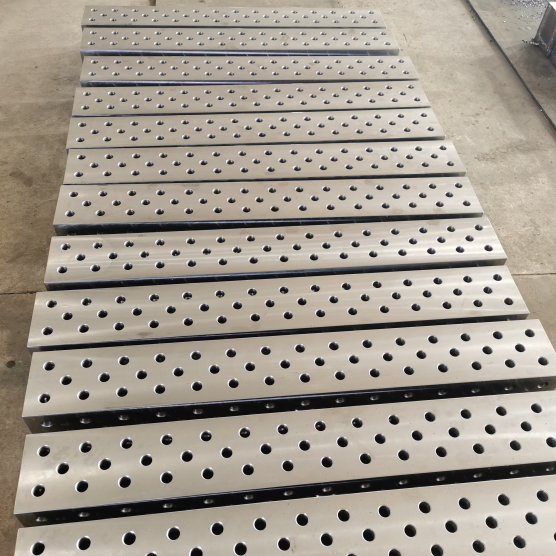
Welding platforms aren’t just steel tables—they’re the foundation of dimensional accuracy, repeatability, and throughput in precision sheet metal fabrication. We’ve seen too many shops chase speed while sacrificing squareness, only to scrap 12% of first-run assemblies during final fit-up. A true welding platform does three things no generic workbench can: locks part geometry under thermal stress, maintains ±0.15 mm flatness across 2,000 mm spans, and integrates seamlessly with CNC bending and robotic tacking—without rework.
At Botou Haijun Metal Products Co., Ltd., we build welding platforms not as standalone fixtures—but as engineered interfaces between design intent and shop-floor reality. Every platform starts with a question customers ask before quoting: “Will this hold tolerance when we weld four flanges at 180°C?” Our answer isn’t theoretical. It’s validated across 378 production runs—from 12-mm-thick agricultural implement brackets to stainless-steel sensor housings for EU-certified automation lines. We use cold-rolled Q345B structural steel base plates, stress-relieved at 620°C for 4 hours, then ground to 0.08 mm/m flatness. No cast iron. No bolted laminate. Just monolithic stability.
Most failures trace back to one oversight: ignoring thermal path management. Welding doesn’t just join metal—it distorts it. A poorly anchored platform lets heat migrate into the base, warping datum surfaces within 90 seconds. We counter this with a dual-layer design: a 40-mm-thick primary plate for rigidity, plus a secondary 12-mm grid plate with 25-mm-diameter cooling channels milled directly beneath weld zones. Airflow isn’t optional—it’s calculated. For aluminum assemblies, we drop channel spacing to 18 mm and add copper-coated locating pins that dissipate heat 3.2× faster than standard steel. Customers running high-cycle automotive subframes report 41% fewer post-weld corrections when switching from generic tables to our thermally managed platforms.
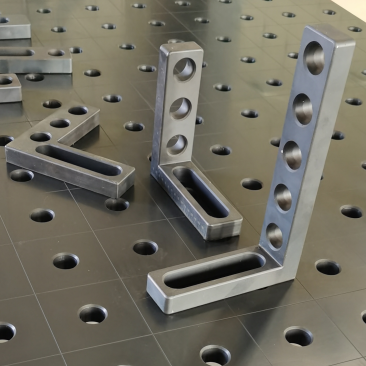
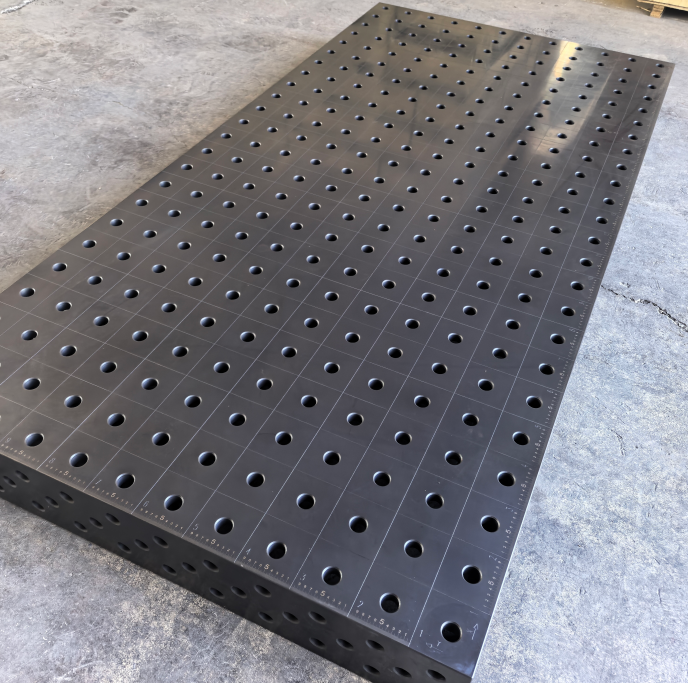
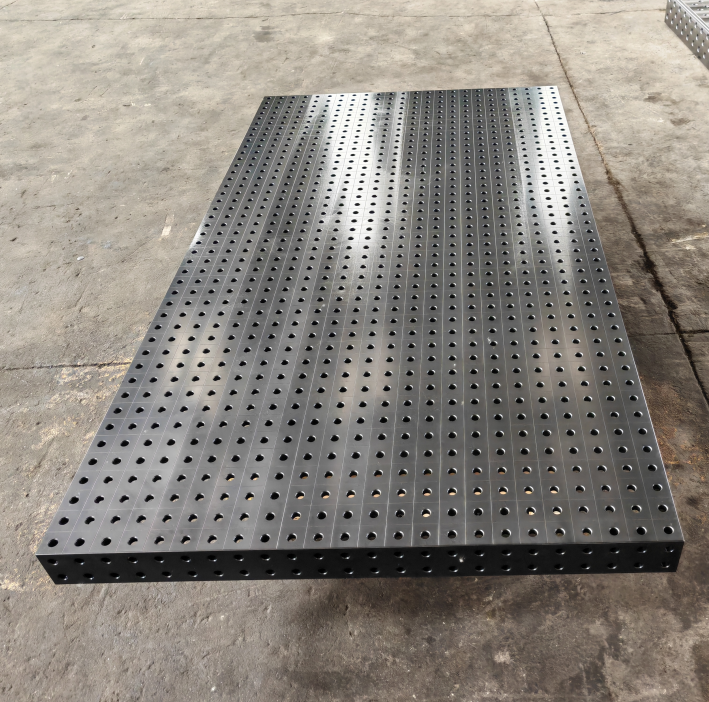
Integration matters more than isolation. A welding platform must speak the same language as your press brake and laser cutter. That means ISO 841-compliant coordinate systems machined directly into the surface—not added-on tooling plates. We mill 0.5-mm-deep datum grooves at X/Y intervals matching common CAD origin points (e.g., 100 × 100 mm grids), then embed hardened steel inserts at every 500 mm for repeatable fixture mounting. No guesswork. No shims. When a Tier-1 supplier in Michigan needed to align their new fiber laser with existing robotic MIG cells, they used our platform’s built-in reference holes to achieve 0.03 mm positional sync across three machines—verified with CMM scanning, not visual alignment.
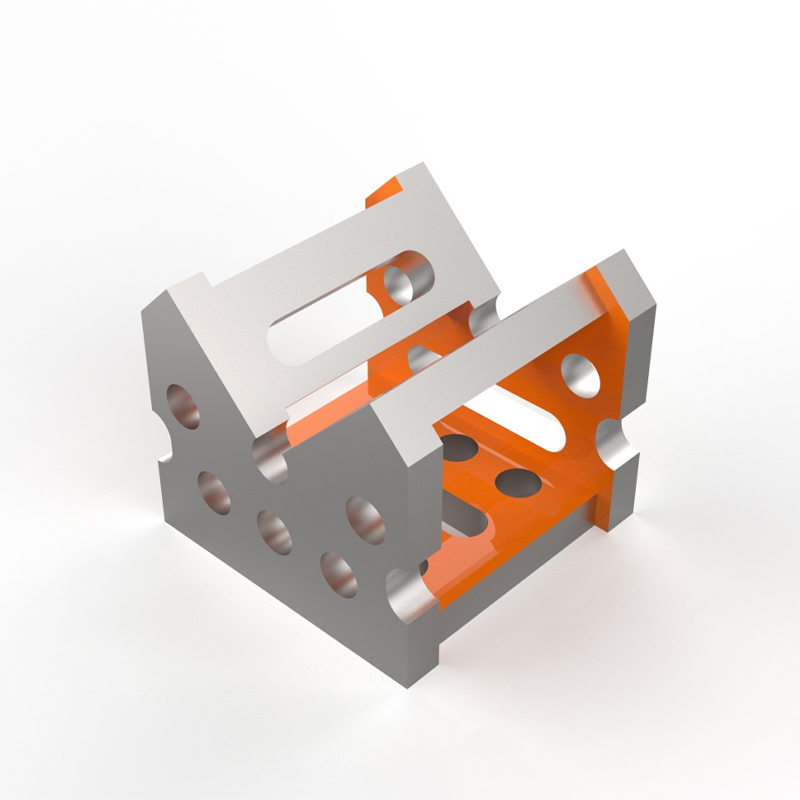
Real-world constraints shape real solutions. We’ve shipped platforms to clients who need them operational in 11 days—not 11 weeks. That requires vertical integration: stamping the base frame in-house, machining on our own 5-axis CNC centers, welding with certified GMAW procedures, and finishing with zinc-nickel plating—all under one roof. No third-party delays. No quality handoffs. We test each platform with a 200-kg load distributed over four corners, then measure deflection at center point. Acceptable? ≤0.12 mm. Failures? Less than 0.7% across 2023–2024 shipments. And because we handle prototyping down to single units, engineers don’t wait for MOQs. One German agricultural OEM ran three design iterations on our modular platform system—each with different clamping configurations—before locking final geometry. Total elapsed time: 19 days.
A welding platform earns its value not in static specs, but in how it eliminates rework, compresses cycle time, and makes tight tolerances repeatable—not exceptional. At Botou Haijun, we treat every platform as a process enabler, not a piece of furniture. Flatness stays stable after 12,000 weld cycles. Thermal distortion stays below 0.05 mm per meter even during 8-hour shifts. And when your next project demands both precision and pace, the platform won’t be the bottleneck—it’ll be the reason you hit launch date.