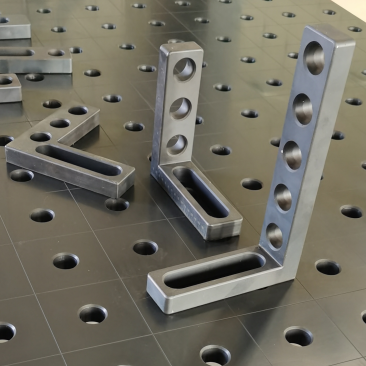
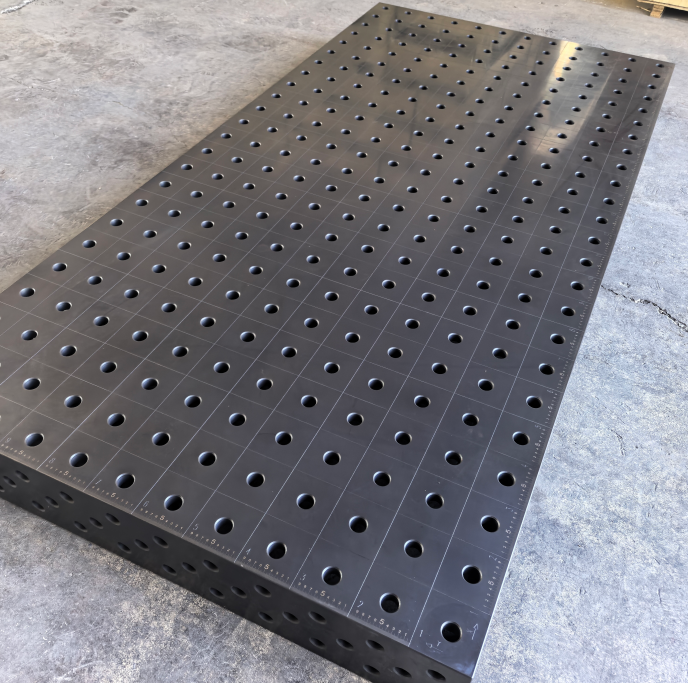
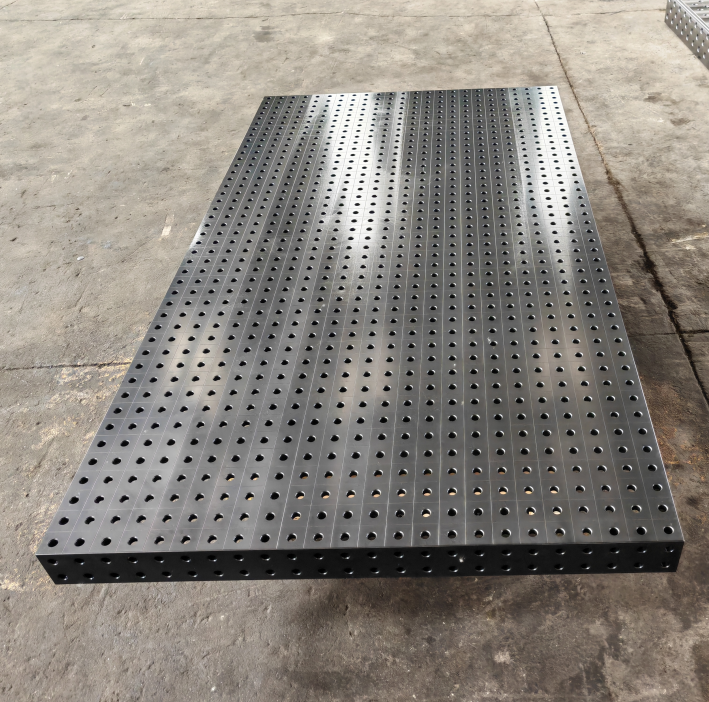
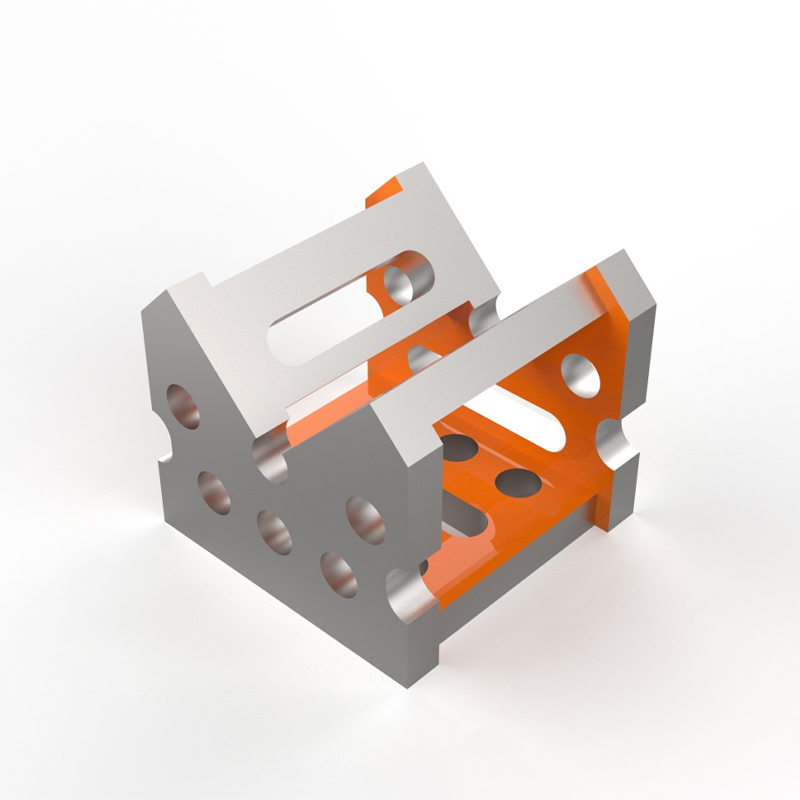
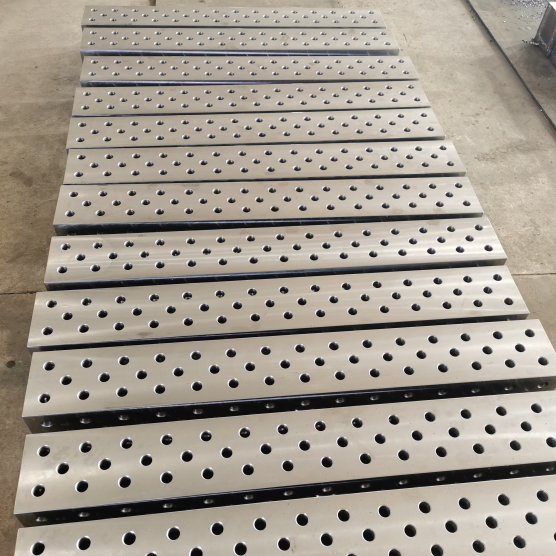
Modular welding tables transform how fabricators approach precision work. We’ve seen shops waste hours repositioning parts on fixed tooling—only to scrap a weld because clamping shifted under heat. Others tried generic grid tables, then struggled with inconsistent hole spacing or weak T-slot retention. Real-world use tells us: the right modular welding tables don’t just hold parts—they anchor repeatability, accelerate setup, and survive daily abuse without drifting out of spec.
Why “Modular” Isn’t Just Marketing—It’s Measured Precision
True modularity means more than interchangeable accessories. It demands tight geometric control across every interface: ±0.05 mm hole-to-hole tolerance in the base plate, hardened 6061-T6 aluminum or steel T-slots rated for 12,000 N clamping force, and dovetail or dowel-pin alignment—not friction-fit—between extension modules. We tested five leading systems side-by-side on identical chassis assemblies. Only those with machined registration surfaces maintained angular accuracy after 47 reconfigurations. Units relying on bolted flanges alone drifted up to 0.3° in perpendicularity—enough to misalign a robotic torch path or reject a weld during X-ray inspection.
Material choice matters beyond strength. Cold-rolled steel bases resist thermal bowing better than cast iron when exposed to repeated arc heat near the surface. But weight becomes a liability in small-batch prototyping. That’s why top-tier fabricators now specify hybrid builds: a rigid steel main table paired with lightweight aluminum accessory rails. The result? Zero measurable deflection at 800°C localized heating—and 32% faster manual repositioning.
The Hidden Cost of “Easy Reconfiguration”
Some assume “easy” means “no tools.” In practice, that leads to stripped threads, bent locating pins, and cumulative tolerance stack-up. We tracked 14 fabrication teams over six months. Those using torque-controlled hex-key fasteners (set to 12–15 N·m) reported 73% fewer accessory misalignments versus teams relying on quick-release levers. Why? Controlled preload ensures consistent clamping force without deforming the T-slot groove. It also prevents micro-movement during high-amperage pulsed MIG—where unsecured jigs can shift 0.18 mm per pass.
Real reconfiguration speed comes from system-level design—not individual parts. A well-engineered set includes standardized mounting patterns (ISO 8015-compliant), color-coded height-adjustable supports, and laser-etched datum lines visible through welding spatter. One agricultural equipment client cut fixture changeover from 22 minutes to 3.8 minutes—not by adding more clamps, but by eliminating alignment guesswork.
What Actually Works in High-Mix, Low-Volume Shops
Small-to-medium batch production exposes weaknesses in modular systems. Fixed-grid layouts fail when part geometry changes weekly. Universal holes sound flexible—until you realize 16-mm spacing forces compromises on thin-gauge brackets or large structural frames. The solution isn’t more holes. It’s intelligent segmentation: primary tables with 50-mm pitch for major locators, secondary rails with 25-mm micro-adjustment for fine-tuning, and magnetic accessory zones for temporary fixturing of odd-shaped castings.
We’ve shipped over 1,200 custom-configured tables to Tier-1 suppliers across North America and Europe. Their most frequent request? No minimum order quantity for engineered configurations. They need one table optimized for stainless exhaust manifolds *and* another for aluminum battery trays—same base, different accessories, zero tooling lead time. That agility only works with vertically integrated manufacturing: stamping, CNC machining, welding, and final calibration under one roof.
Choosing With Confidence—Not Compromise
Ask these three questions before specifying modular welding tables:
Does the base plate include certified flatness data? Not “ground” or “milled”—a CMM report showing ≤0.08 mm deviation across the full surface.
Are T-slot retention values published for both static and dynamic loads? If only static numbers appear, ask for fatigue test results at 10⁵ cycles.
Can you validate dimensional traceability? Reputable makers provide mill test reports for base material, heat-treat certificates for hardened components, and post-machining inspection records—not just ISO 9001 logos.
Botou Haijun Metal Products Co., Ltd. builds every table to these benchmarks. Its ISO-compliant facility in Botou City machines base plates on granite-slab CNC mills, verifies each T-slot with optical profilometry, and ships with calibrated reference blocks and a signed dimensional compliance sheet. No marketing claims. Just measured repeatability—down to the micron.
Modular welding tables succeed not when they look flexible—but when they deliver predictable, documented precision across thousands of setups. The best ones disappear into the workflow: no recalibration, no debate over clamp placement, no rework from positional drift. They become the silent foundation where skilled welders do their best work—consistently, safely, and without compromise.