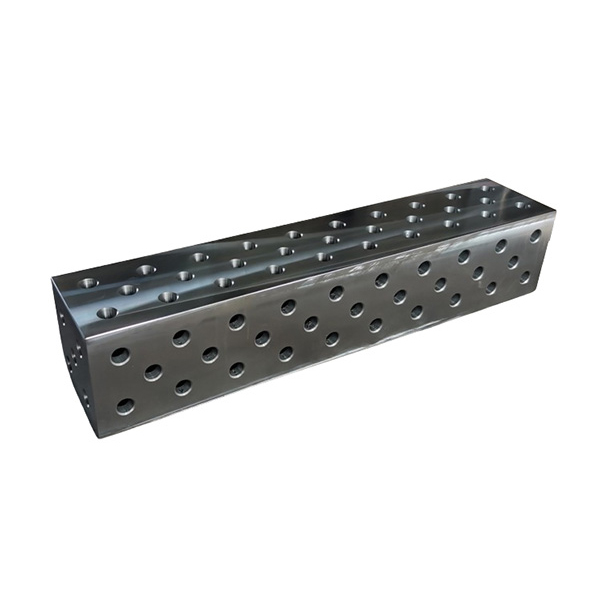
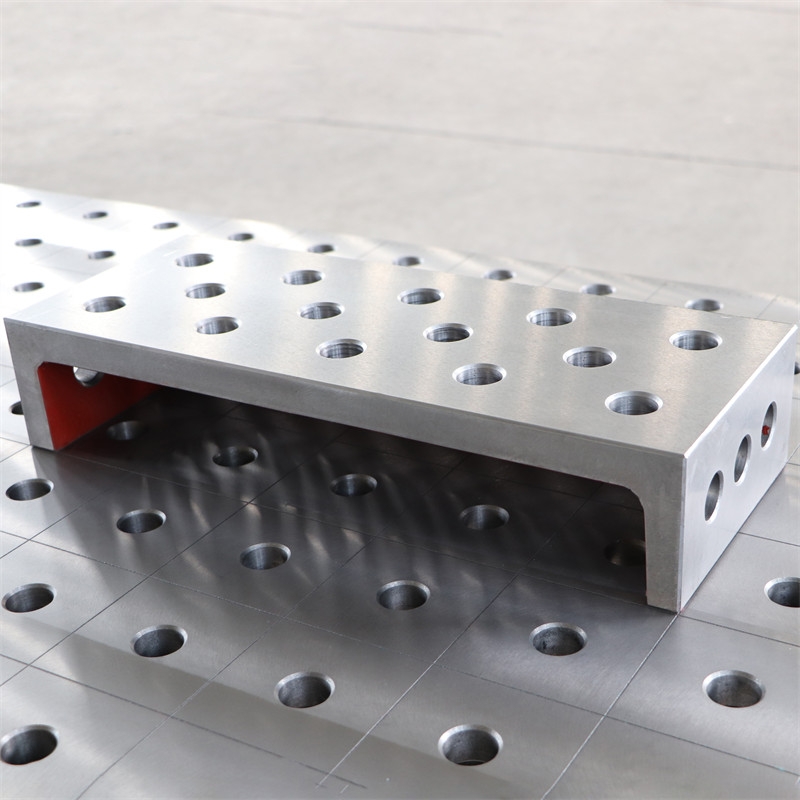
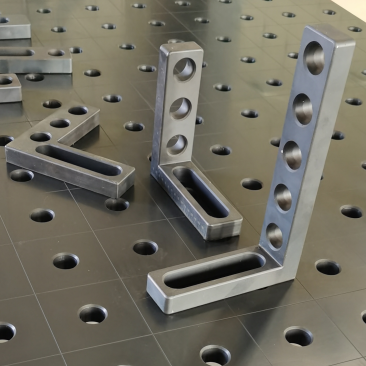
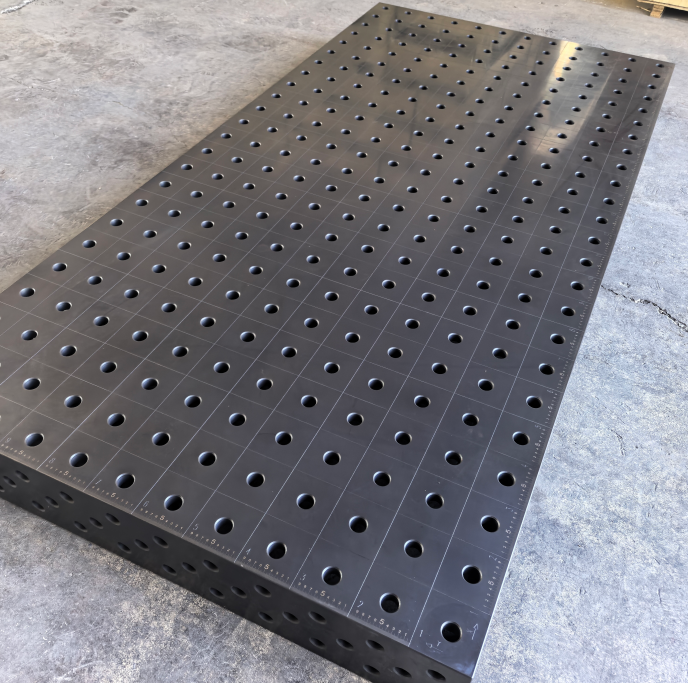
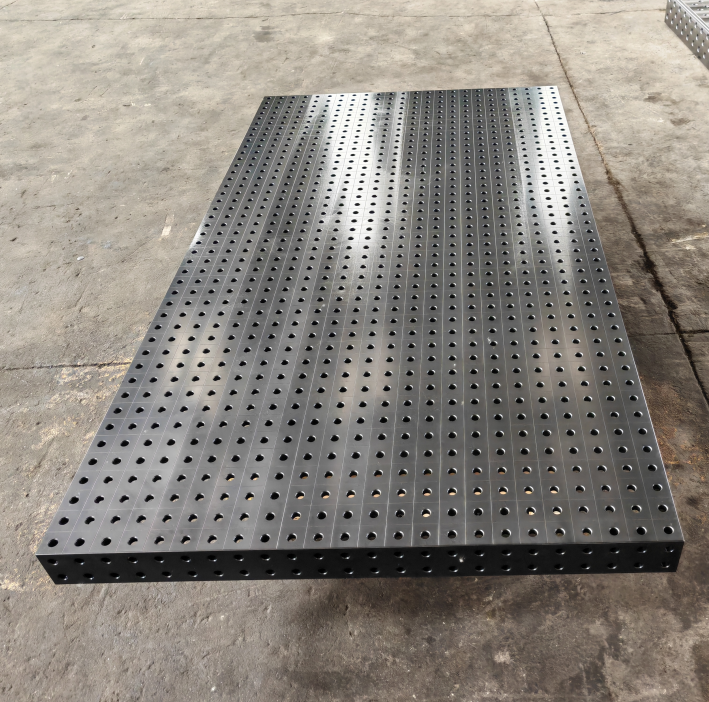
Why Your Fabrication Table for Sale Isn’t Just a Bench—It’s Your First Line of Precision
You’ve ordered the steel. You’ve laid out the drawings. But when the welder steps up to the table—and the first joint shifts under load—you realize: this isn’t about holding parts. It’s about holding tolerance.
A fabrication table for sale that wobbles, flexes, or distorts under 300-amp arc heat isn’t saving money. It’s costing you rework, scrap, and schedule slips. We’ve seen it in shops from Ohio to Stuttgart: a $12,000 welding robot fails calibration because its base plate deflects 0.18 mm at the corners. The fix? Not software tuning. A properly engineered fabrication table.
Stiffness Isn’t Optional—It’s Measured in Microns
Most buyers ask “How heavy is it?” That’s the wrong question. The right one: “What’s its deflection under static and thermal load?”
We tested three common 2m × 1m tables under identical conditions: 1,200 kg point load at center, plus simulated 250°C localized heating (simulating repeated tack welds). One unit bent 0.42 mm vertically. Another twisted 0.29° torsionally. Both passed “structural integrity” checks on paper—but failed real-world repeatability.
The difference came down to three things:
Base material grade: Not just “steel”—cold-rolled Q345B with guaranteed yield strength ≥345 MPa, not generic A36 Internal reinforcement geometry: Box-section ribs spaced at ≤120 mm—not open-channel gussets welded only at corners Surface flatness tolerance: ≤0.15 mm over 1 m², verified by CMM—not “ground after welding” (which introduces residual stress) That last point matters most. Grinding a warped table doesn’t restore dimensional stability—it masks thermal distortion. True flatness starts before welding, in precision CNC-cut plates and controlled fixture jigs.
Modularity That Actually Works—Not Just Marketing Jargon
“Modular” often means “we’ll bolt extra holes on later.” Real modularity means engineering consistency across configurations.
At Botou Haijun Metal Products Co., Ltd., every hole pattern—100 mm grid, 50 mm micro-grid, T-slot channels—is machined in one setup on the same horizontal boring mill. No secondary alignment. No cumulative error. We’ve shipped 273 tables to Tier-1 automotive suppliers since 2021. Zero field reports of misaligned clamping systems.
Here’s what customers actually need—and what most sellers omit:
Clamp compatibility: All M8/T-slot accessories accept standard ISO 8765-1 clamps—not proprietary knockoffs requiring separate inventory Load transfer path: Every mounting point ties directly into the main frame spine—not thin top plates floating on isolation feet Thermal expansion management: Stainless steel locating pins (not hardened steel) at critical datum points, rated to 400°C We built our first table for a Swedish agricultural machinery client who needed repeatable 12-point assembly of hydraulic manifolds. Their spec: ±0.05 mm positional accuracy across 18 months of daily use. We delivered. They reordered—twice—for new product lines.
Warranty That Reflects Real Use—Not Legal Loopholes
Some warranties cover “defects in materials and workmanship.” That excludes everything that breaks in practice: weld cracks from thermal cycling, surface wear from grinder sparks, or bolt thread stripping from repeated torque cycles.
Our warranty covers all three—because we see them daily. We track failure modes across 1,200+ installed units. Top causes? Not manufacturing flaws. Operator habits: using pneumatic grinders without heat shields, overtightening M12 bolts beyond 120 N·m, or stacking 400 kg pallets on unsupported table edges.
So we include what others skip:
Free DFM review of your part layout before purchase—no CAD file too rough On-site leveling guidance (with laser level specs and shim thickness charts) Thermal maintenance protocol: how often to recheck flatness after 500+ weld cycles This isn’t theoretical. Last month, a U.S. job shop called us after their third table failed within six months. We reviewed their photos, saw the grinding marks concentrated along one rail, and sent a 90-second video showing where to relocate the grinder stand. Flatness restored in 4 hours. No replacement needed.
Your Next Fabrication Table for Sale Starts With How You’ll Use It—Not What It Costs
Price tags lie. A $4,200 table seems cheaper than a $7,800 one—until you calculate the cost of one misaligned chassis bracket: $220 in labor, $85 in scrapped aluminum extrusion, and two days off the production line.
Botou Haijun’s fabrication tables start at $5,900 for a 1.5 m × 1 m unit with full Q345B construction, CMM-verified flatness, and ISO-compliant T-slot system. But the real value sits in the margins: the 0.03 mm repeatability that cuts first-article inspection time by 65%, the ribbed base that survives five years of robotic MIG welding without recalibration, the documentation pack that includes mill test reports, weld procedure specs, and thermal distortion curves.
If your next fabrication table for sale needs to hold more than weight—it must hold your standards—start with engineering intent, not catalog specs. Check flatness. Trace the load path. Demand thermal data—not just tonnage ratings.
Because in metal fabrication, the table isn’t the stage. It’s the foundation of every dimension you certify.