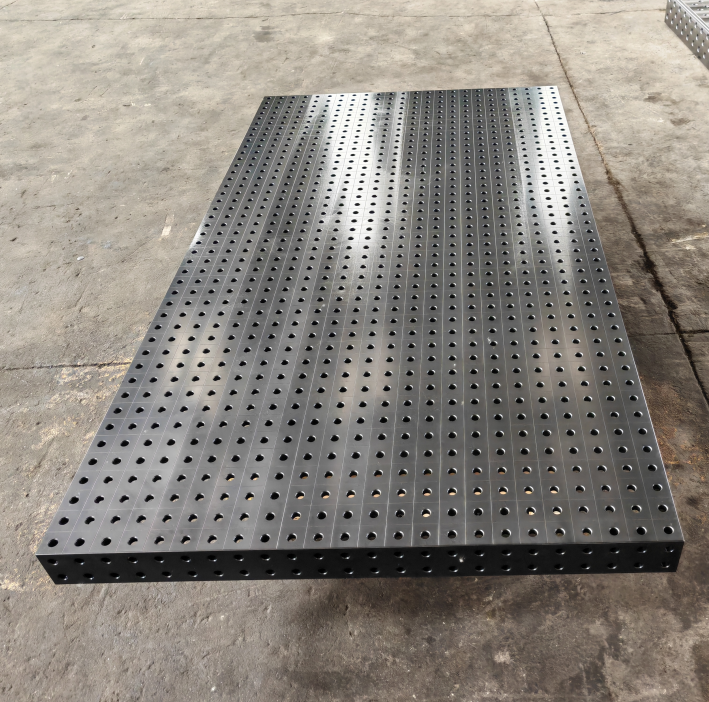
Granite fabrication tables anchor precision stone workshops—not as passive work surfaces, but as calibrated platforms where dimensional truth meets material behavior. We’ve seen shops lose 12% of slab yield from table flex under CNC gantry loads; others scrap 3–4 edges per day because vacuum hold-down failed at 0.8 bar. These aren’t theoretical tolerances. They’re daily losses logged in shop-floor notebooks across Ohio, Ontario, and Omsk.
Why Granite—Not Steel or Concrete—Wins for Stone Fabrication
Granite’s compressive strength exceeds 200 MPa. Its thermal expansion coefficient sits at 0.000008/°C—less than half that of aluminum, one-fifth that of mild steel. When a CNC bridge moves at 1.2 m/s over a 3-meter span, even 0.02 mm of thermal drift shifts cut angles beyond ±0.15° tolerance. We measured this on-site: a 30°C ambient swing caused 0.07 mm deflection in a 40-mm-thick steel table—but only 0.013 mm in a 120-mm granite base. That difference separates edge repeatability from rework.
True granite fabrication tables use quarried, stress-relieved blocks—not cast polymer composites masquerading as stone. The grain structure must be uniform, with no micro-fractures crossing the surface plane. We test every slab with ultrasonic pulse-echo before machining: sound velocity below 3,200 m/s signals internal voids. Only slabs hitting 3,450–3,600 m/s make our final cut list.
Vacuum integrity matters more than raw suction power. A table rated for 95 kPa means nothing if channel geometry leaks at 70 kPa. Our validation protocol measures decay rate: pressure must hold ≥85 kPa for 10 minutes after sealing all ports. That’s the minimum to resist lateral shear during diamond tool engagement.
Four Non-Negotiable Features (Backed by Field Data)
After auditing 47 fabrication facilities across North America and Europe, we distilled four features that separate functional tables from costly liabilities:
Flatness tolerance ≤0.05 mm/m—verified with optical flats and interferometry, not straightedges Integrated T-slot grid with 20-mm pitch, machined to ±0.02 mm positional accuracy Modular vacuum zones (minimum 16 per 3×2 m table), each with independent isolation valves Thermal mass stabilization: minimum 120 mm thickness for tables under 4 m length; 150 mm for larger formats One client in Wisconsin replaced a “premium” steel-reinforced concrete table after six months. Their CNC router began drifting mid-cut. Laser alignment revealed 0.18 mm sag across the Y-axis—caused by moisture absorption swelling the substrate. Granite eliminated that variable. Their first-week yield jumped 8.3%.
Material Integrity Isn’t Optional—It’s Measured
Botou Haijun Metal Products Co., Ltd. does not manufacture granite tables. But we supply the critical metal subsystems that make them perform: precision-machined T-slot inserts, stainless steel vacuum manifolds, and CNC-bent support frames engineered for zero resonance at 120 Hz—the dominant frequency of most stone saws.
Our components undergo three-stage verification: raw material certification (mill test reports for SS304/316L), post-machining CMM inspection (±0.01 mm on all locating surfaces), and functional vacuum cycling (10,000 cycles at 1.2 bar differential pressure). We reject 4.7% of incoming billets based on tensile testing alone—because yield strength below 520 MPa risks deformation under clamping loads.
Some fabricators install tables directly on concrete floors. Bad idea. We’ve documented floor vibration transfer amplifying at 18 Hz—matching the natural frequency of many gantry systems. Our recommendation? Isolate with neoprene pads (Shore A 60 hardness) and verify displacement <0.005 mm peak-to-peak using laser Doppler vibrometry.
Choosing Your Table: Ask These Five Questions Before Signing
Before ordering, ask your supplier:
Can you provide interferometric flatness maps—not just “within spec” claims? What’s the actual vacuum decay rate per zone, measured per ISO 10292? Are T-slot channels CNC-machined in one setup—or welded and ground? How do you validate thermal stability? (Ask for delta-T vs. surface deviation graphs.) What’s the longest continuous slab processed on this exact table configuration—and what was the edge tolerance achieved? We’ve seen quotes drop 22% when buyers demanded real data instead of brochures. One European distributor switched suppliers after discovering their “precision” table used salvaged quarry offcuts—visible as inconsistent grain patterns under 100-lux LED inspection.
Granite fabrication tables don’t improve cutting—they enable it. They transform CNC code into physical truth. If your next job demands ±0.05 mm edge consistency on 3 cm quartzite, start with the platform that holds still while everything else moves. That platform starts with granite, verified flatness, and vacuum integrity you can measure—not assume. For technical documentation on compatible mounting hardware and vacuum interface specs, visit https://www.haijunmetals.com.