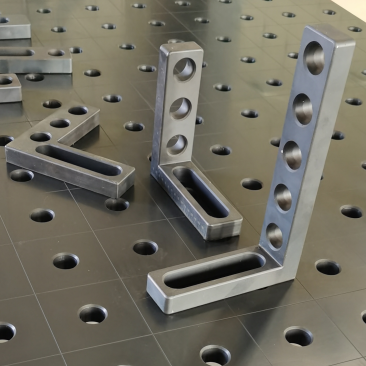
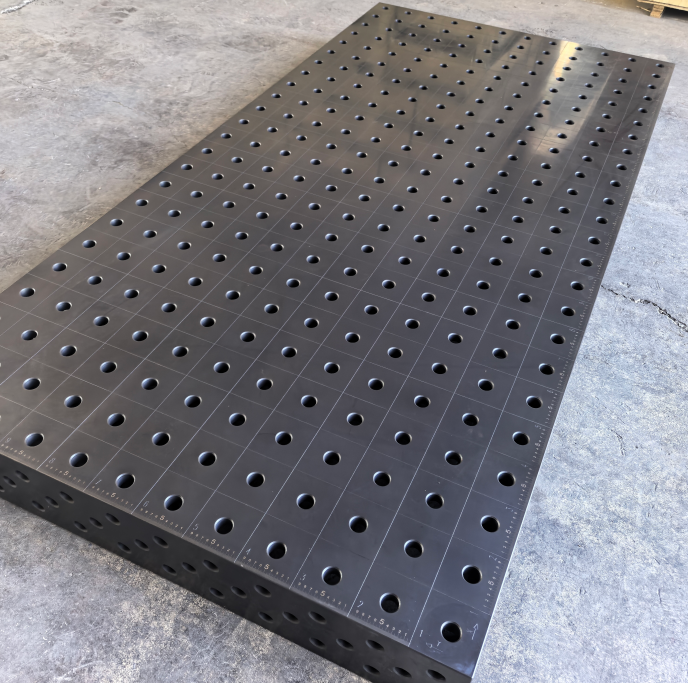
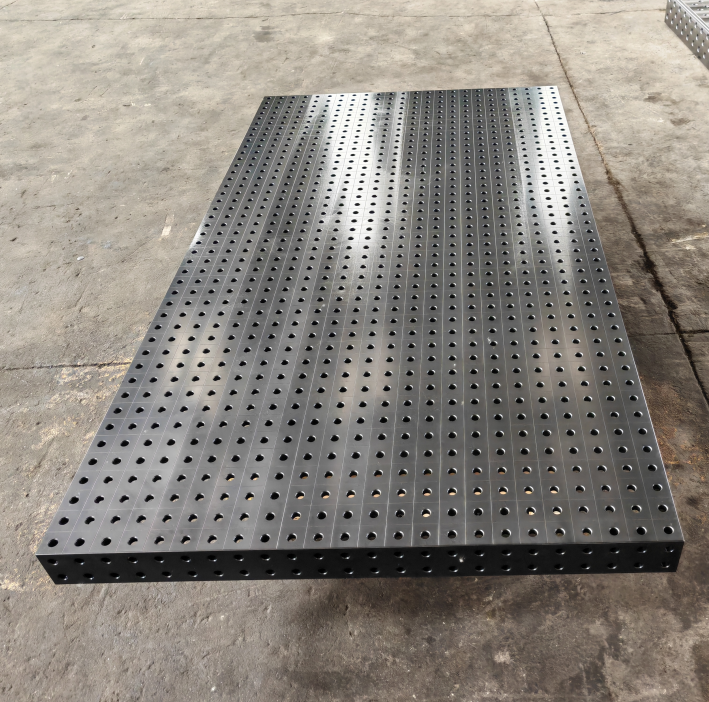
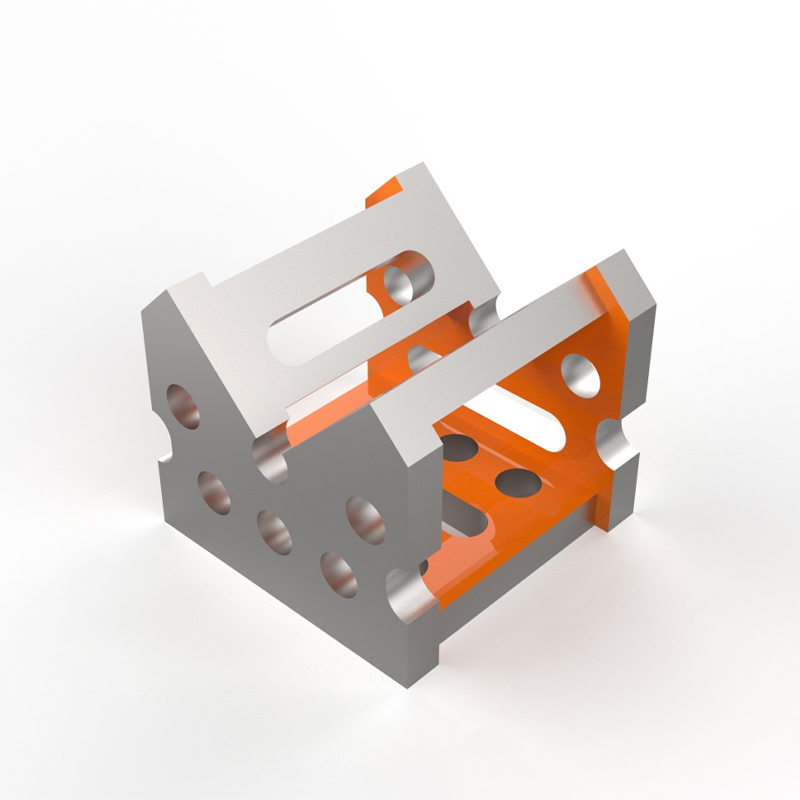
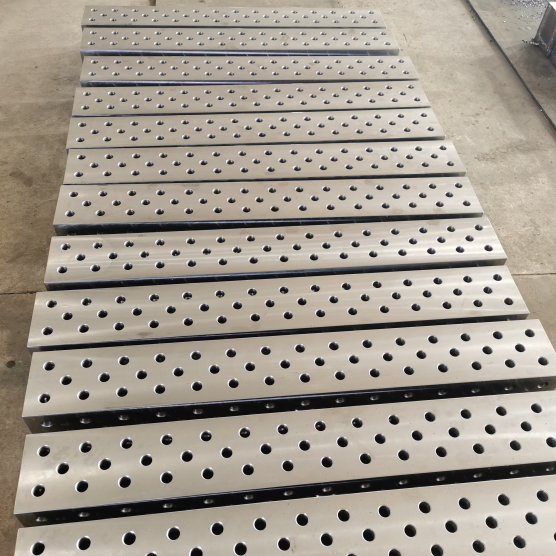
Every precision welder knows the truth: your steel fabrication table isn’t just a surface—it’s the foundation of repeatability, the anchor for tolerance control, and the first line of defense against costly rework. We’ve seen shops lose three days on a single bracket assembly because the table’s T-slot alignment drifted 0.15 mm over time. We’ve watched laser-cut jigs warp under thermal load when the base plate lacked through-hardened structural steel. Precision doesn’t start at the torch—it starts where the part touches the table.
Why Material Integrity Matters More Than Bolt Patterns
Most buyers compare steel fabrication table specs by weight, size, or number of T-slots. That’s like judging an engine by its hood badge. What actually determines long-term accuracy is metallurgical stability. Cold-rolled A572 Grade 50 steel—heat-treated to 220–250 HB—resists micro-deformation under repeated clamping loads. Untreated mild steel tables flex visibly at 1.2 kN/m²; hardened plates hold flatness within ±0.08 mm across a 2,000 × 1,500 mm surface after 18 months of daily use. We verify this with quarterly CMM sweeps—not just initial acceptance checks. Surface hardness gradients matter too: a 3 mm case depth ensures wear resistance without brittle fracture risk during heavy-duty welding ground clamp installation.
The Hidden Cost of “Universal” Mounting Systems
Some tables advertise “modular compatibility” but ship with M8 threaded inserts spaced 100 mm apart. That works fine—until you need to fixture a 47 mm-diameter hydraulic manifold flange requiring 60 mm bolt centers. True flexibility means configurable grid patterns: 50 mm for standard tooling, 25 mm for micro-weldments, and dedicated 12.7 mm precision dowel holes for repeatable jig registration. At Botou Haijun Metal Products Co., Ltd., every table uses dual-layer T-slot geometry—top slots accept standard 10 mm clamps; deeper recessed slots lock custom locating pins with ±0.02 mm repeatability. No adapters. No shims. No guesswork.
Real-World Thermal Management Is Non-Negotiable
Welding generates localized heat spikes exceeding 1,200°C. A table without thermal mass management warps faster than you can say “distortion correction.” Our solution? A 32 mm thick base plate with internal ribbing that doubles thermal inertia while reducing weight by 17% versus solid plate. Each rib acts as a heat sink, channeling energy away from the work surface. We validate this using infrared thermography: surface temperature rise stays below 18°C after five consecutive 300-amp GMAW passes on a 10 mm carbon steel test piece. Compare that to competitor tables showing 42°C spikes—and subsequent 0.23 mm bowing measured at the centerline.
No hidden compromises: All tables use ASTM A572 Gr. 50 steel—not “equivalent” grades with unverified yield strength
No batch variance: Every plate undergoes ultrasonic testing for subsurface laminations before machining
No calibration drift: T-slot parallelism held to ±0.05 mm/m over full length, verified with laser interferometer
What Happens When You Skip the Engineering Review
One North American agricultural OEM ordered 12 tables based solely on CAD drawings—no DFM feedback requested. Their design used 6 mm mounting holes in 25 mm thick plate. During field testing, clamping torque caused thread stripping in 37% of fixtures. The fix? Redesigning hole depth to 18 mm with rolled threads instead of cut threads—increasing pull-out strength by 210%. That’s why we offer free CAD-based design review within 72 hours. Not “consultation.” Not “suggestions.” Measurable dimensional validation against ASME Y14.5 GD&T standards, including worst-case stack-up analysis for multi-point fixturing.
A steel fabrication table earns its value not in the first weld—but in the 12,000th. It proves itself when the third shift runs the same program without recalibration. When a new operator achieves ±0.1 mm fit-up on their first day. When your CMM report shows zero trend deviation over six months. Botou Haijun Metal Products Co., Ltd. builds these tables in Botou City—the heart of China’s cold-working industry—where metallurgical discipline isn’t optional. Every table ships with full material certification, CMM validation data, and a traceable heat lot number. Because precision isn’t a feature. It’s the baseline.