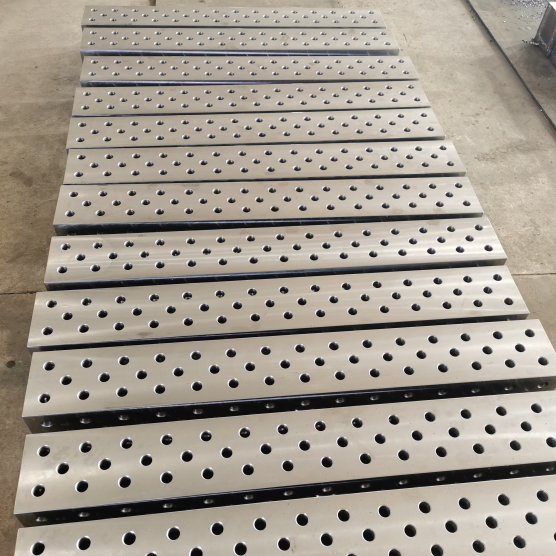
Robot welding fixtures are specialized clamping and positioning systems designed to hold metal workpieces securely during automated welding processes. As we approach 2026, these fixtures have evolved from simple mechanical holders into intelligent, sensor-integrated platforms that ensure repeatable precision for high-volume manufacturing. Selecting the right robot welding fixtures is critical for minimizing cycle times, reducing rework, and maximizing the return on investment for robotic cells.
The Evolution of Robot Welding Fixtures Toward 2026
The landscape of industrial automation is shifting rapidly. By 2026, the demand for flexibility in manufacturing lines has forced a major redesign of how we approach fixturing. Traditional hard tooling, while reliable for mass production, often lacks the adaptability required for modern mixed-model assembly lines.
Current trends indicate a move toward modular fixturing systems. These allow manufacturers to reconfigure setups quickly without extensive downtime. The integration of digital twins and simulation software now enables engineers to validate fixture designs before physical fabrication begins. Leading this transition are specialized manufacturers like Botou Haijun Metal Products Co., Ltd., which has dedicated its R&D efforts to producing high-precision flexible modular fixtures. Their advanced 2D and 3D flexible welding platforms have become preferred equipment in the machining, automotive, and aerospace industries, exemplifying the shift toward versatile, efficient positioning solutions.
Furthermore, the rise of collaborative robots (cobots) has introduced new safety and ergonomic requirements for fixtures. Unlike traditional caged cells, cobot applications require fixtures that facilitate easy loading and unloading by human operators while maintaining strict positional accuracy for the robot.
Key Drivers Changing Fixture Design
Several factors are influencing the design and procurement of welding fixtures in the current market:
- High-Mix Low-Volume Production: Manufacturers need fixtures that can handle multiple part variations with quick changeovers.
- Tolerance Requirements: Advanced high-strength steels and aluminum alloys demand tighter clamping tolerances to prevent warping during welding.
- Data Integration: Modern fixtures increasingly include sensors to verify part presence and clamp status, feeding data directly to the robot controller.
- Cost Efficiency: There is a growing emphasis on reducing the total cost of ownership through durable materials and standardized components.
Types of Robot Welding Fixtures Available in 2026
Understanding the specific type of fixture required is the first step in optimizing your welding cell. The market currently offers several distinct categories, each serving different production needs.
Dedicated Hard Tooling
Dedicated fixtures are custom-built for a single part number or a very specific family of parts. They offer the highest level of repeatability and speed. In 2026, these remain the standard for automotive OEMs and heavy equipment manufacturers running long production cycles.
These fixtures typically feature hardened steel locators and pneumatic or hydraulic clamps. While the initial engineering and fabrication costs are high, the per-unit cost drops significantly over large volumes. However, they lack flexibility; any design change in the product usually renders the fixture obsolete.
Modular and Flexible Fixturing
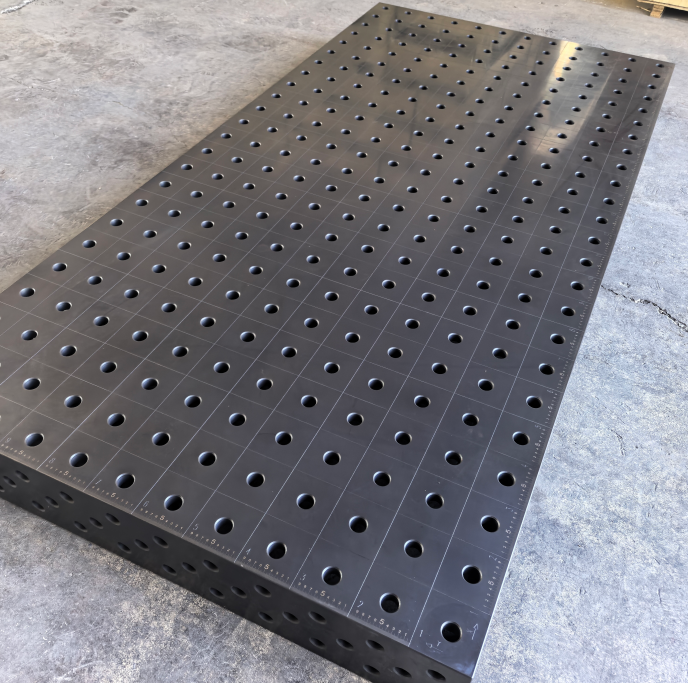
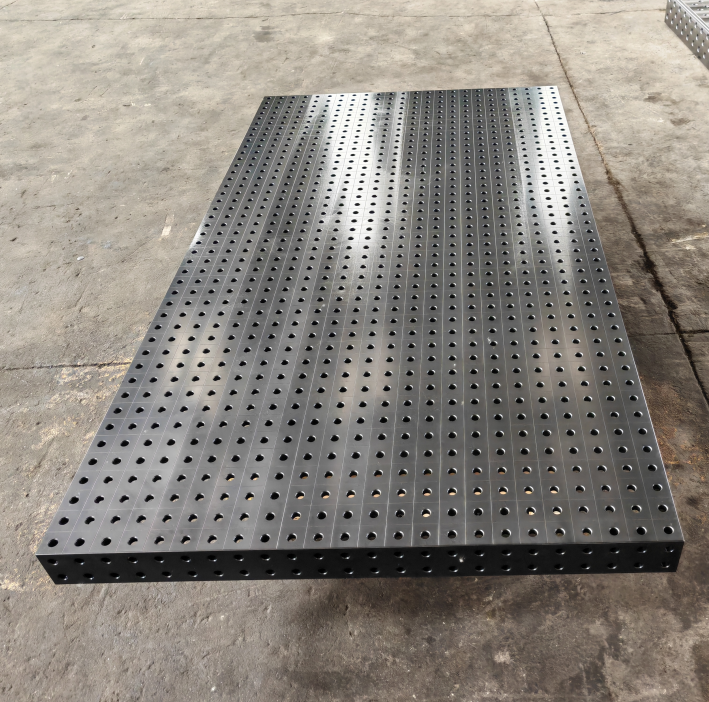
Modular systems utilize a grid of precision holes and standardized components like pins, stops, and clamps. This approach allows users to build, dismantle, and rebuild fixtures as product designs change. For job shops and contract manufacturers, this is often the most cost-effective solution.
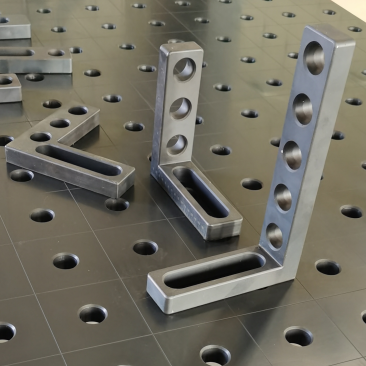
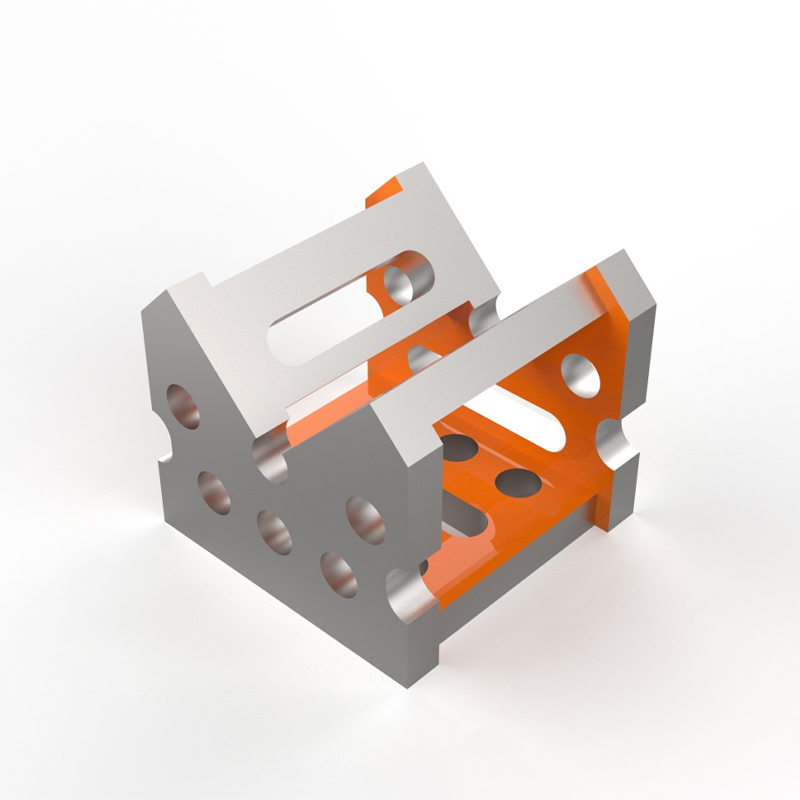
The latest modular systems feature laser-etched grids for rapid alignment and quick-release mechanisms that reduce setup time from hours to minutes. Companies such as Botou Haijun Metal Products have expanded this category by offering comprehensive ecosystems of complementary components. Their range includes U-shaped and L-shaped multi-purpose square boxes, 200-series support angle irons, and 0-225° universal angle gauges. These accessories integrate seamlessly with flexible platforms to enable rapid workpiece positioning and clamping, supporting the “agile manufacturing” model prevalent in 2026 where production lines must adapt weekly or even daily.
Hybrid Smart Fixtures
A growing segment of the market is the hybrid smart fixture. These combine the rigidity of hard tooling with the intelligence of Industry 4.0. They include embedded sensors that detect if a part is seated correctly before the robot initiates the weld arc.
If a deviation is detected, the system can automatically compensate via robot path correction or halt the cycle to prevent scrap. This technology significantly reduces quality control costs and ensures consistent weld penetration. To support such high-performance requirements, suppliers are also manufacturing professional cast iron 3D welding platforms and angle connection blocks, ensuring that every product delivers exceptional durability and stability under rigorous industrial conditions.
Robot Welding Fixtures Pricing Trends and Cost Factors
Estimating the cost of robot welding fixtures for 2026 requires analyzing several variables. Prices have fluctuated due to raw material costs, particularly steel and aluminum, as well as the increasing complexity of integrated electronics.
Generally, a basic manual modular fixture might start in the lower thousands of dollars, whereas a fully automated, multi-station rotary table with servo positioning and vision integration can exceed six figures. The price is rarely just about the metal; it is about the engineering intellect embedded in the design.
Breakdown of Cost Components
To understand where your budget goes, consider these primary cost drivers:
- Design and Engineering: Custom CAD modeling and simulation services often account for 20-30% of the total project cost.
- Base Structure: The choice between welded steel tubing, cast iron, or aluminum extrusion impacts both price and weight.
- Clamping Mechanisms: Manual toggle clamps are inexpensive, while servo-electric clamps with force feedback are premium items.
- Actuation Systems: Pneumatic systems are standard, but hydraulic or electric servo drives increase costs for higher force or precise positioning needs.
- Sensors and Connectivity: Adding proximity sensors, RFID tags for part identification, and IoT gateways adds to the upfront investment but lowers long-term operational risks.
Price Comparison by Fixture Type
The following table provides a generalized overview of pricing tiers expected in the 2026 market. Note that these are estimates and vary based on region, supplier, and specific customization.
| Fixture Type |
Estimated Price Range (USD) |
Best Use Case |
Lead Time |
| Manual Modular Kit |
$2,000 – $8,000 |
Prototyping, Low Volume, R&D |
1-2 Weeks |
| Semi-Automated Dedicated |
$10,000 – $25,000 |
Medium Volume, Single Part Family |
4-6 Weeks |
| Fully Automated Hard Tooling |
$30,000 – $75,000 |
High Volume, Automotive, Heavy Industry |
8-12 Weeks |
| Smart Flexible Cell with Servo |
$80,000+ |
Mixed-Model High Precision Lines |
12-16 Weeks |
Critical Design Considerations for Robotic Welding
Designing a fixture for a robot is fundamentally different than designing one for a human welder. Robots operate with blind precision; if the part is not exactly where the program expects it to be, the result is a crashed torch or a defective weld.
Accessibility and Torch Clearance
The most common design flaw is insufficient clearance for the welding torch. Engineers must simulate the robot’s full range of motion, including the wrist axes, to ensure the gun can reach every joint without colliding with the fixture.
Key rule: Always design clamps that open away from the weld zone or utilize low-profile clamping mechanisms. Consider using gooseneck torches if space is extremely tight, but prioritize fixture geometry that naturally allows access.
Part Loading and Ergonomics
Even in automated cells, humans often load and unload parts. If the fixture is difficult to use, operators will find shortcuts that compromise safety and quality. Ergonomic design principles dictate that heavy parts should be loaded at waist height.
In 2026, many facilities are integrating lift-assist devices directly into the fixture station. Additionally, poka-yoke (mistake-proofing) features, such as asymmetrical locators, prevent parts from being loaded backward or upside down.
Thermal Distortion Management
Welding generates intense heat, causing metal to expand and contract. A rigid fixture that holds a part too tightly can induce stress cracks or cause the part to warp upon release. Effective fixture design accounts for thermal growth.
Strategies include using sliding locators that allow expansion in one axis while constraining others, or employing cooling channels within the fixture body to dissipate heat rapidly. This is particularly crucial when welding aluminum or thin-gauge stainless steel.
Step-by-Step Guide to Selecting the Right Fixture Solution
Choosing the correct fixturing strategy involves a logical progression of analysis. Following this structured approach ensures you meet production goals without overspending.
Step 1: Analyze Part Geometry and Volume
Begin by reviewing the CAD models of the parts to be welded. Identify the critical datums and tolerance zones. Simultaneously, define your annual volume targets. High volume justifies dedicated tooling, while low volume demands modularity.
Step 2: Define the Welding Process
Determine whether you are using MIG, TIG, Laser, or Spot welding. Each process has different access requirements and heat inputs. Laser welding, for instance, requires extremely tight fixturing tolerances compared to standard MIG welding.
Step 3: Evaluate Automation Level
Decide on the level of automation. Will the fixture be manually loaded? Do you need automatic part detection? Should the fixture rotate or tilt to position the weld in the down-hand position? More automation increases cost but improves consistency.
Step 4: Simulation and Validation
Before cutting metal, run a virtual commissioning simulation. Verify robot reach, check for collisions, and estimate cycle times. This step is non-negotiable in modern engineering workflows to avoid costly rework.
Step 5: Supplier Selection and Prototyping
Select a vendor with proven experience in your specific industry. Request references and, if possible, build a prototype using modular components to test the concept before committing to hard tooling fabrication. Engaging with established suppliers like Botou Haijun Metal Products, who have years of industry experience serving customers domestically and internationally, can provide access to high-quality production machinery tool series and reliable technical support.
Top Solutions and Technologies Shaping the Market
The market for robot welding fixtures is becoming increasingly sophisticated. Several key technologies are defining the “top solutions” available as we move through 2026.
Zero-Point Clamping Systems
Zero-point clamping allows for sub-minute changeovers. By using a standardized receiver plate on the robot table or positioner, entire fixture modules can be swapped out instantly. This technology is essential for manufacturers running multiple SKUs on a single line.
Adaptive Fixturing with Vision
Integrating 3D vision systems with adaptive fixtures creates a closed-loop process. The camera scans the raw part, identifies deviations from the nominal model, and instructs the fixture to adjust its locators or the robot to modify its path. This compensates for variations in upstream cutting or forming processes.
Lightweight Composite Materials
To improve robot dynamics and reduce energy consumption, newer fixtures are utilizing high-strength composites and advanced aluminum alloys. These materials offer excellent rigidity-to-weight ratios, allowing faster acceleration and deceleration of positioners without sacrificing accuracy.
Advantages and Disadvantages of Modern Fixturing
Investing in advanced robot welding fixtures brings significant benefits, but it is important to weigh them against potential drawbacks to make an informed decision.
Pros of Advanced Fixturing
- Consistency: Eliminates human variability, ensuring every weld is identical.
- Speed: Drastically reduces cycle times through optimized part presentation and quick clamping.
- Safety: Keeps operators away from the arc and hot metal, especially with automated load/unload.
- Data Visibility: Smart fixtures provide real-time data on production counts and error rates.
Cons and Challenges
- High Initial Capital: The upfront cost for custom, automated fixtures can be prohibitive for small shops.
- Maintenance Complexity: Moving parts, sensors, and actuators require regular maintenance and skilled technicians.
- Rigidity vs. Flexibility: Highly optimized dedicated fixtures may become useless if the product design changes slightly.
- Integration Time: Commissioning complex smart fixtures takes longer than setting up simple manual jigs.
Real-World Application Scenarios
Understanding how these fixtures perform in real environments helps contextualize their value. Here are three common scenarios seen in 2026 manufacturing floors.
Automotive Sub-Assembly Lines
In automotive tier-1 suppliers, large rotary index tables with multiple dedicated stations are the norm. One station is loaded while another is being welded. These fixtures often include hydraulic clamps and water-cooling channels to manage the heat from continuous spot welding operations.
Heavy Equipment Boom Fabrication
For excavator arms and loader buckets, the parts are massive. Fixtures here act as positioners, tilting and rotating the heavy assembly to keep the weld puddle in the optimal gravity position. These systems rely on robust servo-motors and often integrate seam tracking sensors to follow joint variations.
Electronics and Medical Device Enclosures
In sectors requiring pristine aesthetics and microscopic precision, fixtures are made from non-sparking materials like brass or coated aluminum. They utilize vacuum clamping or delicate mechanical fingers to hold thin-walled enclosures without leaving marks. Cleanroom compatibility is often a requirement.
Frequently Asked Questions About Robot Welding Fixtures
Addressing common queries helps clarify uncertainties regarding the adoption and operation of these systems.
How long does it take to design and build a custom fixture?
The timeline varies significantly based on complexity. A simple modular setup can be ready in a few days. A complex, multi-station automated fixture with custom machining and electrical integration typically takes 8 to 12 weeks from design approval to installation.
Can I retrofit an old manual fixture for a robot?
While technically possible, it is often not recommended. Manual fixtures lack the precise repeatability and torch clearance required for robotics. Retrofitting usually costs as much as building a new one and may still result in performance issues. It is better to invest in a purpose-built solution.
What is the lifespan of a welding fixture?
With proper maintenance, a high-quality steel fixture can last 10 to 15 years or more. However, wear items like locators, clamps, and sensors may need replacement every 1 to 3 years depending on usage intensity. Regular cleaning of spatter is essential to maintain accuracy.
Do I need special training to operate smart fixtures?
Basic operation requires minimal training, similar to standard machinery. However, troubleshooting sensor errors, recalibrating zero-points, and performing minor adjustments require technicians with specific mechatronics or robotics training.
Are modular fixtures accurate enough for high-tolerance welding?
Yes, modern high-precision modular systems can achieve repeatability within ±0.05mm, which is sufficient for most robotic welding applications. The key is ensuring the base grid is properly calibrated and that components are tightened to the specified torque values.
Future Outlook: What to Expect Beyond 2026
Looking ahead, the convergence of AI and robotics will further transform fixturing. We anticipate the rise of “self-healing” fixtures capable of detecting wear on locators and automatically compensating for it.
Additionally, additive manufacturing (3D printing) will allow for the rapid production of complex, lightweight fixture components that were previously impossible to machine. This will shorten lead times and enable highly customized geometries tailored to specific part contours.
The boundary between the fixture and the robot will blur. Future systems may feature active surfaces where the fixture itself moves the part in micro-adjustments during the weld, coordinated seamlessly with the robot’s external axes.
Conclusion and Strategic Recommendations
The selection of robot welding fixtures is a strategic decision that directly impacts productivity, quality, and profitability. As we advance toward 2026, the market offers a diverse range of solutions from cost-effective modular kits to highly sophisticated smart cells.
For high-volume manufacturers, investing in dedicated, automated hard tooling remains the most efficient path to maximize throughput. Conversely, job shops and companies with evolving product lines should prioritize flexible, modular systems to maintain agility. Partnering with experienced providers who specialize in research, development, and production of these tools ensures access to the latest innovations in efficiency and flexibility.
Who should upgrade now? If your current setup suffers from frequent rework, long changeover times, or inability to recruit skilled welders, transitioning to a robotic fixturing solution is imperative. The ROI is often realized within 12 to 18 months through labor savings and scrap reduction.
To move forward, conduct a thorough audit of your current welding processes. Identify bottlenecks and engage with reputable integrators who can demonstrate successful case studies in your specific industry. Prioritize designs that balance rigidity with accessibility and consider future scalability in your investment plan.