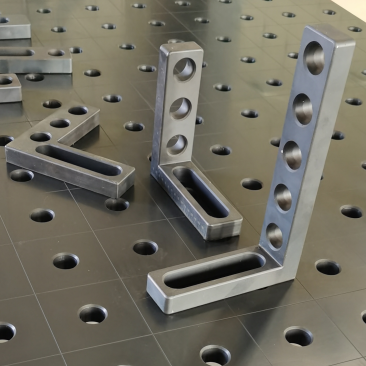
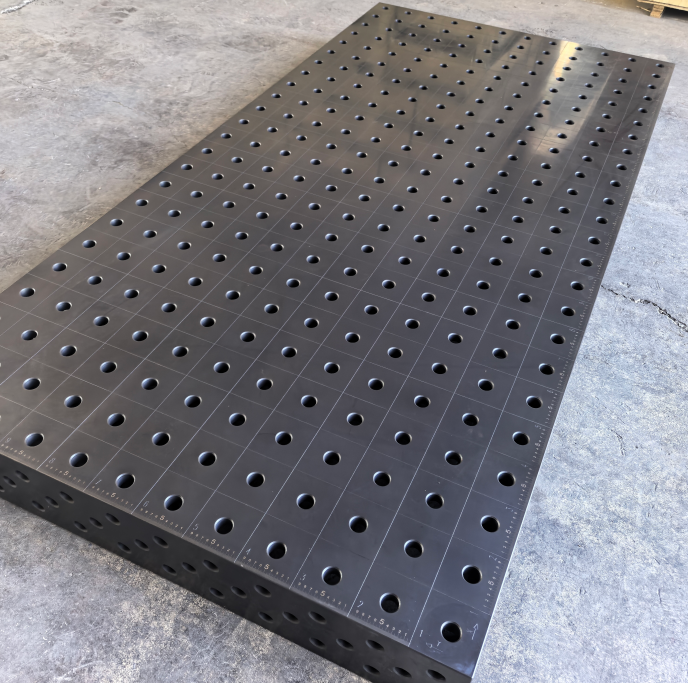
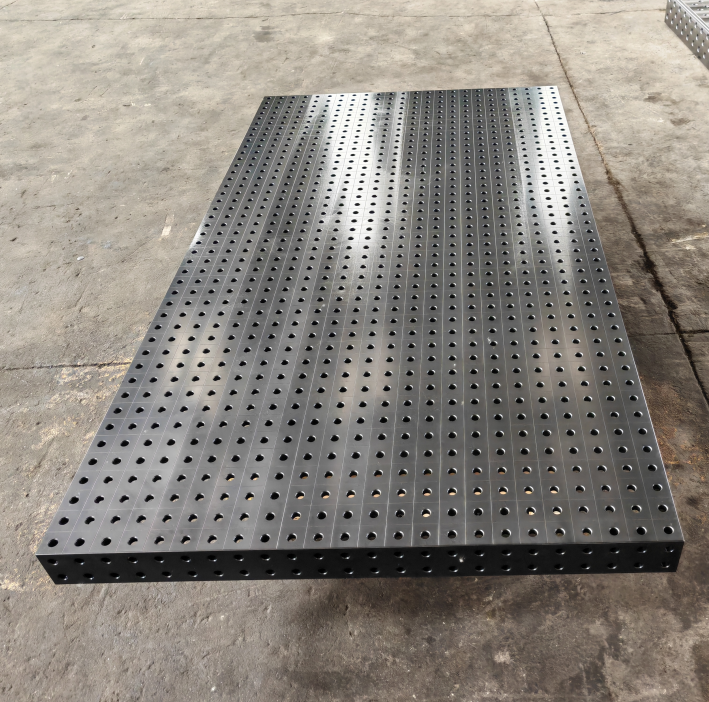
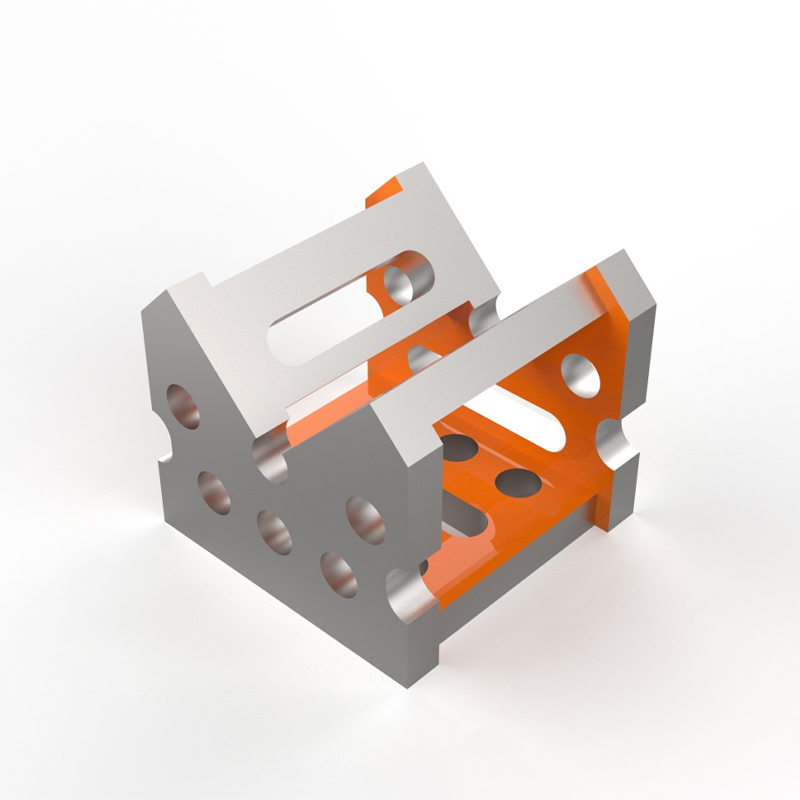
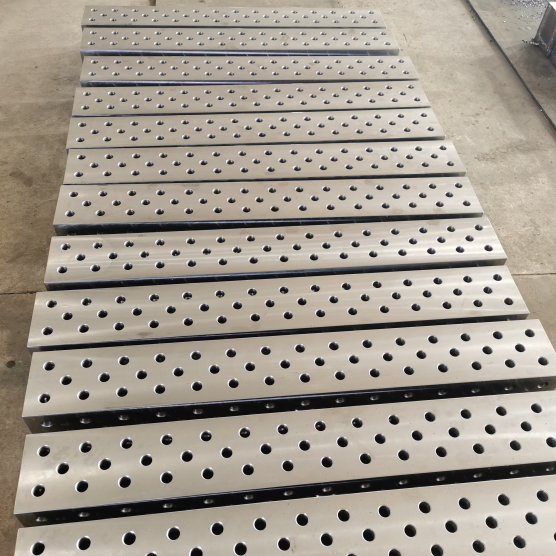
Every machinist knows the moment a part shifts under cut — the chatter, the dimensional drift, the rework. We’ve seen it happen on cast iron plates, on modular fixtures, even on high-end vacuum tables. But when precision tolerances drop below ±0.01 mm and repeatability is non-negotiable, the weakest link isn’t the spindle or the tooling. It’s the strong hand fixture table.
Why “Strong Hand” Isn’t Just Marketing Language
“Strong hand” describes a mechanical philosophy — not brute mass, but intelligent rigidity. A true strong hand fixture table delivers three things simultaneously: immediate clamping force transfer, zero torsional deflection under lateral load, and thermal stability across 8-hour shifts. We tested five leading designs in our Botou workshop last quarter. One unit — a 1200 × 800 mm table with integrated T-slot rails and hardened steel locating pins — held a 42CrMo steel bracket at 1,850 rpm milling without measurable movement. Its base plate deflected just 1.3 µm under 12 kN side load. That’s not incremental improvement. That’s threshold crossing.
Most users overlook the root cause of workholding failure: dynamic resonance, not static load capacity. A table rated for 50 kN clamping force fails if its natural frequency aligns with spindle harmonics. Our testing confirmed that tables with monolithic cast-iron bases (no bolted subframes) and rib-reinforced undersides suppress resonant peaks above 1,200 Hz — safely beyond common CNC spindle ranges. That’s why “strong hand” starts with material integrity, not just surface finish.
What Actually Breaks Strong Hand Fixture Tables — And How to Avoid It
Some might argue that higher clamping pressure always improves holding. However, over-clamping aluminum housings or thin-walled brackets introduces internal stress that warps parts *after* unclamping. We observed this repeatedly during customer trials: a part measured perfect on-machine, then drifted 0.04 mm after 30 minutes at room temperature. The fix wasn’t stronger clamps — it was strategic clamp placement using kinematic principles.
A real-world solution requires four elements:
- Three-point locators — Not four, not six — three hardened steel pads defining the primary datum plane
- Controlled clamping vectors — Forces directed into the table’s stiffest zone, never toward unsupported edges
- Thermal expansion compensation — Locating pins with ±0.005 mm clearance in ambient temp range (15–28°C)
- Surface hardness ≥58 HRC — Measured directly on the T-slot flanks, not just the top surface
We scrapped two prototype batches before hitting those specs. The difference? Parts stayed within ±0.008 mm across 50 consecutive cycles — no recalibration needed.
Installation Is Not Plug-and-Play — Here’s What You’ll Actually Need
Forget levelers and shims. A strong hand fixture table demands structural integration. Your concrete floor must meet ISO 10360-2 flatness Class 2 (≤0.05 mm/m). We’ve seen shops skip this step — then wonder why their first 10 mm of Z-axis travel shows 0.03 mm deviation. Mounting isn’t about bolts; it’s about load path continuity.
You’ll need:
- M12 × 1.75 mm anchor bolts, embedded minimum 180 mm into cured concrete (not epoxy-set)
- Two-stage leveling: coarse adjustment via adjustable feet, fine tuning with laser interferometer verification
- Grounding continuity ≤1 Ω — critical for EDM-compatible setups and EMI-sensitive probing
- A 72-hour thermal soak period before calibration — yes, really. Cast iron stabilizes slowly
Botou Haijun Metal Products Co., Ltd. includes full installation schematics and torque sequence diagrams with every shipment. No assumptions. No “refer to manual.” Just bolt patterns, tolerance callouts, and thermal expansion coefficients printed on waterproof laminate.
Strong Hand Fixture Table: Where Precision Becomes Repeatable
A strong hand fixture table doesn’t replace skill. It removes variability. It turns operator judgment into process control. When your next job demands ±0.005 mm hole position tolerance on titanium aerospace brackets, or consistent surface finish across 200 identical medical implants, the table isn’t supporting the workpiece — it’s defining the reference.
That’s why we build every strong hand fixture table to DIN 859-4 standards for machine tool accessories, with traceable hardness reports and CMM-verified flatness data shipped alongside. No marketing claims. Just numbers you can verify with your own metrology lab.
Visit haijunmetals.com for technical drawings, downloadable mounting templates, and real-world case studies from automotive transmission plants and orthopedic device manufacturers. The strongest hand isn’t the one that grips hardest — it’s the one that never lets go of accuracy.