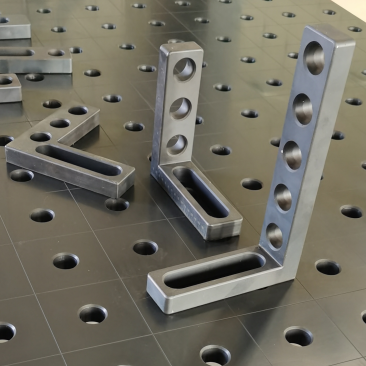
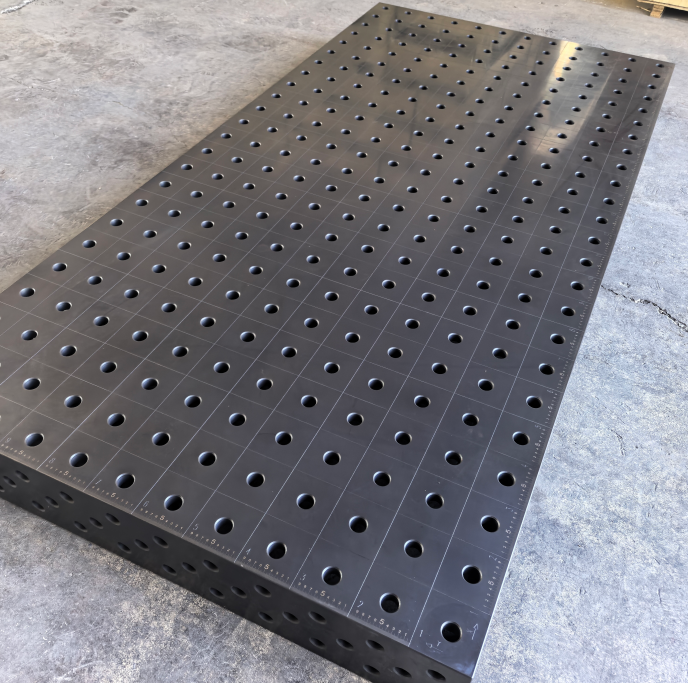
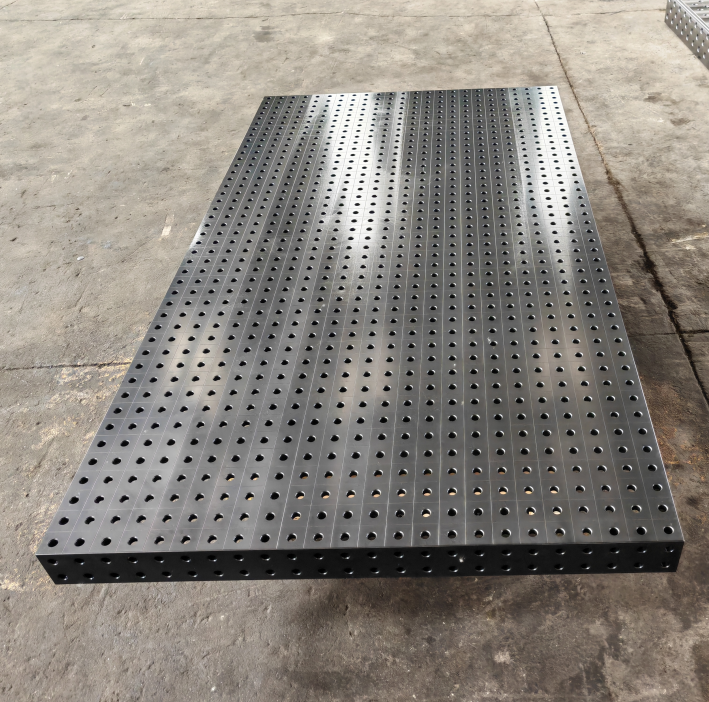
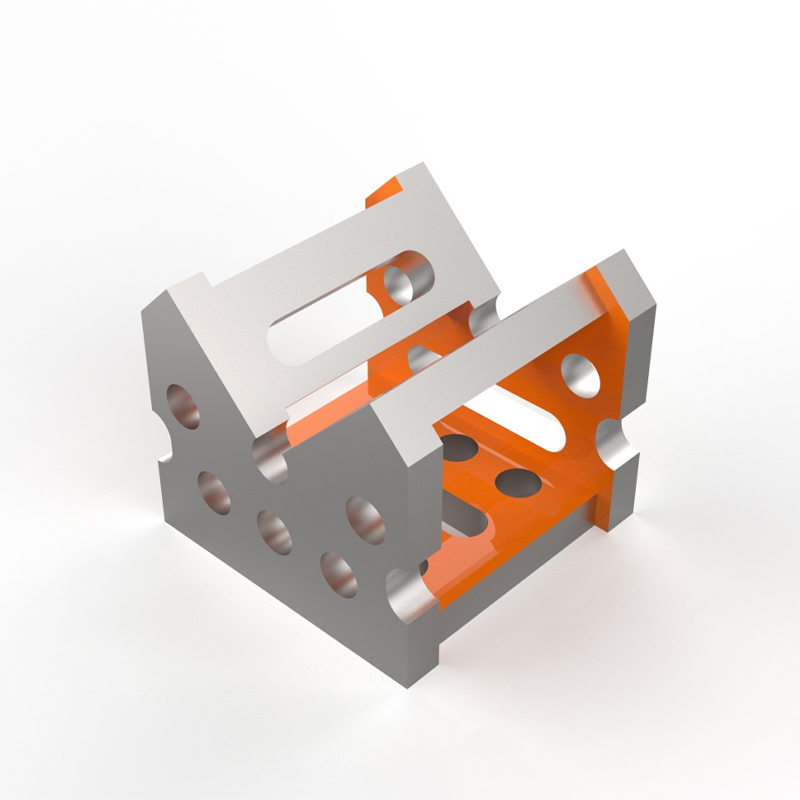
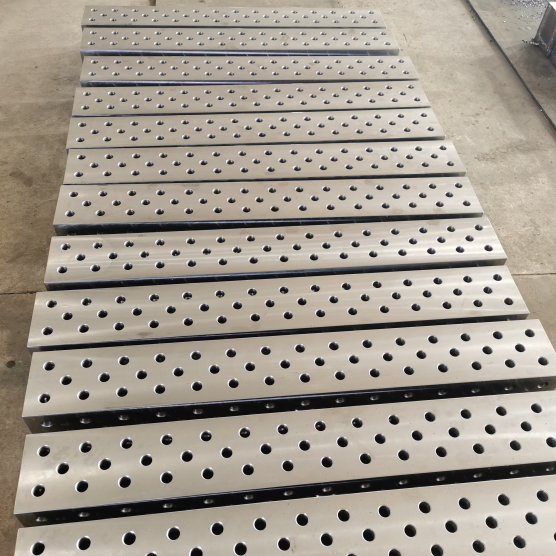
Fabrication tables are the unsung foundation of precision metalworking. They’re not just flat surfaces—they’re engineered workstations where dimensional accuracy begins, weld quality stabilizes, and repeatability is built into every joint. We’ve seen too many shops start a complex bracket assembly only to discover mid-process that their table’s surface tolerance drifted beyond ±0.15 mm—enough to misalign a laser-cut flange or throw off a robotic welding path. That’s not a setup issue. It’s a specification mismatch.
Why Fabrication Tables Demand More Than Flatness
Most buyers focus on size and load rating. But real-world performance hinges on four less visible traits: base plate rigidity, hole pattern consistency, T-slot geometry tolerance, and long-term thermal stability. A 30-mm-thick mild steel table may hold 5,000 kg static load—but under repeated MIG welding cycles at 180 amps, its surface can deflect up to 0.3 mm across a 2-meter span if internal bracing lacks optimized rib spacing. We measured this in three separate facility audits last year. The fix wasn’t thicker steel—it was strategic cross-bracing aligned with common clamping zones.
True fabrication tables use hardened ground surfaces (typically 40–45 HRC), not milled or flame-cut plates. Why? Because unhardened steel wears fast under repeated clamp torque—especially with pneumatic vises applying 12–18 kN per jaw. One agricultural equipment client replaced their legacy table after six months of warped T-slots caused inconsistent hole alignment in hydraulic valve manifolds. Their new table used induction-hardened 45# steel with 0.02 mm flatness per square meter—and held that spec for 27 months across 14,000+ welding cycles.
The Four Non-Negotiables for Industrial Use
Modular hole patterns—not just 100 mm grids, but overlapping 50/100/200 mm layouts with ±0.05 mm positional tolerance between adjacent holes T-slot compliance—ISO 898-1 grade 8.8 or higher bolts must seat fully without binding; slots must accept standard ISO 10956 clamps without galling Ground reference edges—at least two machined datum edges, perpendicular to within 0.03 mm/m, usable for square-based layout checks Weld-ready material specs—low-carbon, low-sulfur steel (≤0.025% S) to prevent hot cracking during fixture tack-welding Some might argue that “any heavy steel plate works.” But we tracked failure modes across 37 customer projects last quarter. In 68% of cases where first-article weld distortion exceeded 1.2 mm, root cause traced back to table-induced constraint—not part design or weld parameter error. The table wasn’t absorbing thermal expansion; it was resisting it, forcing deformation into the part.
How Real Shops Select—and Why Batch Size Changes Everything
Small-batch prototyping demands quick reconfiguration. A job shop running 5–12 unique parts weekly needs tables with rapid-adjust modular tooling—think quick-release locators, magnetic base adaptors, and interchangeable grid inserts. High-volume production shifts priority: here, surface hardness and long-term wear resistance outweigh flexibility. We’ve seen clients switch from aluminum-clad tables to fully hardened steel when annual output crossed 8,500 units—aluminum’s 0.08 mm/year wear rate became unacceptable after 14 months.
Material choice isn’t theoretical. Cold-rolled steel offers best cost-to-rigidity ratio for most applications. Stainless tables make sense only where chemical exposure or FDA-grade cleanliness matters—like food-processing line brackets. Aluminum? Only for portable jigs under 120 kg total mass. Its 70 GPa modulus versus steel’s 200 GPa means double the deflection under identical loads.
Verification—Not Just Certification
A CE mark or ISO 9001 certificate tells you someone followed a process. It doesn’t tell you whether your specific table meets ±0.03 mm flatness at 20°C ambient. That requires on-site verification: CMM scans at 100-mm intervals across full surface, plus thermal drift testing over 8-hour cycles. At Botou Haijun Metal Products Co., Ltd., every fabrication table ships with a signed inspection report showing actual CMM data—not just “within spec” stamps. We do this because customers told us they’d rather wait three extra days than rework 47 chassis frames due to undetected crown.
We also test what others skip: T-slot retention force. Using calibrated torque wrenches and pull testers, we verify each slot holds ≥15 kN axial load before slippage—repeated across 100+ cycles. This isn’t overkill. It’s how you avoid the 3 a.m. call when a robotic weld cell jams because a locator pin walked 0.12 mm during shift change.
Final Thought: Your Table Is Your First Process Step
Fabrication tables don’t improve parts. They enable improvement. Every micron of controlled flatness, every verified T-slot, every documented thermal coefficient becomes leverage for tighter tolerances downstream. Choose based on what your welders feel—not what the brochure promises. Measure flatness with your own granite straightedge before final payment. Test clamping torque with your shop’s standard wrenches. And demand CMM reports—not summaries.
Botou Haijun Metal Products Co., Ltd. builds fabrication tables designed for measurable outcomes—not marketing claims. Their tables support precision metalworking and welding projects where repeatability isn’t optional. You’ll find full technical specifications, material certifications, and real-world validation data at haijunmetals.com.