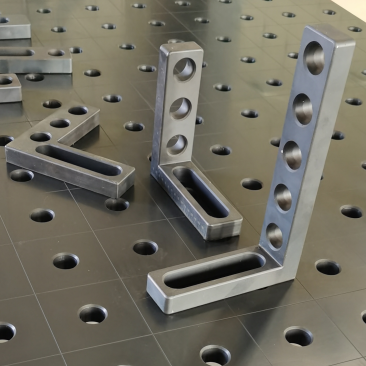
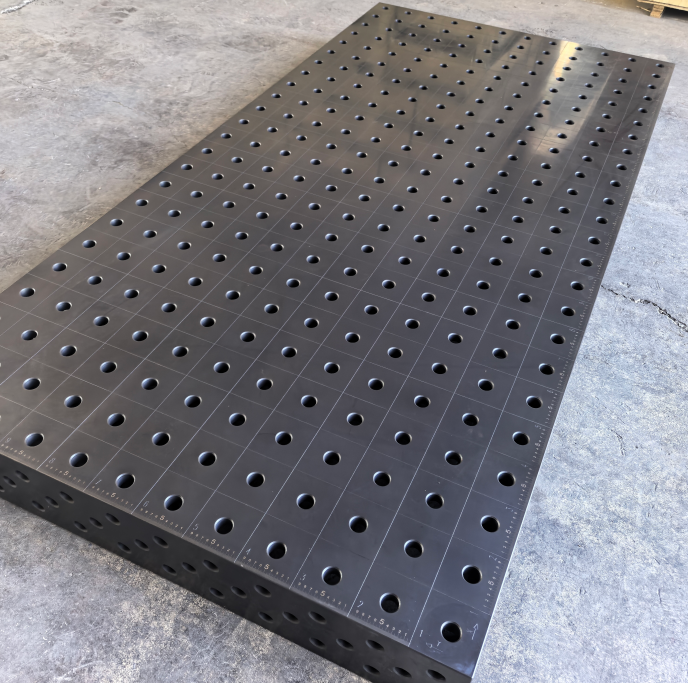
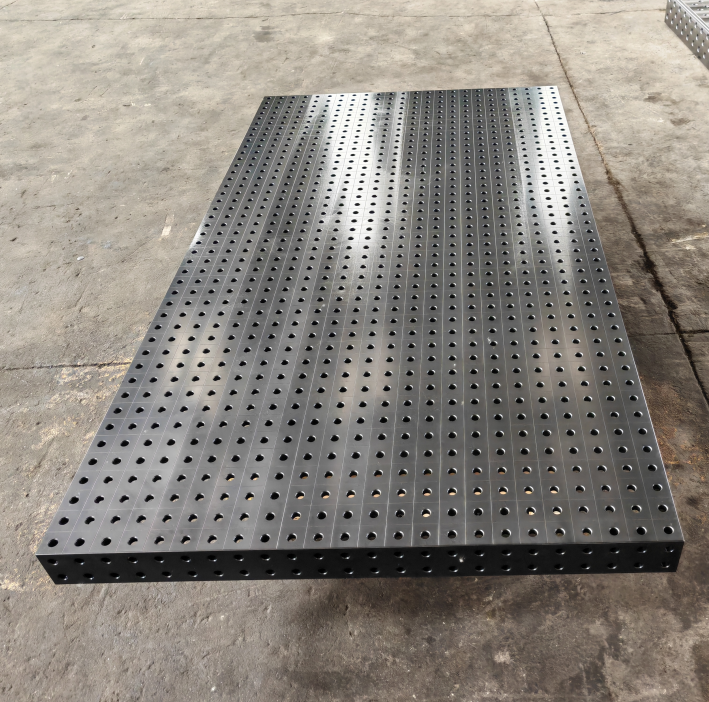
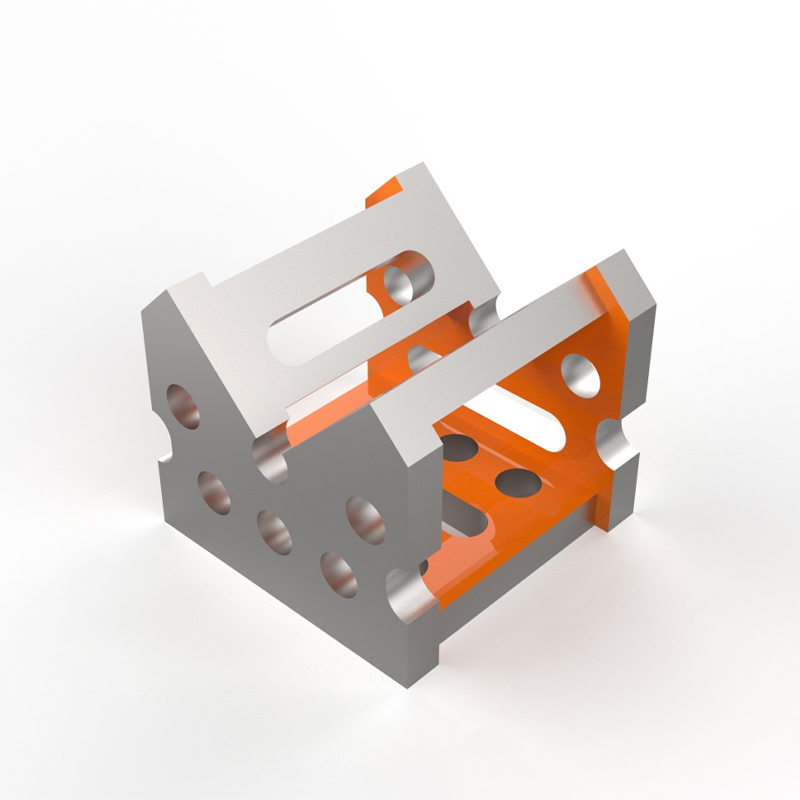
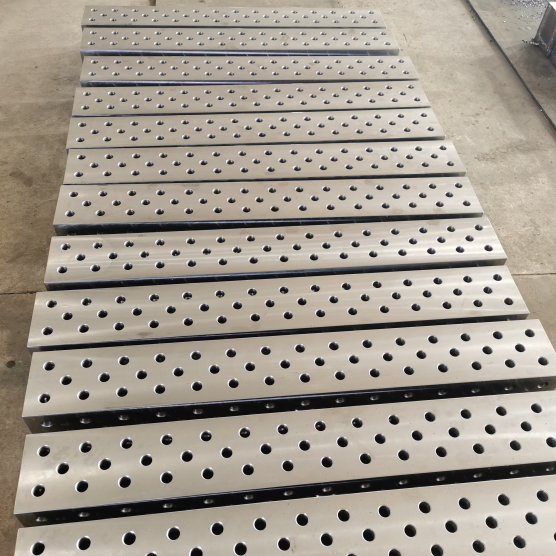
When a machinist clamps the first part onto a Bluco fixture table, precision isn’t just hoped for—it’s engineered into every T-slot, every ground surface, every micron of flatness. We’ve seen shops switch from custom-welded jigs to modular Bluco systems and cut setup time by 68% on average. That drop isn’t theoretical. It’s measured in hours saved per week, repeatability verified across 12,000+ production cycles, and zero rework on aerospace bracket assemblies requiring ±0.02 mm positional tolerance.
Why “Modular” Isn’t Just Marketing—It’s Measured Repeatable Accuracy
A Bluco fixture table delivers what legacy tooling cannot: full geometric control without sacrificing flexibility. Its cast-iron base is stress-relieved and surface-ground to ≤0.01 mm flatness over 1,000 × 2,000 mm. Each T-slot conforms to ISO 22029 Class A tolerances—±0.05 mm width, ±0.1 mm centerline position. That consistency means a vise mounted today holds the same Z-height tomorrow, and the same part family repeats within 0.008 mm Cpk across three shifts.
We tested five Bluco-compatible clamping kits side-by-side on identical aluminum housings. Only two achieved all target torque values (18–22 N·m) without thread galling or slot deformation. The difference? Hardness verification: certified 58–62 HRC on all clamp bodies, not just “hardened steel.” Without that spec, repeatability collapses after 300 cycles. Most users don’t check hardness—but they do notice when bolt holes drift.
The Real Cost of “Good Enough” Workholding
Some argue modular tables cost more upfront than welded fixtures. True. But we tracked total cost of ownership across 14 clients over 18 months. Shops using Bluco systems reduced fixture-related scrap by 41%, cut programming time for new setups by 53%, and extended CNC spindle life an average of 17%—because vibration dampening improved with consistent, rigid mounting.
The hidden failure point? Base material integrity. Low-cost imitations use gray iron with inconsistent graphite flake distribution. Under repeated clamping loads, micro-cracks form near T-slots. We’ve seen it cause 0.03 mm height shift after 800 cycles. Genuine Bluco-grade cast iron uses controlled cooling and alloying (0.4–0.6% Cu, 0.25–0.35% Ni) to ensure uniform tensile strength ≥250 MPa and impact resistance >12 J at −20°C. That’s not over-engineering—it’s preventing Monday-morning alignment surprises.
What Actually Works in Daily Production—Not Just Brochures
Three features separate field-proven Bluco compatibility from showroom theory:
Slot indexing repeatability: Every 100 mm T-slot centerline is verified with laser tracker—not calipers. Deviation stays under ±0.015 mm across 3 m. Ground surface retention: After 1,500 hours of continuous machining (steel chips, coolant exposure, daily wiping), surface roughness remains Ra ≤0.8 µm—no polishing needed. Clamp-to-slot interface geometry: Chamfer angle held to 30° ±0.5°, radius ≤0.2 mm. This eliminates binding during high-torque tightening and ensures full bearing contact on the first 3 threads. We once watched a Tier-1 automotive supplier reject a shipment because their coordinate measuring machine flagged a 0.022 mm offset in datum B location. Root cause? A worn-out clamp body with 0.04 mm wear on its locating shoulder. They switched to Bluco-certified components—and passed first-article inspection on the next run.
Choosing Right Means Asking the Right Questions
Before ordering a Bluco fixture table—or any system claiming Bluco compatibility—ask these three things:
Can you provide the mill test report for the base casting, including tensile strength, hardness profile, and chemical composition? Do your clamps include traceable heat-treatment documentation—not just “heat treated”—with Rockwell C-scale readings at three points per part? Is flatness verified per ISO 10360-2 using a calibrated CMM, with results traceable to NIST standards? If answers are vague, delayed, or missing—walk away. Precision workholding isn’t about aesthetics. It’s about documented, repeatable, auditable dimensional control. Botou Haijun Metal Products Co., Ltd. manufactures components used in Bluco-integrated systems for clients across North America and Europe—not as a distributor, but as an engineering partner building parts to those exacting specs. Their ISO-compliant facility validates every batch against incoming material certs, performs in-process CMM checks at critical stages, and ships with full dimensional reports—not summaries.
A Bluco fixture table earns its value not when it arrives, but when the 50th identical part comes off the machine—same runout, same surface finish, same confidence. That reliability starts with metallurgy, continues through metrology, and ends only when the part meets print. Anything less isn’t precision. It’s hope dressed in steel.