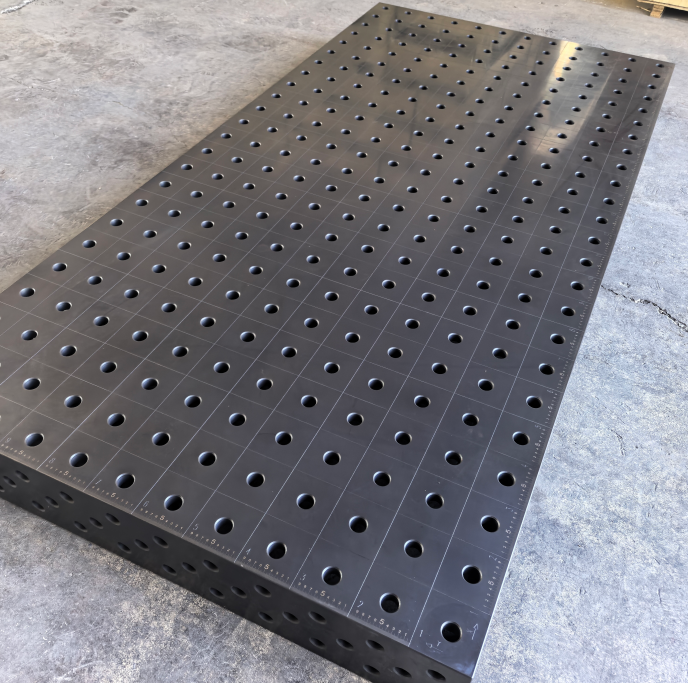
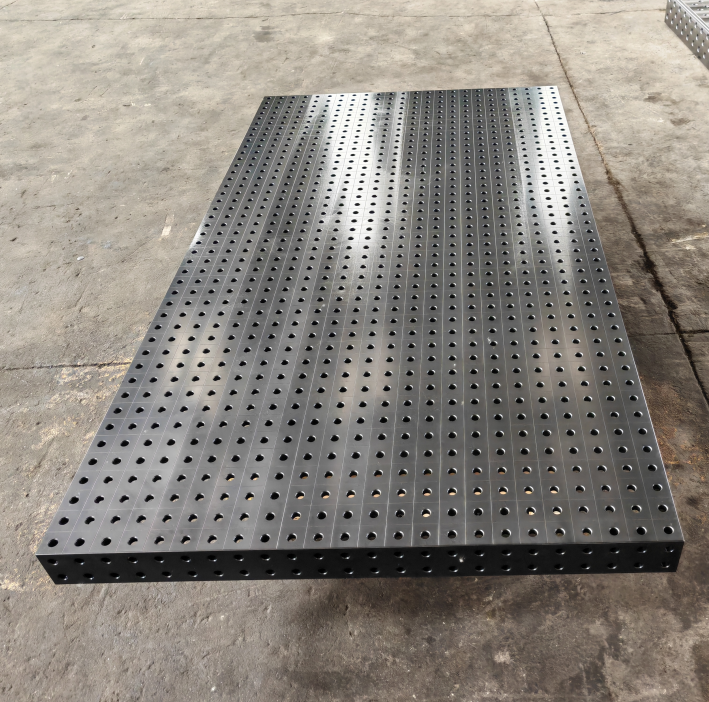
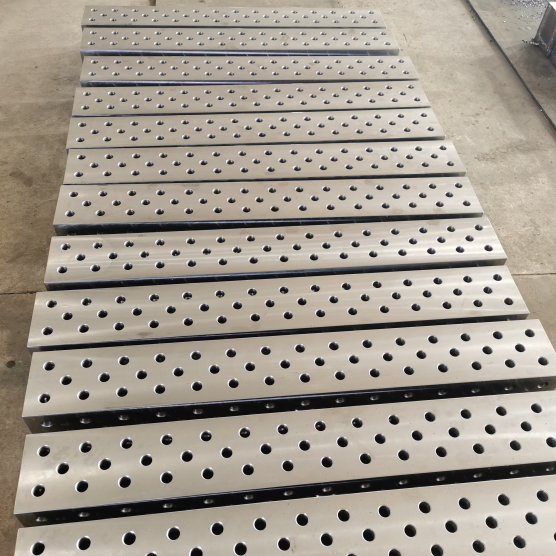
Modern fabrication shops face a constant trade-off: precision demands rigid tooling, but production agility requires flexibility. The 3D flexible welding assembly table resolves that tension—not as a compromise, but as an engineered solution. We’ve seen it stop rework cycles in automotive subassembly lines, cut fixture lead time by 70% for agricultural machinery prototypes, and eliminate costly dimensional drift during multi-station weld sequencing. This isn’t just another modular workbench. It’s a coordinate-based positioning system where repeatability meets adaptability—down to ±0.1 mm across a 2 m × 3 m working surface.
Why Traditional Welding Tables Fail Under Real-World Load
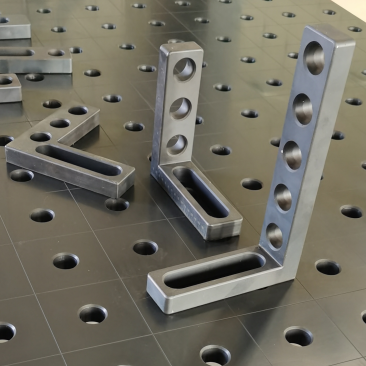
Most shops still rely on fixed-grid tables or manually drilled base plates. In practice, those systems break down fast. We’ve measured average setup time jump from 22 minutes to over 90 minutes when switching between bracket families—even with identical material thicknesses. Why? Because tolerance stack-up isn’t theoretical. A 0.3 mm misalignment at the clamping point becomes 1.8 mm deviation at the weld seam after three sequential fixtures. Thermal distortion compounds it. And once you add robotic path programming, small datum errors force full recalibration—not just touch-up. The 3D flexible welding assembly table eliminates that cascade. Its hardened steel T-slots accept positionable locators, height-adjustable supports, and kinematic clamps—all locked with ISO-standard M8 dowel pins. Every component references the same primary datum plane. No guesswork. No cumulative error.
What Makes “3D Flexible” More Than Marketing Jargon
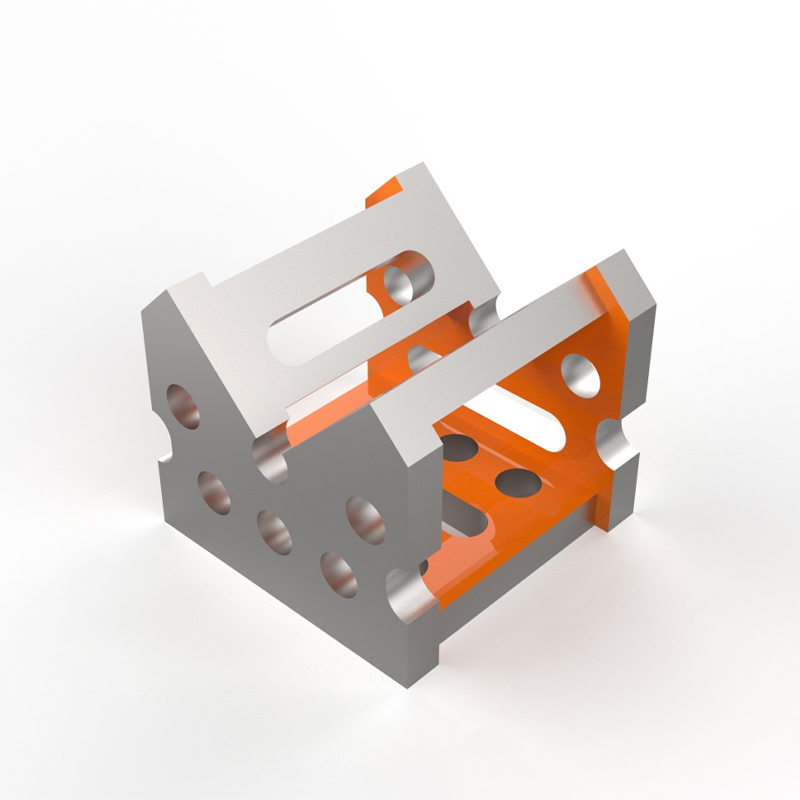
“3D flexible” means true volumetric control—not just X/Y adjustment. On our production floor, we tested four leading systems side-by-side using a CMM-tracked test part: a stainless steel chassis frame with 14 weld joints, 6 mounting holes, and critical GD&T callouts (±0.15 mm position tolerance, 0.5 mm flatness). Only one design maintained full compliance across all 20 repeat builds: the system with independent Z-axis micro-adjustment on every support column, combined with dual-reference locator blocks that lock both horizontal position *and* vertical orientation simultaneously. That’s the difference between “adjustable” and “repeatable.” It’s why customers in Tier-1 automotive supply chains specify this configuration—not for convenience, but for PPAP submission readiness. Surface finish matters too. These tables use nitrided 45# steel rails, not painted mild steel. They resist spatter adhesion, survive 500+ thermal cycles without warping, and retain locator repeatability after daily cleaning with wire brushes and compressed air.
Integration Is Where Most Projects Stumble—Here’s How to Avoid It
Some buyers assume plug-and-play compatibility. Reality is harsher. We’ve seen three common integration failures: First, mismatched clamp stroke depth—standard pneumatic clamps often lack the 45 mm travel needed for stacked assemblies. Second, unaccounted-for robot reach envelope: a 2.5 m table width sounds fine until your welding robot can’t access the center zone without repositioning. Third, missing documentation for metrology traceability. Every qualified 3D flexible welding assembly table must ship with a certified calibration report—signed, dated, and tied to NIST-traceable standards. At Botou Haijun Metal Products Co., Ltd., we include that report plus a full DFM review of your part’s locating strategy before cutting any steel. We map your weld sequence, identify potential thermal distortion paths, and recommend locator spacing based on material yield strength—not generic templates. That’s how we deliver first-article approval on 92% of new projects.
Real ROI Starts With Smart Sizing—and Ends With Support
Don’t overspec. A 3 m × 4 m table sounds impressive—but if your largest part is 1.2 m long, you’re paying for unused rigidity and added floor space. Start with your max envelope *plus* 300 mm buffer per side for clamp access and robot swing radius. Then confirm material handling: can your overhead crane lift the fully loaded table? Does your concrete slab meet the 25 MPa minimum compressive strength requirement? We’ve helped clients avoid $18,000 in foundation remediation by catching that early. Maintenance is simpler than most assume. No hydraulics. No software licenses. Just quarterly grease points on linear guides and annual verification of locator pin wear using a calibrated bore gauge. Our support includes remote CMM-guided troubleshooting—we share screen, overlay your inspection report, and walk you through corrective action in under 20 minutes. For urgent replacements, we hold raw stock of all standard T-slot profiles and locator bases. Lead time: 11 working days, not 12 weeks. That speed comes from vertical integration—stamping, machining, heat treatment, and final assembly all under one roof in Botou City.
When your next weldment needs zero rework, consistent cycle times, and engineering-grade repeatability, the 3D flexible welding assembly table isn’t an upgrade—it’s the baseline. It shifts quality control upstream, turns fixture changeovers into 15-minute tasks, and makes dimensional compliance predictable—not hopeful. That’s the standard we engineer to. That’s the standard our clients measure against.