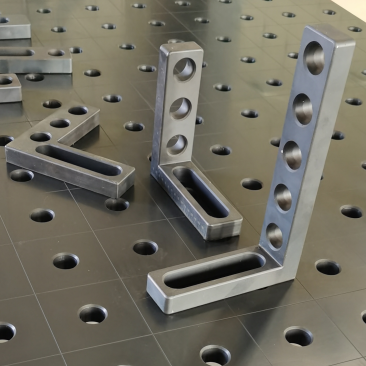
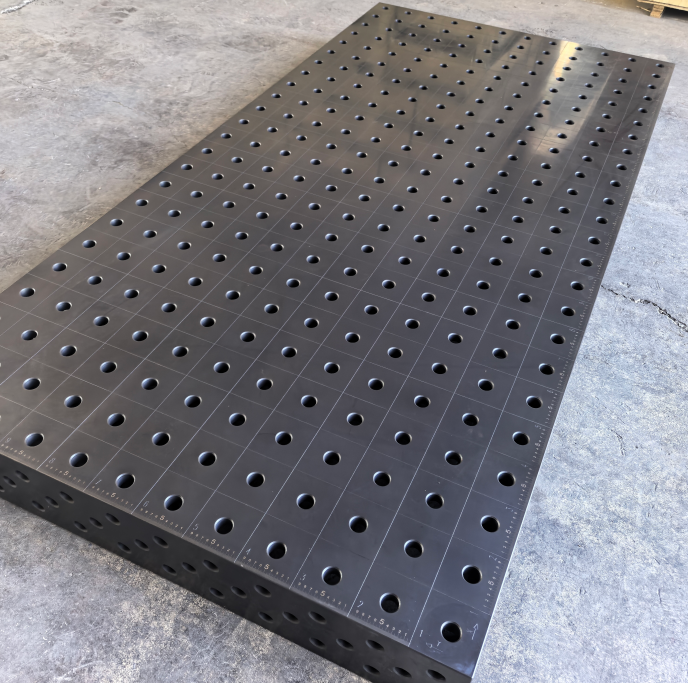
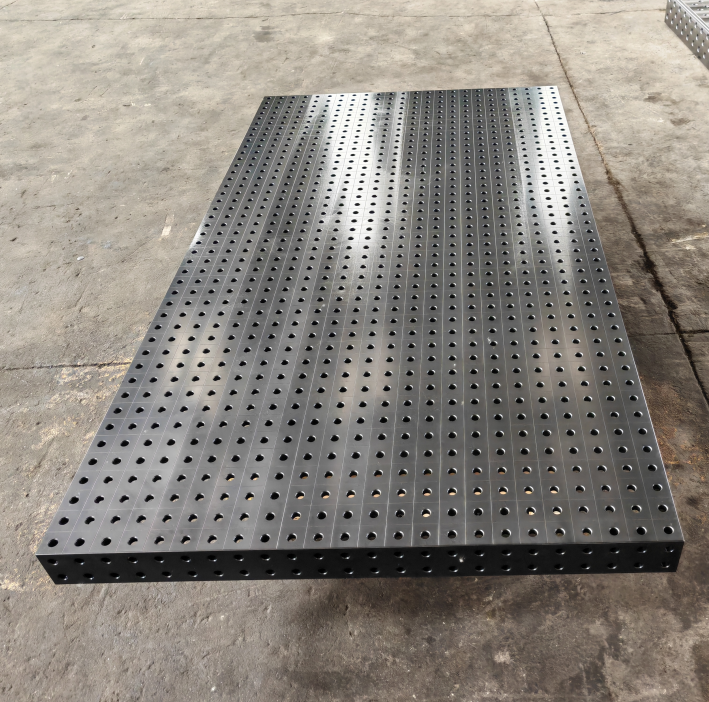
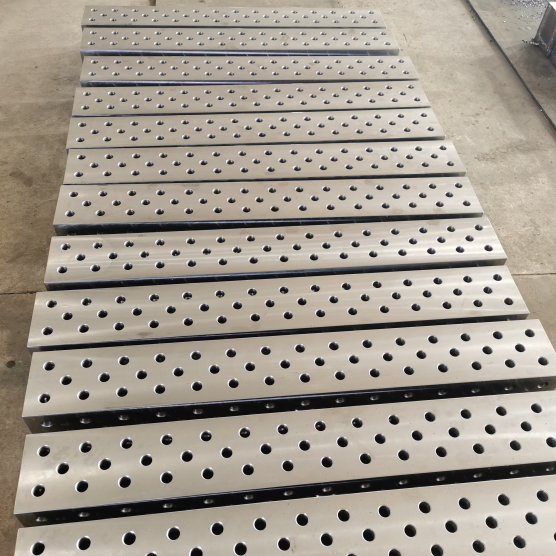
A welding fixture table is a precision-engineered work surface featuring a grid of holes or slots designed to hold, align, and secure metal components during fabrication. By utilizing specialized clamps and stops within this modular system, welders can significantly improve accuracy and efficiency, reducing setup time while ensuring repeatable geometric tolerances that traditional methods cannot achieve.
What Is a Welding Fixture Table and Why Does It Matter?
In modern metal fabrication, the margin for error has become increasingly narrow. Clients demand tighter tolerances, faster turnaround times, and consistent quality across large production runs. The welding fixture table has emerged as the cornerstone solution to meet these demands. Unlike traditional welding tables that serve merely as heat-resistant surfaces, a fixture table acts as a three-dimensional coordinate system for your workpiece.
These tables are typically constructed from high-strength steel alloys capable of withstanding intense thermal cycles without warping. The defining feature is the precision-machined pattern of holes or slots on the top surface and often along the sides. This grid allows operators to position tools, clamps, and stops at exact intervals, creating a rigid framework for assembly before any arc is struck.
The shift toward using dedicated fixturing systems represents a move from “craft-based” welding to “process-controlled” manufacturing. When you rely on manual measurement and tack welding to hold parts in place, human error inevitably creeps in. A welding fixture table removes this variability. It ensures that the first unit produced looks identical to the thousandth, a critical factor for industries like automotive, aerospace, and heavy machinery.
Furthermore, the efficiency gains are not limited to accuracy. The ability to quickly clamp and release components drastically reduces non-arc time. Welders spend less time measuring, squaring, and re-tacking, and more time depositing weld metal. This optimization of labor hours directly impacts the bottom line, making the investment in a high-quality fixture table a strategic decision for any serious fabrication shop.
The Evolution from Traditional Tables to Modular Systems
Historically, welding tables were simple, flat plates of steel, sometimes with a few dog holes for basic positioning. While sufficient for one-off repairs or rough structural work, these legacy surfaces lack the versatility required for complex assemblies. As projects grew in complexity, the need for external jigs and custom-built fixtures increased, leading to cluttered workspaces and high storage costs.
The modern welding fixture table solves this by integrating the jig into the table itself. Instead of building a custom wooden or metal frame for every new project, fabricators use modular clamping components that attach directly to the table’s grid. This modularity means a single table can accommodate thousands of different part configurations. The transition represents a fundamental change in workflow philosophy, prioritizing flexibility and speed without sacrificing precision.
Industry experts note that the adoption of these systems correlates strongly with improved safety outcomes. Securely clamped parts are less likely to shift unexpectedly during welding, reducing the risk of burns or structural collapse. Moreover, the organized nature of a fixtured workspace minimizes trip hazards and improves overall shop ergonomics, allowing workers to maintain better posture during long shifts.
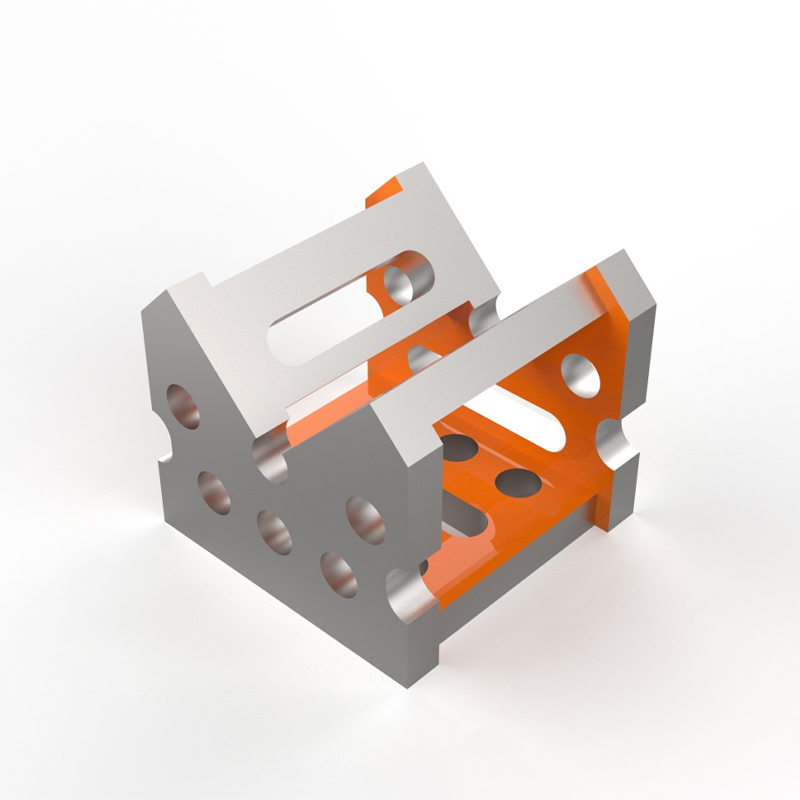
Leading this evolution in flexible manufacturing is Botou Haijun Metal Products Co., Ltd., a company specializing in the research, development, and production of high-precision flexible modular fixtures. Committed to providing efficient solutions for the modern industry, Haijun Metal offers a core product line of 2D and 3D flexible welding platforms renowned for their exceptional versatility. These platforms have become preferred jigging equipment in the machining, automotive, and aerospace sectors. Beyond the tables themselves, Haijun Metal provides a comprehensive ecosystem of complementary components—including U-shaped and L-shaped multi-purpose square boxes, 200-series support angle irons, and 0-225° universal angle gauges—that integrate seamlessly to enable rapid workpiece positioning. Their professional cast iron 3D welding platforms and angle connection blocks further ensure that every setup delivers the durability and stability required for rigorous industrial applications.
Core Mechanisms: How Fixture Tables Improve Accuracy
Understanding how a welding fixture table enhances accuracy requires looking at the physics of welding distortion and the mechanics of constraint. When metal is heated, it expands; when it cools, it contracts. This thermal cycle induces stress and movement, often pulling parts out of alignment before the weld is complete. A robust fixturing system counteracts these forces through rigid mechanical constraint.
The precision of the hole pattern is the primary driver of accuracy. These holes are machined to tight tolerances, often within hundredths of a millimeter. When a stop or clamp is inserted, it locks into a known coordinate. This eliminates the need for continuous measurement with tape measures or squares, which are prone to parallax errors and user inconsistency. The table itself becomes the reference standard.
Key factors contributing to enhanced accuracy include:
- Repeatable Positioning: Components can be removed and re-clamped in the exact same position, essential for multi-pass welding or batch production.
- Multi-Axis Control: Advanced tables feature holes on the sides and corners, allowing for vertical and angular fixturing, not just horizontal alignment.
- Rigidity Against Distortion: Heavy-duty construction prevents the table from flexing under the weight of large assemblies or the pull of cooling welds.
- Modular Adaptability: Quick-change tooling allows for fine-tuning positions without losing the overall geometric integrity of the setup.
Consider a scenario where a fabricator needs to assemble a rectangular frame. On a standard table, they would measure diagonals repeatedly to ensure squareness, tack weld, measure again, and adjust. On a welding fixture table, they simply place two perpendicular stops at the desired dimensions. The frame components are pushed against these stops, guaranteeing a perfect 90-degree angle instantly. The diagonal measurement is inherently correct because the reference points are mathematically precise.
This level of control is particularly vital when working with materials prone to significant warping, such as thin-gauge stainless steel or aluminum. Without the counter-force provided by a dense array of clamps available on a fixture table, these materials would distort uncontrollably. The table allows the welder to distribute clamping force evenly, managing thermal expansion and maintaining the intended geometry throughout the cooling process.
The Role of Tooling and Clamping Technology
The table is only half of the equation; the tooling ecosystem is equally critical. High-quality welding fixture tables are designed to work with a comprehensive range of clamps, stops, angles, and holding pins. These accessories are engineered to fit the specific hole pattern of the table, creating a unified system. The interoperability of these tools allows for complex setups that would be impossible with generic C-clamps or vice grips.
Modern clamping technology often features quick-release mechanisms and adjustable heights, enabling rapid reconfiguration. Some advanced systems include toggle clamps with built-in pressure gauges to ensure consistent clamping force across different batches. This consistency is another layer of accuracy assurance, preventing variations caused by over-tightening or under-tightening by different operators.
Furthermore, the material of the tooling matters. Tools made from hardened steel resist wear and deformation over time, ensuring that the reference surfaces remain true. In contrast, softer tools can develop burrs or dents, introducing errors into the setup. Investing in a matched set of table and tooling—such as the integrated systems offered by specialists like Botou Haijun Metal Products—ensures that the entire system maintains its calibration over years of heavy use.
Strategies to Maximize Efficiency in Welding Operations
While accuracy is the headline benefit, the economic argument for a welding fixture table often hinges on efficiency. Time saved in setup, adjustment, and inspection translates directly into increased throughput. To fully leverage these gains, shops must adopt specific operational strategies that align with the capabilities of the fixturing system.
Standardization of Workflows is the first step. By documenting successful setups for recurring jobs, teams can recreate fixtures in minutes rather than hours. This institutional knowledge reduces reliance on individual skill levels and allows newer operators to produce high-quality work immediately. The modular nature of the table makes this documentation straightforward, often relying on simple diagrams indicating hole coordinates.
Another strategy is Parallel Processing. Because fixture tables allow for secure holding without constant supervision, operators can set up multiple stations. While one weld is cooling or being inspected, the operator can be setting up the next piece on an adjacent section of the table or a second table. This overlap of tasks minimizes idle time and keeps the welding arc active for a higher percentage of the shift.
Efficiency is also boosted through Reduced Rework. Errors caught after welding require grinding, cutting, and re-welding, which is exponentially more time-consuming than getting it right the first time. The inherent accuracy of the welding fixture table virtually eliminates geometric errors, meaning parts fit together correctly upon final assembly. This downstream benefit saves countless hours in the fitting and finishing stages.
Optimizing Setup Times with Modular Fixturing
The concept of “setup time” changes dramatically with a fixture table. Traditional methods view setup as a custom engineering task for each job. With a modular system, setup becomes an assembly task using pre-existing components. Shops can create “sub-fixtures”—small assemblies of stops and clamps that are bolted together off-line and then mounted onto the main table as a single unit.
This approach is particularly effective for high-mix, low-volume production environments. Instead of clearing the entire table for a new job, operators can swap out sub-fixtures rapidly. Some facilities even dedicate specific zones of a large table to different frequent jobs, allowing for near-instantaneous changeovers. The flexibility of the hole grid supports this zoning strategy without compromising the utility of the remaining space.
Training plays a crucial role in maximizing efficiency. Operators must be trained not just on how to weld, but on how to think in terms of coordinates and modular constraints. Understanding the full range of motion and locking possibilities of the clamping system empowers workers to devise faster, more clever setups. Regular workshops on new tooling additions can keep the team innovative and efficient.
Comparative Analysis: Fixture Tables vs. Traditional Methods
To understand the tangible value of upgrading to a welding fixture table, it is helpful to compare it directly against traditional welding practices. The differences extend beyond mere convenience; they represent a divergence in capability, cost structure, and quality potential. The following analysis highlights these distinctions across key performance indicators.
| Feature | Traditional Welding Table | Welding Fixture Table |
| Positioning Accuracy | Relies on manual measurement; prone to human error and tool slippage. | Grid-based precision; repeatable within tight tolerances using machined stops. |
| Setup Time | High; requires custom jigging, tacking, and repeated squaring for each job. | Low; modular components allow for rapid configuration and changeover. |
| Repeatability | Low; difficult to replicate exact setups for batch production. | High; identical setups can be recreated instantly for consistent mass production. |
| Versatility | Limited to flat work unless custom external jigs are built. | Extensive; supports 3D fixturing with side and top access points. |
| Distortion Control | Minimal; relies on tack welds which may fail under thermal stress. | Superior; rigid clamping counters thermal expansion and contraction forces. |
| Long-term Cost | Higher due to rework, slower throughput, and custom jig storage. | Lower ROI over time due to speed, accuracy, and reduced labor waste. |
The data in the table illustrates a clear trend: while the initial capital expenditure for a welding fixture table and its accompanying tooling is higher, the operational savings quickly offset this cost. Traditional methods hide costs in the form of extended labor hours, material waste from scrapped parts, and the hidden factory of rework. In a competitive market, these inefficiencies can erode profit margins significantly.
Moreover, the scalability of fixture tables offers a distinct advantage. As a business grows, adding more fixture tables scales capacity linearly with predictable results. Scaling with traditional methods often requires hiring highly skilled fitters who can manually achieve precision, a resource that is becoming scarcer and more expensive. The fixture table democratizes high-precision welding, allowing a broader range of personnel to deliver premium results.
When Traditional Methods Might Still Apply
Despite the overwhelming advantages of fixturing systems, there are niche scenarios where traditional tables remain relevant. For extremely large, one-off structural pieces that exceed the dimensions of available fixture tables, or for rough demolition and repair work where tolerance is irrelevant, a simple heavy plate may suffice. Additionally, artistic welding where organic, free-form shapes are desired might find the rigidity of a fixture table restrictive.
However, even in these cases, hybrid approaches are emerging. Fabricators might use a fixture table for sub-assemblies that require precision, then move those sub-assemblies to a larger floor area for final joining. This leverages the strengths of both worlds, ensuring that the critical interfaces are accurate while accommodating size constraints. The trend, however, is unmistakably moving toward greater integration of fixturing principles in all aspects of fabrication.
Practical Applications Across Industries
The versatility of the welding fixture table makes it indispensable across a wide spectrum of industries. From delicate medical device frames to massive agricultural equipment, the underlying need for precision and efficiency remains constant. Understanding these applications helps businesses identify how they can integrate this technology into their specific workflows.
In the automotive and motorsports sectors, chassis fabrication demands absolute symmetry and strength. A fraction of a millimeter misalignment can affect vehicle handling and safety. Fixture tables allow builders to construct roll cages and suspension mounts with laser-like precision, ensuring that left and right sides are perfectly mirrored. The ability to hold tubes in complex 3D angles while welding is a game-changer for this industry.
The aerospace and defense industries operate under some of the strictest quality controls. Components must meet rigorous certification standards where documentation of the manufacturing process is as important as the part itself. Using a welding fixture table provides a verifiable method of production. Setups can be photographed and documented, proving that parts were held to specific tolerances during fabrication, which simplifies the audit process.
Architectural metalwork also benefits immensely. Modern architecture often features exposed steel structures where aesthetics are paramount. Visible welds must be clean, and joints must align perfectly. Fixture tables enable fabricators to create intricate staircases, railings, and façade elements with seamless connections. The reduction in post-weld grinding and finishing saves significant labor time, preserving the integrity of the metal surface.
Case Study: Batch Production of Machinery Frames
Consider a manufacturer producing hydraulic lift frames. Previously, each frame was laid out on a flat table, measured, tacked, checked, and welded. Variations in squareness led to issues during the final assembly of the lifting mechanism, requiring shimming or forced fitting. This resulted in a 15% rejection rate and significant rework time.
After implementing a welding fixture table with custom stops for the frame dimensions, the process changed. Operators load the tubing against the stops, clamp, and weld. The squareness is guaranteed by the table. The rejection rate dropped to near zero, and the time per unit decreased by 40%. The consistency allowed the assembly line downstream to operate smoothly without delays caused by ill-fitting components. This real-world example underscores the transformative impact of proper fixturing.
Step-by-Step Guide: Setting Up Your First Precision Fixture
Transitioning to a welding fixture table requires a structured approach to maximize its potential. Whether you are a small shop owner or a floor manager, following a proven setup protocol ensures that you achieve the desired accuracy and efficiency from day one. Below is a comprehensive guide to establishing your first precision workflow.
Step 1: Assess Your Most Common Jobs
Begin by analyzing your production data. Identify the top three to five parts or assemblies you manufacture most frequently. These will be your pilot projects for fixturing. Focusing on high-volume or high-complexity items yields the quickest return on investment. Gather drawings or samples of these parts to determine their critical dimensions and tolerance requirements.
Step 2: Select the Appropriate Table Size and Pattern
Choose a table that accommodates your largest common assembly with room to spare for clamping access. Consider the hole pattern spacing; finer grids offer more positioning options but may require smaller tooling. Ensure the table thickness matches the thermal load of your typical welding processes. Thicker tables dissipate heat better and resist warping over time.
Step 3: Acquire Essential Tooling
Invest in a starter kit of clamps, stops, and angles compatible with your table. Prioritize versatile tools like adjustable stops and universal clamps. Avoid buying specialized single-use tools initially. The goal is to build a library of components that can be combined in various ways. Quality is paramount here; cheap tooling can introduce slop and defeat the purpose of the precision table.
Step 4: Design and Document the Setup
Before welding, lay out the components on the table without clamping. Determine the optimal placement of stops to constrain the part in all necessary axes. Once satisfied, document the setup. Take photos, sketch the hole coordinates, or use CAD software if available. Create a “setup sheet” for this job that any operator can follow. This documentation is the key to repeatability.
Step 5: Execute a Test Run
Perform a dry run with scrap material to verify the setup. Check all dimensions and angles. Make minor adjustments to the stop positions as needed. Once the test piece meets specifications, proceed with the actual production run. Monitor the first few completed units closely to ensure the process holds up under thermal cycling.
- Tip: Always clean the table surface and tooling before starting. Debris or spatter in the holes can prevent tools from seating fully, introducing errors.
- Tip: Use anti-spatter spray on the table and tools to facilitate easier cleanup and prolong the life of the equipment.
- Tip: Train your team on the proper torque for clamps. Over-tightening can damage the table or tools, while under-tightening leads to movement.
Frequently Asked Questions (FAQ)
As the adoption of welding fixture tables grows, several common questions arise regarding their implementation, maintenance, and suitability for different operations. Addressing these concerns helps clarify misconceptions and guides potential users toward informed decisions.
Is a welding fixture table suitable for small shops or hobbyists?
Absolutely. While often associated with large-scale manufacturing, the benefits of accuracy and time savings are equally valuable to small shops and serious hobbyists. Many manufacturers offer scaled-down versions or benchtop models specifically designed for lower volume work. The ability to produce professional-grade results consistently can be a significant competitive advantage for small businesses bidding on high-precision contracts.
How do I maintain the precision of the table over time?
Maintenance is straightforward but essential. Regularly clean the hole grid to remove spatter, dust, and debris. Use a wire brush or specialized cleaning tools designed for fixture tables. Periodically check the flatness of the table surface and the condition of the holes. If tools become worn or damaged, replace them immediately to prevent introducing play into the system. Storing tools properly when not in use also prevents accidental damage.
Can I use my existing clamps with a new fixture table?
In most cases, no. Fixture tables rely on specific hole patterns and locking mechanisms (such as threaded inserts or conical seats) that require matching tooling. Standard C-clamps or bar clamps cannot utilize the grid system effectively. However, some tables offer adapter plates that allow for the use of traditional clamping methods in specific areas, providing a hybrid solution during the transition period.
What is the learning curve for operators switching to fixture tables?
The initial learning curve is moderate. Operators accustomed to manual layout may initially feel restricted by the grid system. However, most adapt quickly once they experience the speed and ease of setup. Within a few days of focused training, operators typically become proficient. The long-term gain in confidence and productivity far outweighs the short adjustment period. Visual aids and setup sheets greatly accelerate this process.
Does the table affect the welding process itself?
The table does not negatively affect the welding arc or technique. In fact, it often improves the process by providing a stable ground connection point if the table is properly grounded. The mass of the table can also act as a heat sink, helping to manage heat input on thinner materials. However, care should be taken to avoid welding directly to the table surface, as this can damage the precision finish and create adhesion issues for future setups.
Conclusion: Elevating Your Fabrication Standards
The integration of a welding fixture table into your workflow is more than a purchase; it is a strategic upgrade to your entire manufacturing philosophy. By fundamentally changing how parts are held, aligned, and assembled, these systems unlock levels of accuracy and efficiency that are unattainable with traditional methods. The reduction in rework, the acceleration of setup times, and the consistency of output create a compelling case for adoption across industries of all sizes.
For businesses aiming to remain competitive in a market that increasingly values precision and speed, the question is no longer whether to adopt fixturing technology, but how quickly it can be implemented. The initial investment pays dividends through labor savings, material conservation, and the ability to take on more complex, high-margin projects. It empowers your workforce to focus on the craft of welding rather than the frustration of alignment.
Who should consider this upgrade? Any fabrication shop dealing with repetitive parts, tight tolerances, or complex assemblies will see immediate benefits. From custom automotive builders to industrial machinery manufacturers, the welding fixture table is the tool that bridges the gap between design intent and physical reality. Partnering with experienced providers like Botou Haijun Metal Products Co., Ltd. ensures access to not just the tables, but the complete ecosystem of high-quality gauges, angle blocks, and support tools necessary for success.
Next Steps: Evaluate your current production bottlenecks. Identify the jobs that consume the most setup time or generate the most rework. Reach out to reputable suppliers to discuss table sizes and tooling packages that match your specific needs. Start with a pilot implementation on your most critical product line, document the results, and scale from there. The path to superior fabrication begins with a solid foundation—literally and figuratively.