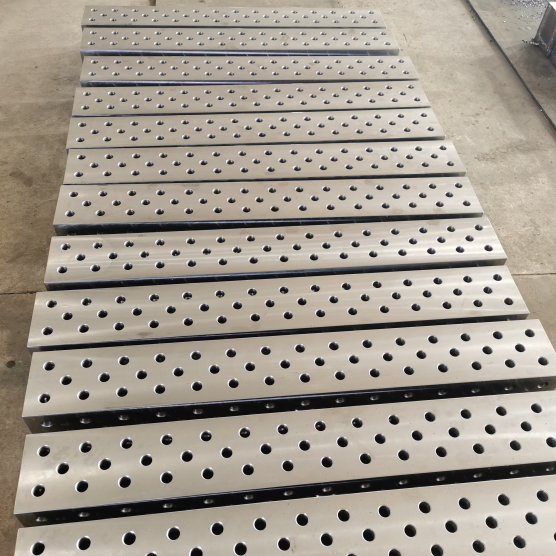
A foldable welding table is a portable work surface designed for fabrication, featuring collapsible legs and often a perforated top for versatile clamping. Unlike stationary benches, these units prioritize mobility and space efficiency without sacrificing rigidity. In 2026, top designs integrate high-tensile steel frames, precision-ground surfaces, and quick-release locking mechanisms. They are essential for mobile welders, limited-space workshops, and on-site repair teams requiring immediate, stable platforms for TIG, MIG, and stick welding operations.
Why the Foldable Welding Table Dominates 2026 Fabrication Workflows
The shift toward modular and mobile fabrication has redefined workshop requirements. Traditional fixed tables consume valuable floor space and limit operational flexibility. A portable welding table solves these constraints by offering a rigid workspace that can be stored vertically or transported to job sites. In 2026, the demand for these units has surged among contract fabricators and industrial maintenance crews who require rapid deployment capabilities.
Modern engineering focuses on balancing weight reduction with structural integrity. Advanced alloys and optimized truss designs allow these tables to support heavy assemblies while remaining light enough for single-person transport. The integration of standardized fixturing holes ensures that portability does not compromise the ability to perform complex, multi-axis welding tasks. This evolution makes the foldable variant a critical asset for dynamic manufacturing environments.
Key Drivers for Adoption in Industrial Settings
Several factors drive the preference for collapsible workstations over traditional benches:
- Space Optimization: Facilities with limited square footage can store the table against a wall when not in use, freeing up floor space for other operations.
- On-Site Mobility: Construction and repair teams can transport the unit directly to the asset location, eliminating the need to move heavy components to a central shop.
- Versatile Fixturing: Perforated tops allow for infinite positioning of clamps and stops, adapting to various project geometries instantly.
- Rapid Deployment: Quick-fold leg mechanisms enable setup times of under two minutes, crucial for time-sensitive repairs.
Core Engineering Features of 2026 Portable Designs
The architecture of a high-performance folding welding bench relies on specific mechanical features that ensure safety and precision. In 2026, manufacturers have refined these elements to meet stricter industrial standards. The focus is no longer just on “folding” but on maintaining absolute flatness and stability during the welding process.
Structural Rigidity and Frame Geometry
The frame serves as the backbone of the table. High-end models utilize rectangular tubing with reinforced gussets at stress points. The folding mechanism typically employs a scissor-leg design or a hinged drop-leaf system. Critical to performance is the locking pin or latch system. These must engage positively to prevent any lateral movement or collapse under load. In professional-grade units, the legs lock into a fully extended position with zero play, ensuring the table behaves like a stationary mass during vibration-intensive grinding or welding.
Surface Material and Flatness Tolerance
The tabletop material dictates the longevity and accuracy of the work. Most premium tables feature low-carbon steel plates, often pickled and oiled to resist initial corrosion. The surface flatness is machined to tight tolerances, frequently within ±0.5mm across the entire span. This precision is vital for squareness checks and assembly alignment. Some 2026 models incorporate hardened tool steel inserts in high-wear zones to extend the service life of the working surface.
The Fixturing Grid System
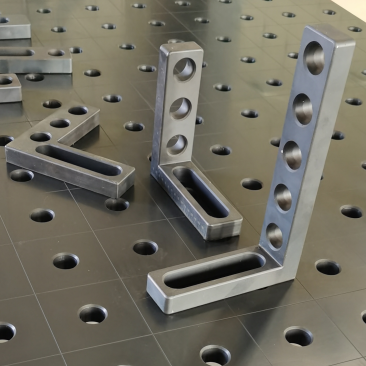
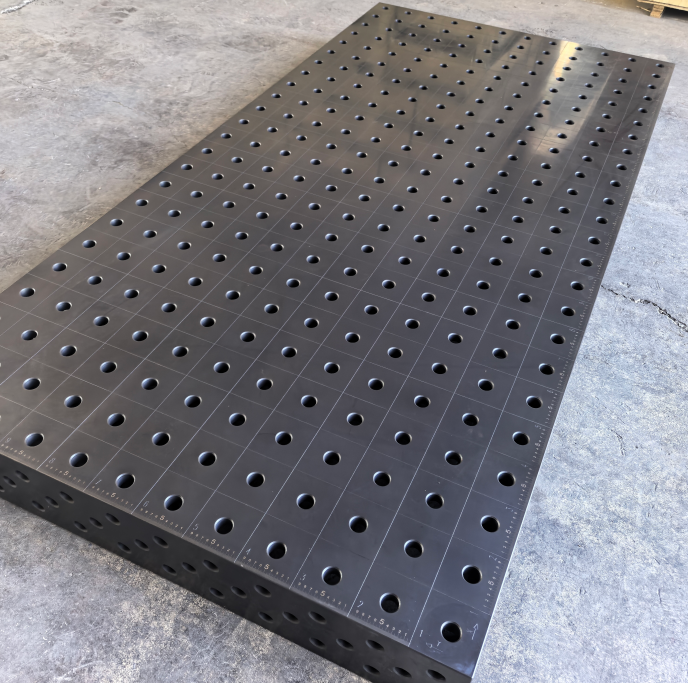
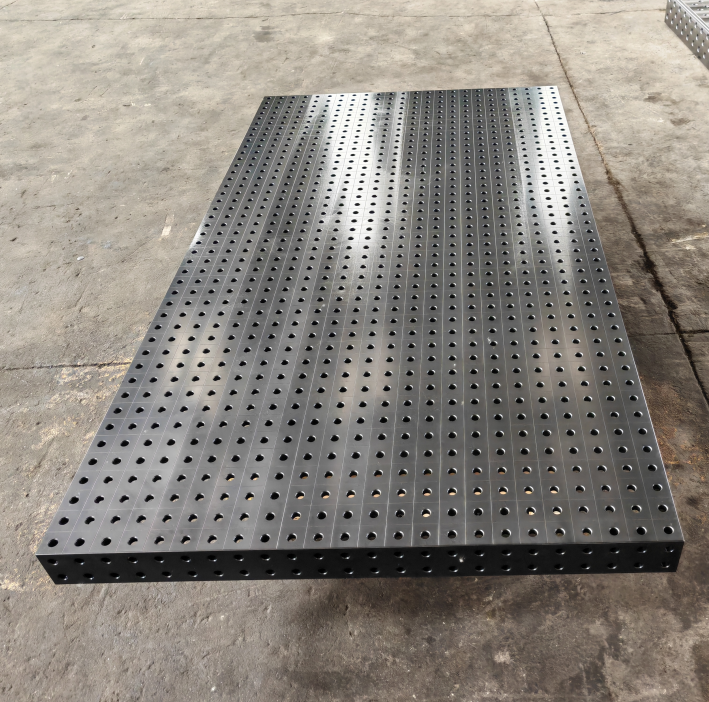
A defining characteristic of modern welding tables is the grid of holes. Standard spacing includes 50mm (2-inch) or 100mm (4-inch) centers. These holes accept a wide range of clamping tools, including stop pins, angle brackets, and toggle clamps. The holes are often countersunk or chamfered to facilitate easy tool insertion and removal. This system transforms a simple table into a comprehensive 3D fixturing platform, allowing users to build complex jigs directly on the surface.
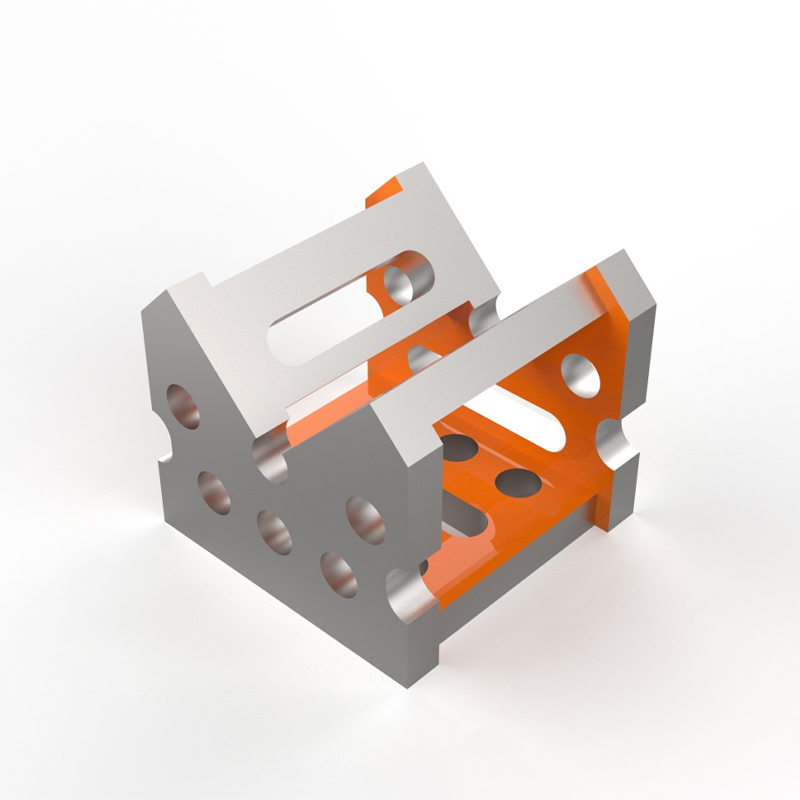
Leading this technological charge is Botou Haijun Metal Products Co., Ltd., a specialist in the research, development, and production of high-precision flexible modular fixtures. Recognizing the industry’s shift toward agility, Haijun Metal has engineered a core product line of 2D and 3D flexible welding platforms that seamlessly integrate with modern foldable designs. Renowned in the machining, automotive, and aerospace sectors, their solutions provide the exceptional versatility and precision required for today’s complex fabrication tasks. By offering complementary components such as U-shaped and L-shaped multi-purpose square boxes, 200-series support angle irons, and 0-225° universal angle gauges, Haijun Metal ensures that every foldable station can be rapidly configured for unique workpiece positioning. Their commitment to durability is further evidenced by their professional cast iron 3D welding platforms and angle connection blocks, making them a trusted global supplier for manufacturers seeking efficient, stable, and flexible welding solutions.
Comparative Analysis: Fixed vs. Foldable Welding Tables
Selecting between a stationary and a collapsible unit depends on specific operational needs. The following comparison highlights the trade-offs regarding stability, portability, and application scope.
| Feature | Fixed Welding Table | Foldable Welding Table |
| Stability | Maximum; bolted to floor or extremely heavy | High; relies on locking leg mechanisms and weight distribution |
| Portability | None; permanent installation | High; often includes wheels or handles for transport |
| Storage Footprint | Constant; occupies floor space permanently | Minimal; can be folded vertically or stacked |
| Setup Time | N/A (Always ready) | 1-3 minutes for unfolding and leveling |
| Load Capacity | Very High (2000+ lbs typical) | Moderate to High (500-1500 lbs typical) |
| Ideal Use Case | High-volume production lines, heavy structural fab | Mobile repair, prototyping, low-volume batches, training |
When to Choose a Foldable Model
A collapsible welding station is the superior choice when flexibility outweighs the need for massive static load bearing. If your workflow involves moving between different job sites, or if your workshop serves multiple purposes (e.g., welding in the morning, assembly in the afternoon), the foldable design offers unmatched utility. It is also the preferred solution for educational institutions and training centers where equipment must be reconfigured frequently.
Technical Specifications and Selection Criteria
Evaluating a portable welding table requires a detailed look at technical parameters. In 2026, buyers should look beyond marketing claims and focus on measurable engineering data. These specifications determine whether the table can handle specific amperages, material thicknesses, and fixture loads.
Load Rating and Weight Distribution
The maximum load capacity is rarely a single number. It varies based on whether the load is centered or distributed. Professional tables specify both uniform distributed load (UDL) and point load limits. For heavy fabrication, ensure the UDL rating exceeds the weight of your largest typical assembly. Point load capacity is critical when using heavy vises or clamps in a single location. Always verify that the leg locking mechanism is rated for the intended dynamic loads, including the force of hammering or grinding.
Tabletop Thickness and Hole Diameter
Top plate thickness generally ranges from 10mm to 16mm for portable units. Thicker plates offer better heat dissipation and resistance to warping but add significant weight. The hole diameter is equally important. Common sizes are 16mm, 20mm, and 28mm. Larger holes (28mm) accommodate heavier-duty clamping tools but may reduce the structural integrity of thinner plates. Ensure the hole pattern matches the tooling ecosystem you intend to use.
Heat Resistance and Spatter Protection
Welding generates intense heat and spatter. The table surface must withstand direct arc exposure without degrading. High-quality tables are made from materials that do not crack under thermal shock. Some models feature replaceable slat tops or sacrificial sheets that can be swapped out when damaged, preserving the underlying structural frame. This modularity extends the lifespan of the investment significantly.
Step-by-Step Guide: Setting Up and Leveling Your Table
Proper setup is crucial for safety and accuracy. Even the best folding welding bench will perform poorly if not leveled correctly. Follow this procedure to ensure optimal stability.
- Step 1: Site Selection: Choose a flat, clean area free of debris. Ensure there is adequate ventilation and fire safety equipment nearby.
- Step 2: Unfolding: Release the safety latches and slowly extend the legs. Listen for the “click” of the locking pins engaging. Never force the legs; if they resist, check for obstructions.
- Step 3: Initial Stabilization: Once fully extended, gently rock the table to confirm all four legs are firmly planted. If the floor is uneven, proceed to leveling.
- Step 4: Precision Leveling: Place a machinist level on the tabletop surface. Adjust the threaded feet at the base of each leg. Turn clockwise to raise and counter-clockwise to lower. Aim for bubble centering in both X and Y axes.
- Step 5: Final Locking: Tighten any jam nuts on the leveling feet to prevent them from loosening due to vibration. Re-check the level after tightening.
- Step 6: Grounding: Attach the welding ground clamp directly to the table frame or a dedicated grounding lug to ensure a solid electrical circuit.
Common Setup Errors to Avoid
Users often overlook minor details that compromise performance. Failing to fully engage leg locks is the most common error, leading to sudden collapse under load. Another mistake is placing the table on soft or uneven ground without using leveling pads, which causes wobbling during precise welding. Always verify the ground connection; a poor ground on the table can lead to erratic arc performance and potential damage to electronic components in inverter welders.
Application Scenarios for Portable Welding Tables
The versatility of the foldable welding table allows it to serve diverse industries. Understanding these applications helps in selecting the right configuration.
Mobile Repair and Maintenance
In oil and gas, mining, and agriculture, equipment often breaks down in the field. Technicians can transport a folded table to the site, set it up, and perform cutting, fitting, and welding operations immediately. This reduces downtime significantly compared to transporting the broken component back to a central workshop.
Prototyping and R&D
Research and development teams frequently change product designs. A portable table allows engineers to reconfigure their workspace daily. The fixturing grid supports rapid iteration of jigs and fixtures, enabling quick validation of new concepts without committing to permanent tooling.
Educational and Training Environments
Vocational schools and welding academies benefit from the storage efficiency of foldable tables. Classrooms can be cleared quickly for theory sessions or other trades. The durability of these tables also withstands the rigorous use by students learning proper techniques.
Small Batch Manufacturing
Job shops handling custom orders often face space constraints. A foldable table allows a small shop to expand its capacity temporarily. When a large order arrives, multiple tables can be deployed. When the order is complete, they are stored away, keeping the main floor open for other workflows.
Maintenance and Longevity Best Practices
To maximize the return on investment, regular maintenance is essential. A well-cared-for portable welding workstation can last for decades.
Cleaning and Spatter Removal
Accumulated spatter can interfere with clamping tools and distort measurements. Regularly clean the tabletop using a wire brush or a specialized spatter remover spray. Avoid using excessive force that could gouge the surface. For heavily perforated tables, use a dedicated hole cleaning tool to ensure clamps slide in smoothly.
Lubrication of Moving Parts
The folding hinges and locking pins are subject to wear. Apply a light coat of machine oil or dry lubricant to these components every few months. This prevents rust and ensures smooth operation. Avoid greasy lubricants that attract dust and welding spatter.
Inspection of Structural Integrity
Periodically inspect the frame for cracks, especially near weld joints and hinge points. Check the leveling feet for wear and replace them if they become stripped or uneven. Ensure that the locking pins are not bent and that the springs return them reliably. Early detection of fatigue prevents catastrophic failure during use.
Frequently Asked Questions (FAQ)
What is the weight capacity of a standard foldable welding table?
Most professional-grade foldable welding tables support between 500 lbs and 1,500 lbs (225-680 kg) of uniformly distributed load. Heavy-duty models with reinforced legs can exceed 2,000 lbs. Always check the manufacturer’s specific rating for point loads versus distributed loads.
Can I use a foldable table for plasma cutting?
Yes, but with precautions. Plasma cutting generates significant heat and dross. It is advisable to use a sacrificial slat top or a protective sheet over the main surface to prevent damage to the precision holes and flatness. Ensure proper ventilation and grounding.
How do I prevent the table from tipping over?
Stability depends on the leg spread and the center of gravity. Ensure the legs are fully extended and locked. Do not place excessively heavy loads on the edge of the table without counterbalancing. On uneven surfaces, use leveling feet strictly to create a stable base before loading.
Are the fixturing holes compatible with all clamps?
Compatibility depends on the hole diameter and spacing. Standard grids are 50mm or 100mm with hole sizes of 16mm, 20mm, or 28mm. Verify that your clamping tools match these dimensions. Adapters are available to convert between different hole sizes if necessary.
Is assembly required upon delivery?
Most portable welding tables ship fully assembled or require minimal assembly, such as attaching the legs or leveling feet. The folding mechanism is pre-installed at the factory to ensure alignment and safety. Refer to the specific product manual for details.
Can I weld aluminum on a steel table?
Yes, but aluminum spatter can fuse to the steel surface, making cleanup difficult. Using anti-spatter spray or a ceramic blanket is recommended. Additionally, ensure the table is clean of carbon steel dust to prevent contamination of the aluminum weld, which can lead to corrosion.
Strategic Selection: Matching the Table to Your Needs
Choosing the right foldable welding table involves analyzing your specific workflow constraints. Consider the maximum weight of your typical projects. If you frequently work with large structural beams, prioritize a model with a higher load rating and wider leg stance. For intricate TIG work on small components, surface flatness and hole density are more critical than raw load capacity.
Evaluate your storage environment. If space is extremely tight, look for models with a slim fold profile that can fit into narrow closets or hang on wall brackets. For outdoor use, consider tables with powder-coated finishes or galvanized components to resist environmental corrosion. The ideal table balances these factors to enhance productivity without introducing logistical bottlenecks.
Conclusion: Elevating Efficiency with Portable Precision
The foldable welding table represents a pivotal advancement in fabrication technology for 2026. By combining the rigidity of a stationary bench with the flexibility of a mobile unit, it empowers welders to work faster, safer, and more efficiently. Whether for on-site repairs, prototype development, or optimizing shop floor space, these tables provide the foundational stability required for high-quality welds.
This solution is ideally suited for:
- Mobile Fabricators: Who need reliable equipment that travels with them.
- Space-Constrained Shops: Seeking to maximize utility per square foot.
- R&D Teams: Requiring adaptable setups for evolving projects.
- Training Centers: Needing durable, storable infrastructure.
Investing in a high-quality portable welding station is an investment in operational agility. To explore specific models, review detailed technical drawings, or discuss custom configurations for your facility, contact our engineering team today.
→ View Full Product Catalog & Technical Specifications