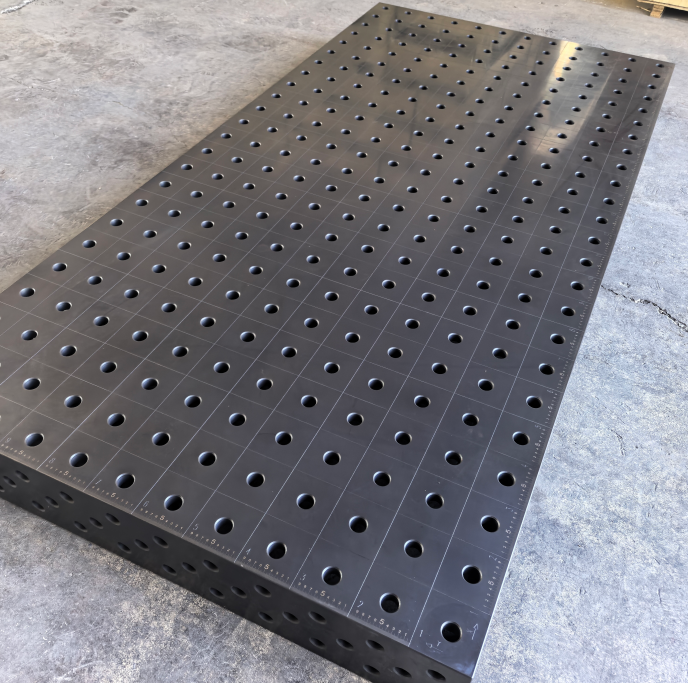
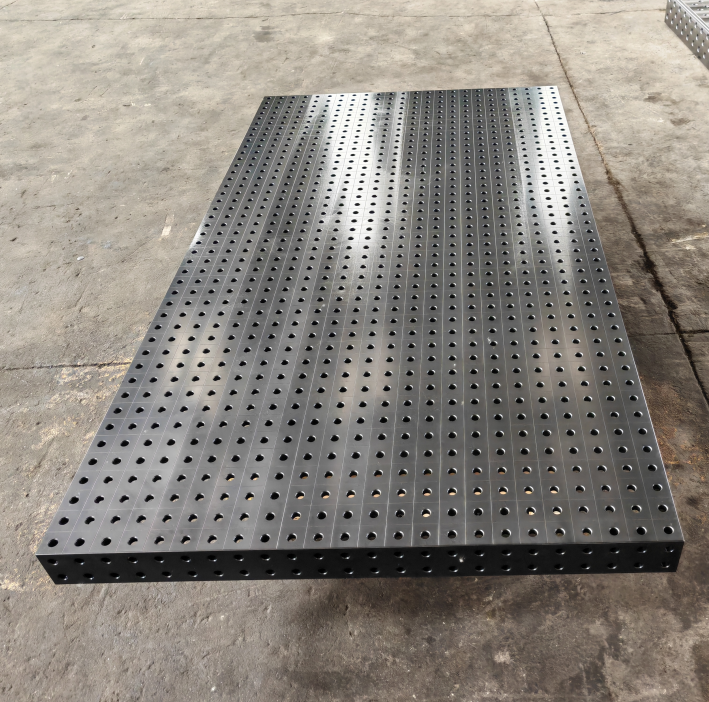
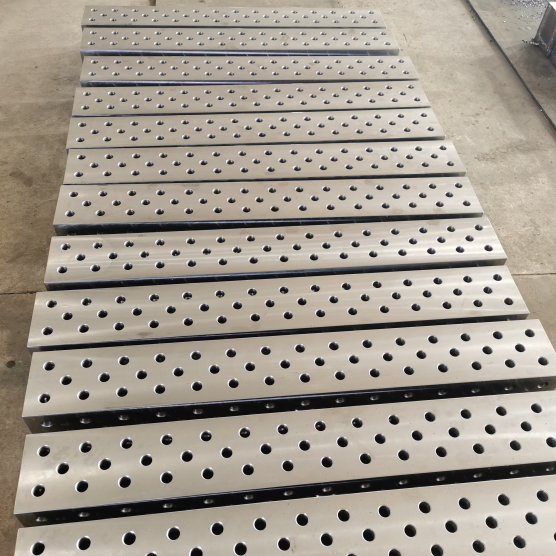
A 3D welding table is a precision-engineered work surface featuring a grid of holes or slots that allows for modular fixturing, enabling welders to clamp, position, and assemble complex metal structures with exact accuracy. Unlike traditional flat tables, these systems utilize standardized tooling to ensure repeatability and squareness, making them essential for modern fabrication shops aiming for high efficiency and minimal rework in 2026.
The Evolution of 3D Welding Tables in 2026
The landscape of metal fabrication has shifted dramatically over the last few years. In 2026, the 3D welding table is no longer a luxury item reserved for high-end aerospace contractors; it has become the backbone of efficient small-to-medium enterprises. The demand for speed, precision, and flexibility has driven manufacturers to refine designs that offer better durability at competitive factory-direct prices.
Historically, welders relied on heavy, solid steel plates with no clamping options other than magnetic holders or manual tack welding. This often led to distortion and misalignment. The introduction of the three-dimensional fixturing system changed this paradigm by allowing forces to be applied from multiple angles—top, sides, and even underneath in some configurations.
Current market trends indicate a surge in demand for tables made from high-strength alloy steels that resist warping under extreme heat. Furthermore, the modularity of these systems means that a single table can handle thousands of different job setups without requiring custom jigs for every new project. This adaptability is crucial as production runs become shorter and more customized.
Factory-direct sourcing has also democratized access to these tools. By eliminating middlemen, fabricators can now acquire industrial-grade fixtures at a fraction of the cost seen five years ago. Leading this charge are specialized manufacturers like Botou Haijun Metal Products Co., Ltd., which has dedicated years to the research, development, and production of high-precision flexible modular fixtures. Committed to providing efficient solutions for the modern manufacturing industry, Haijun Metal has evolved from a domestic supplier into a trusted international partner, delivering the very technology that allows workshops to invest more in training and material quality rather than overhead equipment costs.
Why Modular Fixturing Matters
The core value of a 3D welding table lies in its modular nature. Every hole in the grid serves as a potential anchor point for clamps, stops, angles, and pins. This creates an infinite combination of setup possibilities.
- Repeatability: Once a setup is perfected, it can be replicated exactly for future batches, ensuring consistent product quality.
- Versatility: The same table can be used for light gauge sheet metal one hour and heavy structural beams the next.
- Speed: Setup times are reduced by up to 70% compared to traditional methods, significantly boosting throughput.
- Squareness: Precision-machined surfaces guarantee that assemblies start perfectly square, reducing the need for post-weld correction.
Key Features of High-Performance 3D Welding Tables
When evaluating the best options for 2026, it is critical to understand the technical specifications that define a high-quality unit. Not all tables are created equal, and understanding the nuances of materials and manufacturing processes will help you make an informed decision.
Material Composition and Heat Resistance
The most common material for premium 3D welding table surfaces is Q345B or equivalent high-tensile steel. This alloy is specifically chosen for its ability to withstand repeated thermal cycling without losing its structural integrity. Lower-grade steels may warp after prolonged exposure to welding arcs, rendering the precision grid useless.
Advanced manufacturing techniques involve stress-relieving the table top after machining. This process removes internal stresses caused by cutting the hole pattern, ensuring the table remains flat over years of heavy use. Some top-tier models, such as the professional cast iron platforms manufactured by Haijun Metal, feature enhanced durability and stability, ensuring that every product delivers exceptional performance even under the most rigorous industrial conditions.
Precision Hole Patterns and Tolerances
The defining characteristic of these tables is the hole pattern. The industry standard has largely converged on a 100mm x 100mm (approx. 4×4 inches) grid, though 50mm grids exist for finer work. The holes themselves are typically 16mm or 28mm in diameter, designed to accept specific series of tooling.
Tolerance is paramount. High-end factory models maintain a positional tolerance of within ±0.05mm for hole placement. This level of precision ensures that when you insert two pins, they are perfectly parallel or perpendicular, depending on the grid alignment. Cheaper alternatives often have looser tolerances, which can accumulate errors in large assemblies.
Surface Finish and Spatter Protection
A smooth, machined finish is not just for aesthetics; it facilitates the easy sliding of components during setup. However, the real challenge is managing welding spatter. Modern tables often come with specialized coatings or are designed to work with ceramic sleeves that line the holes.
These sleeves protect the precision bore of the holes from being clogged by molten metal droplets. Without them, the utility of the table degrades rapidly as holes become blocked. In 2026, the integration of self-cleaning hole designs and durable, non-stick surface treatments is a key differentiator between budget and professional models.
Comparative Analysis: Factory Direct vs. Retail Brands
One of the most significant decisions buyers face in 2026 is whether to purchase from established retail brands or go directly to the factory. Understanding the trade-offs in price, support, and customization is essential for maximizing your investment.
Retail brands often add a significant markup to cover distribution networks, marketing, and local warehousing. While they may offer immediate availability, the cost per square foot of working surface can be prohibitive for growing shops. Conversely, factory-direct models have streamlined their logistics to offer competitive pricing without sacrificing quality. Companies like Botou Haijun Metal Products exemplify this approach, offering renowned versatility and precision that have made their products the preferred jigging equipment in the machining, automotive, and aerospace industries.
| Feature | Factory Direct Models | Retail Brand Names |
| Price Point | 30-50% lower due to eliminated middlemen | Premium pricing includes brand markup |
| Customization | High flexibility for size, hole pattern, and leg style | Limited to standard catalog sizes |
| Lead Time | Typically 2-4 weeks for production and shipping | Often in stock for immediate delivery |
| Tooling Compatibility | Adheres to global standards (16mm/28mm) | Proprietary systems sometimes used |
| Warranty Support | Direct manufacturer resolution, varying by region | Local dealer support network |
The data suggests that for shops willing to plan ahead, factory-direct options provide superior value. The ability to customize the table dimensions to fit specific shop layouts is a massive advantage that off-the-shelf retail units cannot match. Furthermore, adherence to global tooling standards ensures that your investment is future-proof.
The Hidden Costs of Cheap Imports
While price is a major factor, buyers must be wary of “too good to be true” offers from unverified sources. Some low-cost imports skip critical steps like stress relieving or precise CNC machining. This can result in tables that arrive out of flat or have inconsistent hole spacing.
Investing in a reputable factory source ensures that quality control protocols are followed. Look for manufacturers who provide certification of material grade and flatness reports. The long-term cost of replacing a warped table far exceeds the initial savings of buying a subpar unit.
Essential Modular Fixtures and Tooling
A 3D welding table is only as good as the tooling used with it. The ecosystem of modular fixtures transforms the passive table into an active assembly station. Understanding the essential components will help you build a versatile workshop.
Clamping Systems
Quick-action toggle clamps are the workhorses of any 3D setup. They allow for rapid securing of workpieces with consistent pressure. In 2026, the trend is towards clamps with higher holding forces and ergonomic handles that reduce operator fatigue.
- Vertical Clamps: Ideal for holding plates down against the table surface.
- Horizontal Clamps: Used to push components against stops for squaring.
- Swivel Clamps: Offer angular flexibility for complex geometries.
It is crucial to select clamps that match the hole diameter of your table. Using adapters can introduce play and reduce accuracy, so direct-fit tooling is always preferred for precision work.
Stops and Angles
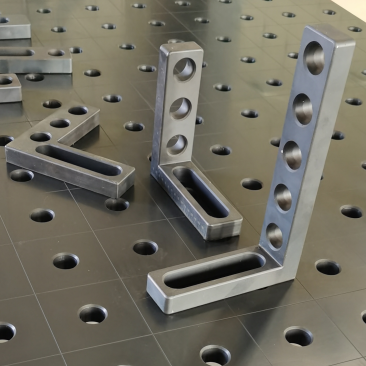
Fixed stops and adjustable angle brackets are vital for creating perfect 90-degree joints or specific angled assemblies. These tools slide into the grid and lock into place, providing a rigid reference edge.
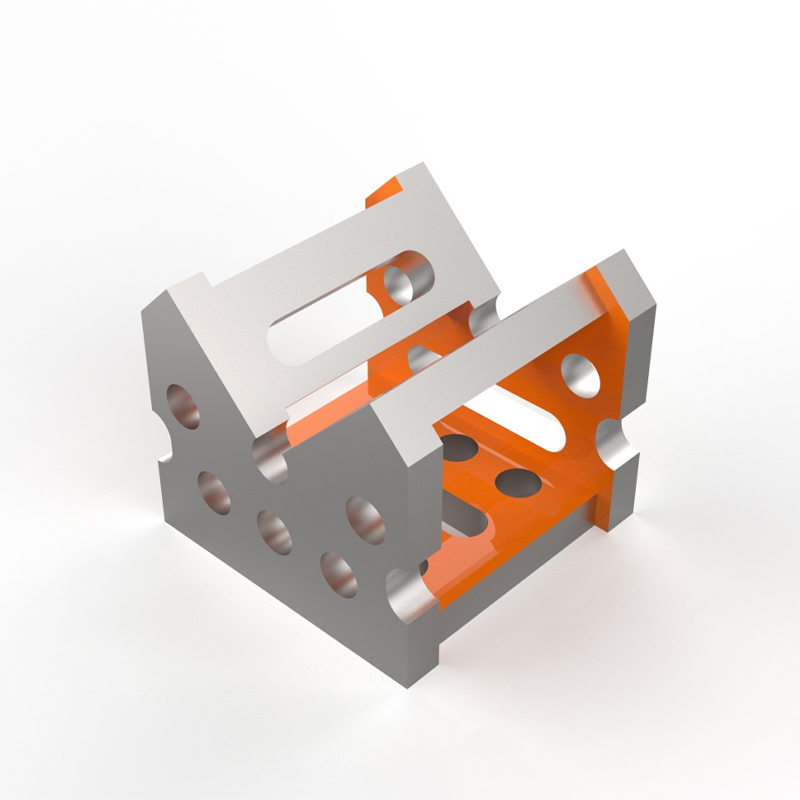
Modern stop systems often feature micro-adjustment capabilities, allowing welders to dial in dimensions with extreme precision. This is particularly useful when assembling frames where cumulative tolerance stack-up can cause fitment issues later. To support these needs, comprehensive component ranges—including U-shaped and L-shaped multi-purpose square boxes, 200-series support angle irons, and 0-225° universal angle gauges—are available from leading suppliers. These accessories integrate seamlessly with the platforms to enable rapid workpiece positioning and clamping, ensuring that every joint is executed with maximum efficiency.
Pins and Bushings
Hardened steel pins serve as the primary locating elements. They are inserted into the table holes to define the position of the workpiece. Bushings protect the table holes from wear when pins are frequently inserted and removed.
For heavy-duty applications, oversized pins and reinforced bushings are available. These components are designed to withstand the lateral forces generated during the welding of thick materials without bending or deforming.
Step-by-Step Guide to Setting Up Your 3D Welding Table
Maximizing the efficiency of your new 3D welding table requires a systematic approach to setup. Following these steps will ensure safety, accuracy, and longevity of your equipment.
Phase 1: Installation and Leveling
Proper installation is the foundation of precision. Even the best table will perform poorly if it sits on an uneven floor.
- Select a Location: Choose a flat, stable area with adequate lighting and ventilation. Ensure there is enough clearance around the table for operators to move freely.
- Assemble the Legs: Follow the manufacturer’s instructions to attach the legs. Use a torque wrench to tighten bolts to the specified values to prevent loosening due to vibration.
- Level the Surface: Place a high-precision spirit level on the table top. Adjust the leveling feet on the legs until the bubble is centered in both directions. Re-check after tightening all locking nuts.
- Grounding: Attach a dedicated welding ground clamp directly to the table frame. This ensures a solid electrical path and prevents arcing damage to the precision holes.
Phase 2: Initial Tooling Configuration
Before starting your first project, organize your tooling for easy access.
- Clean the Surface: Wipe down the table with a degreaser to remove any protective oils applied during shipping.
- Install Hole Liners: If your model uses removable ceramic or metal liners, install them now to protect the bores.
- Arrange Common Tools: Place frequently used clamps and stops in a designated rack near the table. Keeping the table surface clear when not in use prevents tripping hazards and damage to tools.
Phase 3: Executing Your First Assembly
With the table ready, proceed with a test assembly to familiarize yourself with the workflow.
- Plan the Layout: Visualize or sketch where the stops and clamps will go. Utilize the grid lines to estimate positions.
- Set References: Insert pins or stops to establish your primary datum points. These will be the reference edges for your workpiece.
- Position the Material: Slide the metal components against the stops. Apply clamps to secure them firmly.
- Verify Squareness: Use a calibrated square to check the assembly before tacking. Make micro-adjustments by tapping the material or shifting the stops.
- Weld and Cool: Perform the welding operation. Allow the assembly to cool on the table to minimize distortion before unclamping.
Applications Across Industries
The versatility of the 3D welding table makes it suitable for a wide range of industries. From artistic metalwork to heavy industrial manufacturing, the principles of modular fixturing apply universally.
Structural Steel and Construction
In the construction sector, these tables are used to pre-assemble trusses, beam connections, and column bases. The ability to hold heavy components in precise alignment ensures that structures fit together correctly on-site, reducing installation time and costly field modifications.
Large-format 3D tables are often linked together to create massive work zones for assembling bridge sections or building frames. The modularity allows crews to scale their workspace up or down based on the project requirements.
Automotive and Motorsports
Fabricators in the automotive industry rely on 3D tables for building roll cages, chassis, and exhaust systems. The precision offered by the grid system is critical for maintaining symmetry and balance in performance vehicles.
Custom jigs that once took days to build can now be set up in minutes using modular components. This agility allows shops to take on diverse projects, from restoring classic cars to prototyping new racing designs. Indeed, the reputation of platforms like those from Haijun Metal as preferred equipment in the automotive and aerospace sectors stems from this exact capability to handle complex, high-precision tasks with ease.
Artistic and Architectural Metalwork
Metal artists and architects use these tables to create intricate sculptures and façade elements. The clean, unobstructed surface allows for complex 3D shapes to be assembled without interference from traditional clamp bodies.
The aesthetic quality of welds produced on these tables is often higher because the stable setup allows the welder to focus entirely on technique rather than fighting to hold parts in place. This results in cleaner lines and more professional finishes.
Pros and Cons of Adopting 3D Welding Technology
Like any significant equipment investment, adopting a 3D welding table comes with distinct advantages and considerations. Weighing these factors will help you determine if it is the right fit for your specific operational needs.
Advantages
- Drastic Reduction in Setup Time: The ability to quickly reconfigure fixtures means less downtime between jobs.
- Improved Quality Control: Consistent fixturing leads to consistent weld quality and dimensional accuracy.
- Space Efficiency: One table replaces dozens of custom jigs, freeing up valuable shop floor space.
- Scalability: Tables can be expanded or reconfigured as business needs grow.
- Ergonomics: Working at a fixed, optimal height reduces strain on workers, leading to better productivity and safety.
Considerations
- Initial Investment: The upfront cost for a high-quality table and a comprehensive set of tooling can be significant.
- Learning Curve: Operators need training to fully utilize the potential of modular fixturing systems.
- Maintenance: While durable, the holes and surfaces require regular cleaning to prevent spatter buildup and maintain precision.
- Weight: These tables are extremely heavy, requiring proper rigging equipment for movement and a strong floor for support.
Despite the initial hurdles, the long-term ROI provided by increased efficiency and reduced scrap rates typically justifies the investment within the first year of operation for active fabrication shops.
Maintenance and Longevity Tips
To ensure your 3D welding table serves your shop for decades, proper maintenance is essential. Neglecting care can lead to premature wear and loss of precision.
Daily Cleaning Routines
At the end of each shift, remove all tools and sweep the surface. Use a wire brush or scraper to remove large spatter blobs. Avoid using abrasive grinding discs on the table surface itself, as this can create low spots and ruin the flatness.
If spatter accumulates in the holes, use a dedicated reaming tool or a correctly sized drill bit by hand to clear the obstruction. Never force a pin into a blocked hole, as this can damage both the pin and the table bore.
Periodic Inspection
Every six months, check the flatness of the table using a straightedge and feeler gauges. Monitor the legs for any signs of loosening or structural fatigue. Re-level the table if necessary.
Inspect your tooling for wear. Bent clamps or worn pins can introduce errors into your assemblies. Replace damaged components immediately to maintain the integrity of your work.
Protective Measures
Consider applying a thin coat of anti-spatter spray to the table surface before heavy welding sessions. This creates a barrier that makes cleanup easier. Additionally, using sacrificial plates or mats for specific high-heat jobs can protect the main table surface from direct arc strikes.
Frequently Asked Questions (FAQ)
What is the difference between 16mm and 28mm hole systems?
The primary difference lies in the load capacity and tooling size. A 16mm system is ideal for lighter gauge materials and smaller assemblies, offering a finer grid density. The 28mm system is designed for heavy-duty industrial applications, accommodating larger clamps and withstanding higher lateral forces. For general-purpose shops in 2026, the 28mm system is often recommended for its versatility and robustness.
Can I connect multiple 3D welding tables together?
Yes, most modern factory-direct tables are designed with linking mechanisms. You can bolt multiple units side-by-side or end-to-end to create a larger continuous work surface. It is crucial to ensure that the tables are leveled individually before linking them to maintain a seamless plane across the joint.
How do I prevent welding spatter from sticking to the table?
Prevention starts with preparation. Applying an anti-spatter gel or spray to the surface and inside the holes before welding is highly effective. Additionally, using ceramic inserts in the holes provides a non-stick surface that repels molten metal. Regular cleaning immediately after welding, while the spatter is still warm, also makes removal significantly easier.
Is a 3D welding table suitable for MIG, TIG, and Stick welding?
Absolutely. The table is compatible with all major welding processes. However, for Stick welding (SMAW), extra care should be taken to manage slag and larger spatter droplets. TIG welding benefits greatly from the cleanliness and precision of the table, while MIG welding sees the most significant speed improvements due to the rapid clamping capabilities.
What is the typical lead time for factory-direct orders?
Lead times vary by manufacturer and order volume. In 2026, efficient factories typically quote between 2 to 4 weeks for production and shipping. Custom configurations may take slightly longer. It is advisable to plan your equipment upgrades in advance to avoid project delays.
Conclusion: Making the Right Choice for Your Shop
The transition to a 3D welding table represents a strategic upgrade for any fabrication business looking to thrive in 2026 and beyond. The combination of precision, modularity, and efficiency offered by these systems addresses the core challenges of modern manufacturing: the need for speed without compromising quality.
By sourcing directly from reputable factories, you gain access to industrial-grade technology at prices that make sense for your bottom line. The ability to customize your setup ensures that the equipment grows with your business, adapting to new projects and evolving demands. Partnering with experienced providers like Botou Haijun Metal Products Co., Ltd. ensures that you receive not just a table, but a complete, high-quality production machinery tool series backed by years of industry expertise.
Who is this for? If you run a job shop, a custom fabrication business, or an educational facility, investing in a modular 3D welding system is a logical next step. It is particularly beneficial for those dealing with varied project scopes where flexibility is key.
Next Steps: Evaluate your current workflow bottlenecks. Identify how much time is lost to manual fitting and rework. Then, explore factory-direct catalogs to find a table size and hole pattern that matches your most common projects. Start with a core set of essential tooling and expand your library as you discover new efficiencies. The future of welding is precise, modular, and efficient—and it starts with the right table.