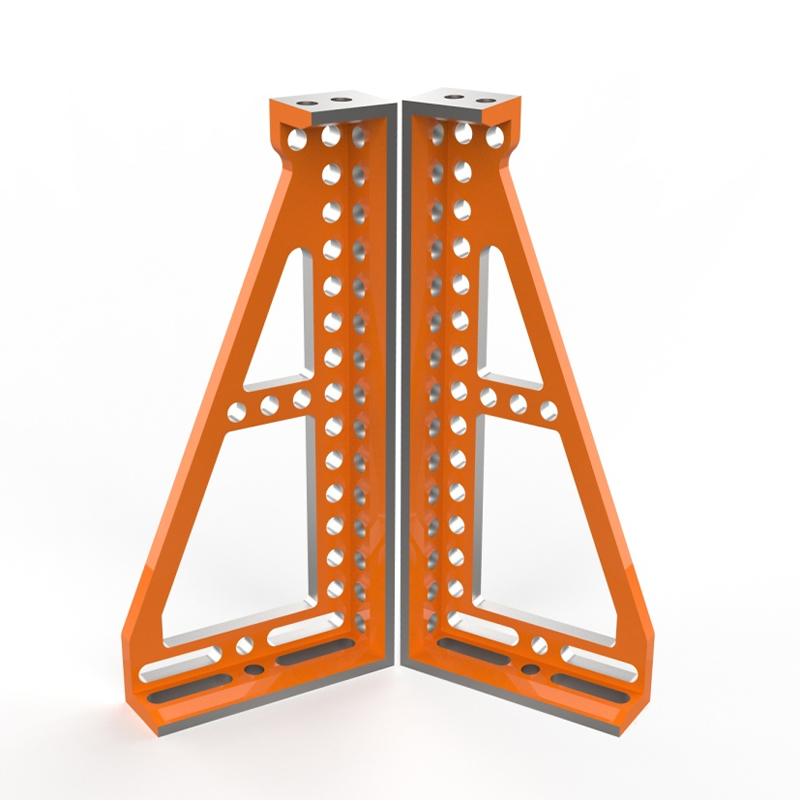
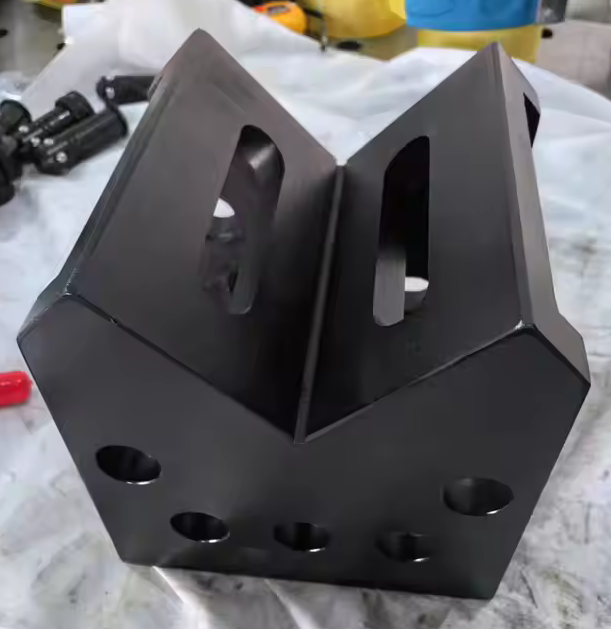
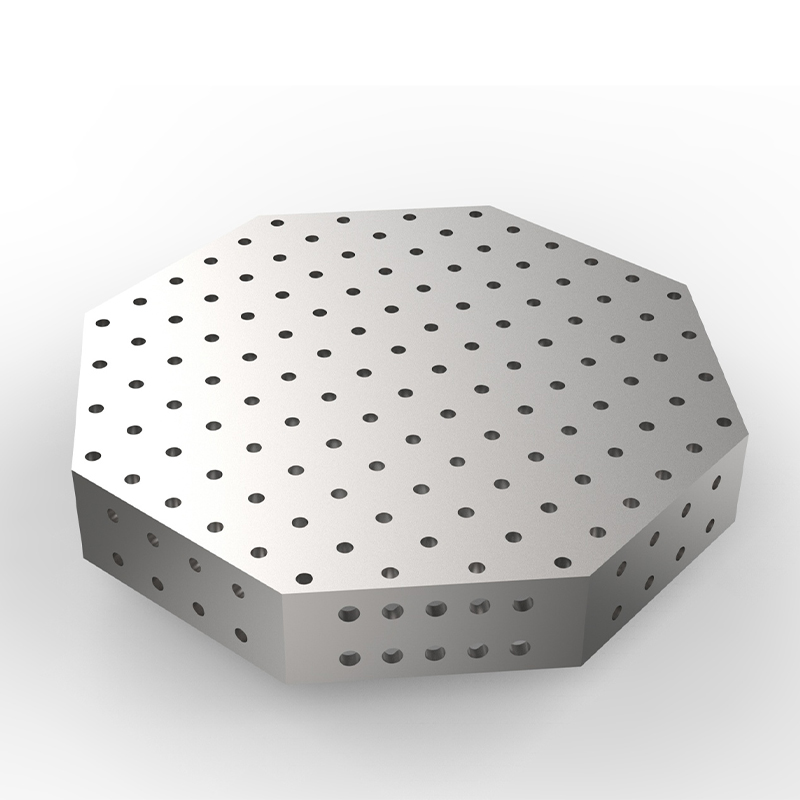
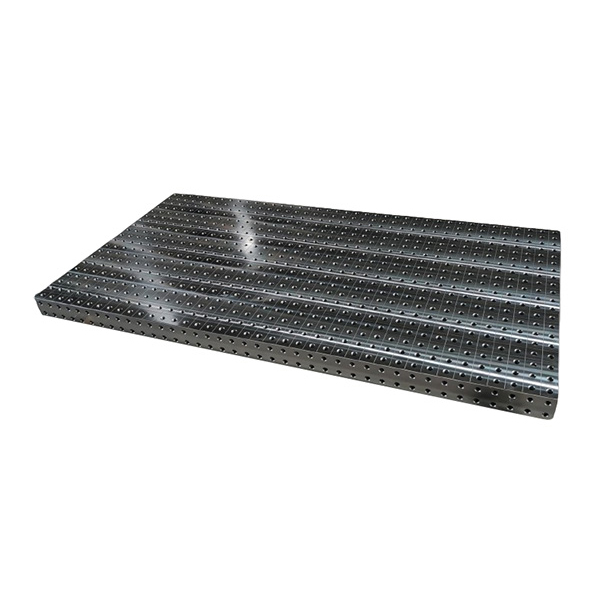
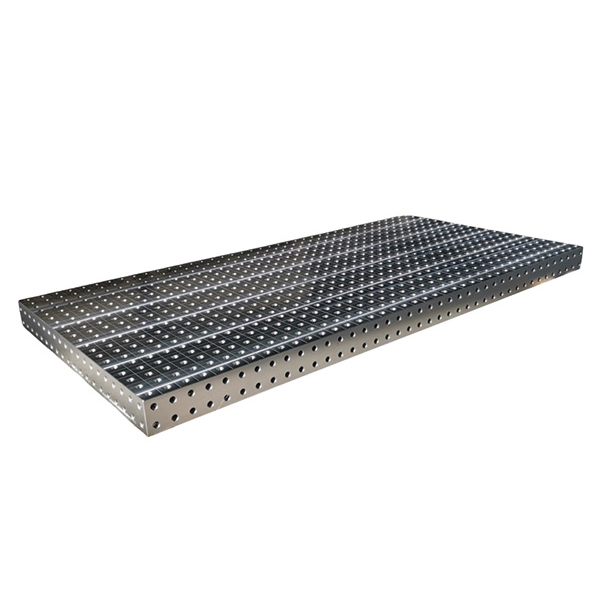
Every precision weld starts not with an arc—but with a surface that doesn’t move. A fabrication jig table isn’t just steel on legs. It’s the silent partner in every repeatable assembly: the foundation that holds tolerances tighter than your GD&T callouts, absorbs vibration before it blurs a fillet, and turns operator skill into process consistency.
We’ve watched too many shops chase weld distortion only to realize the root cause wasn’t heat input—it was part movement during clamping. In one agricultural equipment project last year, a client’s bracket stack-up error averaged ±0.8 mm across 12 holes. They’d upgraded their MIG gun, added purge gas, even trained welders on pulse parameters. The fix? A re-engineered fabrication jig table with kinematic locating pins, hardened dowel bushings, and zero-play toggle clamps. Final variation dropped to ±0.15 mm—within spec, without rework.
Why “Just a Table” Fails Under Real-World Loads
A jig table must do three things at once: locate, constrain, and survive. Not all do.
Locating means repeatability—not just hitting the same spot once, but doing it 500 times across shifts, temperature swings, and tool wear. We use ground stainless steel locating nests with ±0.01 mm flatness, not machined plate. Constraining means preventing six degrees of freedom—not just pressing down, but resisting lift, twist, and lateral creep during welding thermal expansion. That’s why our tables integrate welded-in T-slot rails with load-rated clamping arms—not bolt-on accessories. Surviving means holding calibration after 3,000+ weld passes, not just surviving first light. We stress-relieve all base plates post-machining and verify stability with CMM sweeps before final surface grinding. Skimp on any one—and you pay in scrap, rework, or late shipments. We’ve seen customers replace $120k robotic cells because their jig table warped under thermal cycling. Fixing the table cost 7% of the robot’s price. And delivered in 11 days.
What Engineers Actually Need—Not What Brochures Promise
Some suppliers list “±0.05 mm accuracy” without stating conditions: room temperature? No thermal soak? Unloaded? Real-world accuracy depends on how the table behaves when you’re welding at 4 a.m., with ambient temps swinging 15°C overnight.
That’s why we build every fabrication jig table for operational resilience:
Base material: ASTM A572 Grade 50 structural steel—not mild steel—heat-treated to 220–250 HB hardness, then precision-ground to 0.005 mm flatness over 2 m². Mounting system: Integrated 10-mm T-slot rails with hardened insert strips (62 HRC), tested to 12,000 N clamping force per rail segment. Thermal management: Optional water-cooled base plates for high-duty-cycle applications—tested up to 200 welds/hour without measurable deflection. Modularity: Standardized interface points let users swap locators, add pneumatic clamps, or integrate vision alignment targets—all without drilling new holes. We don’t sell “tables.” We deliver calibrated positioning systems. Each unit ships with a full CMM report showing flatness, parallelism, and rail-to-rail perpendicularity—traceable to NIST standards.
No Minimums. No Guesswork. No Compromise on Traceability
Small batches shouldn’t mean second-tier tooling. One European Tier-1 automotive supplier needed 14 custom jigs—for prototype validation on a new EV battery bracket. Their previous vendor quoted 12 weeks and required 50 units minimum. We delivered 14 fully inspected, CAD-validated tables in 16 days. Every unit included DFM feedback notes, weld sequence recommendations, and material certs for EN 10131 DC04 cold-rolled steel.
This works because our capability is vertical—not layered:
Design: In-house GD&T engineers review your 3D model and flag interference risks before quoting. Build: CNC plasma cutting, robotic welding of substructures, and hand-scraped surface finishing—all under one ISO 9001-certified roof. Validate: Every table undergoes functional testing with production parts and actual clamps—not just calipers. Support: Post-shipment, we retain your CMM data, weld map, and tolerance stack-up analysis for future revisions. No outsourcing. No handoffs. No “we’ll check with manufacturing.” Just one team—from quote to commissioning.
Your Next Step Isn’t Another Quote. It’s a Validation Protocol.
Before you sign off on another fabrication jig table, ask: Does it come with a documented thermal stability curve? Can you verify its flatness under load—not just at rest? Is the locating system designed for your part’s worst-case datum shift—or just ideal geometry?
Botou Haijun Metal Products Co., Ltd. builds jig tables where engineering intent meets shop-floor reality. We’ve shipped over 870 precision jig systems since 2019—to clients in Germany building wind turbine nacelles, to U.S. ag-tech firms assembling autonomous sprayer frames, to Southeast Asian EMS providers assembling medical robotics chassis. All share one requirement: zero tolerance for positional drift.
If your next assembly demands repeatability—not hope—start with surface truth. Start with a fabrication jig table engineered to hold its ground, weld after weld, year after year.