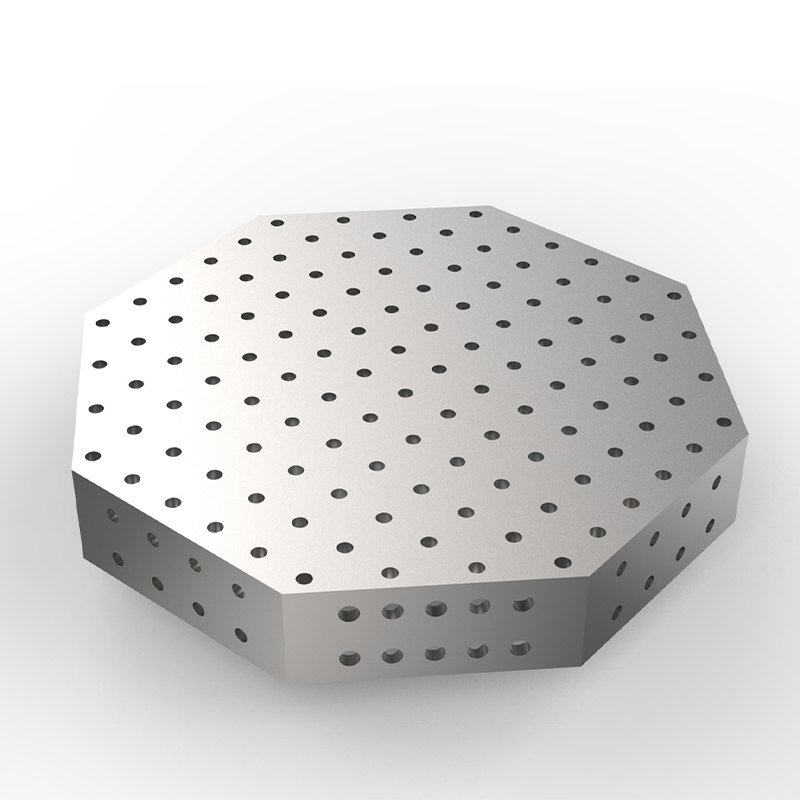
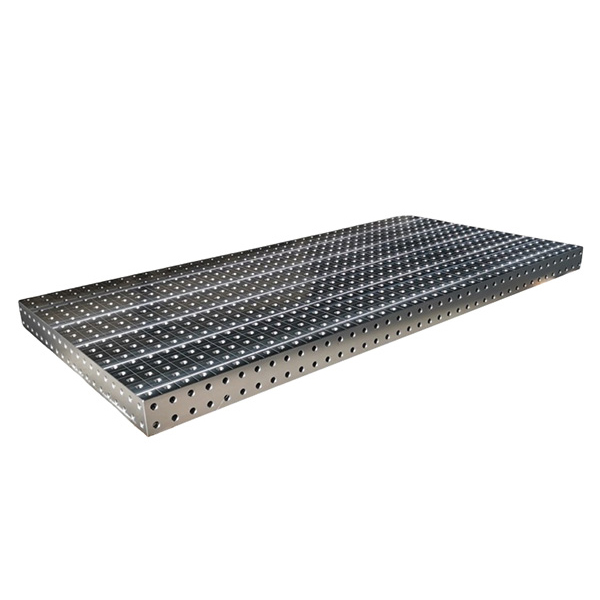
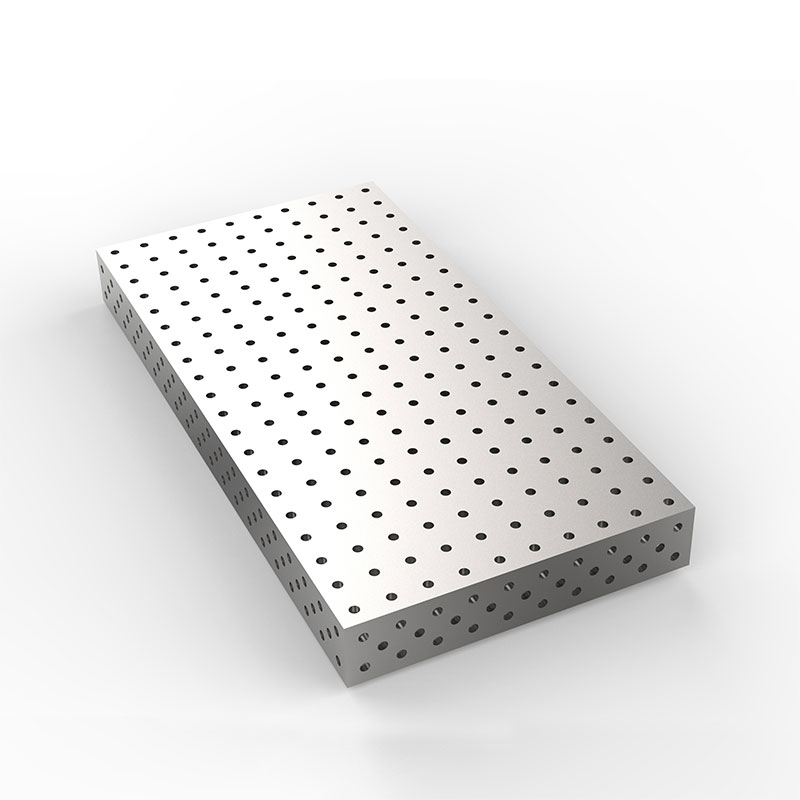
Welding jig table for sale isn’t just a phrase—it’s a signal that your shop is ready to move beyond clamps, angle irons, and guesswork. We’ve seen too many fabricators waste 12–18 minutes per weld joint repositioning parts, chasing alignment, or reworking mislocated holes. That time adds up: 3.7 hours lost per week on a single station. A precision welding jig table cuts that waste—not by theory, but by repeatability built into every mounting hole, T-slot, and ground surface.
Why “Precision” Isn’t Just Marketing Copy
Real precision starts with flatness—and not the kind you eyeball. At Botou Haijun Metal Products Co., Ltd., every welding jig table undergoes full-surface verification on a calibrated CMM. Flatness tolerance? ±0.05 mm across 1,200 × 800 mm base plates. Not ±0.15 mm. Not “within spec.” That difference means your first weld holds true—so your tenth does too. We machine all T-slots in one continuous pass on CNC gantry mills, not staged setups. Slot parallelism stays within 0.03 mm over 1 meter. Why does that matter? Because when your locating pin drops into a slot at 45°, it doesn’t bind or skew. It seats. Consistently.
We use only stress-relieved Q345B structural steel for main frames—no mild steel shortcuts. Yield strength isn’t just listed; it’s verified batch-by-batch with tensile reports traceable to mill test data. Surface hardness? 180–220 HB after shot blasting and primer coating. That’s enough to resist dings from dropped wrenches—but not so hard that drill bits skitter off during field modifications.
Durability You Can Verify—Not Just Claim
Durability fails where most manufacturers stop measuring: at the weld joints. Our jig tables feature full-penetration fillet welds on all critical frame intersections—not spot welds disguised as structural. Each weld passes visual inspection *and* dye penetrant testing on 10% of production lots. Salt spray resistance? 96 hours minimum at 5% NaCl, per ASTM B117. No blistering. No red rust at weld toes. That’s how we support customers running three shifts in humid coastal shipyards—and still seeing zero base-plate warping after 4+ years of daily use.
Here’s what users actually test before buying:
T-slot load rating: 1,200 kg per 20-mm slot (not “tested to failure,” but rated for repeated 3× safety margin)
Mounting hole repeatability: ±0.02 mm positional accuracy across 200+ M6 and M8 threaded inserts
Ground reference surface: 0.005 mm/100 mm straightness, measured with laser interferometer—not spirit level
One agricultural equipment client ran a side-by-side trial: their old custom jig warped 0.12 mm after 8 hours of ambient temperature swing. Our table held 0.018 mm. The difference wasn’t academic—it meant no rework on subframe mounting bosses.
Easy Setup Means “Done in Under 20 Minutes”—Not “Simple in Theory”
“Easy setup” gets abused. Some suppliers mean “you’ll figure it out.” We mean: uncrate, level with four adjustable feet, bolt down, and start welding—all in under 20 minutes. No shimming. No grinding. No “call our engineer.”
How? First, feet are pre-calibrated to ±0.03 mm height variance. Second, base plate has dual-leveling indicators—one for longitudinal, one for transverse—etched directly into the steel. Third, all mounting hardware ships pre-sorted in labeled bags: M12 × 40 mm for frame-to-floor, M8 × 25 mm for accessory rails. No digging through bins.
We include a quick-start QR code etched on the rear flange. Scan it, and you pull up a 90-second video showing torque sequence, leveling order, and first-part loading sequence. No manual flipping. No PDF scrolling. Just action.
What Customers Ask Before They Buy—And What We Tell Them
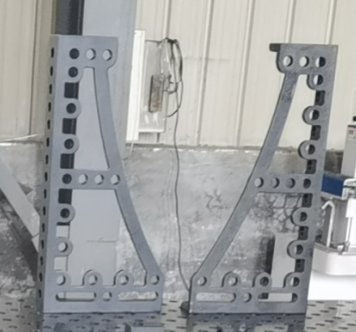
“Do you offer custom layouts?” Yes—but only after DFM review. We don’t just cut holes where you sketch them. We check for interference between clamps and robotic torch paths. We flag unsupported overhangs >150 mm. We suggest reinforcing ribs *before* machining starts.
“What’s the smallest batch you accept?” None. Zero MOQ. We’ve shipped single-table prototypes for R&D labs and 47-table orders for Tier-1 automotive suppliers—all with same QC, same lead time, same documentation.
“Can I integrate this with my existing modular tooling?” Absolutely. Our T-slots match ISO 2768-mK standards. Slot width: 20 mm ±0.05 mm. Center-to-center spacing: 100 mm. All compatible with Festool, ITEM, and Bosch modular accessories—no adapters needed.
We deliver full dimensional reports with every shipment: CMM printouts, surface finish Ra values (≤1.6 μm on reference faces), and raw material certs. Not summaries. Not excerpts. Every page, signed and stamped.
Your Next Step Starts With Real Data—Not Brochures
If you’re searching for welding jig table for sale, you’re likely weighing speed against accuracy—or cost against lifetime value. Here’s the math we see most often: a $2,800 jig pays back in 11 weeks through reduced rework and faster cycle times on medium-complexity assemblies. That’s based on real-time tracking from seven North American job shops—none of them our customers at the time of measurement.
Botou Haijun Metal Products Co., Ltd. builds these tables in Botou City—the heart of China’s cold-working industry—where metallurgical expertise runs deep, not wide. We don’t subcontract welding or heat treatment. We don’t source base plates from third-party mills. Every step lives under one ISO-compliant roof, with CMMs, salt spray chambers, and bending cells all operating under shared calibration protocols.
You don’t need another vendor. You need a partner who treats your weldment like their own prototype—checking GD&T callouts, validating fixture rigidity under thermal load, and shipping with traceable, auditable proof. That starts with asking the right question—not “how much?” but “what do you measure—and how do you prove it?”
Visit haijunmetals.com for dimensional drawings, downloadable STEP files, and live lead-time updates—updated hourly, not weekly.