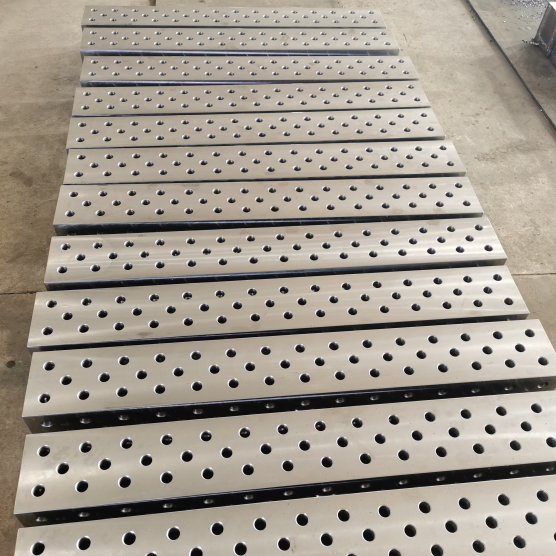
A modular welding table is a precision-engineered work surface featuring a grid of standardized holes that allow for infinite clamping and fixturing possibilities. Unlike traditional solid-top tables, this system enables welders to rapidly assemble complex jigs, ensure perfect squareness, and repeat projects with exact accuracy. For modern workshops aiming to reduce setup time and eliminate rework, adopting a modular welding table is no longer a luxury but an essential upgrade for efficiency and quality control.
What Defines a True Modular Welding System?
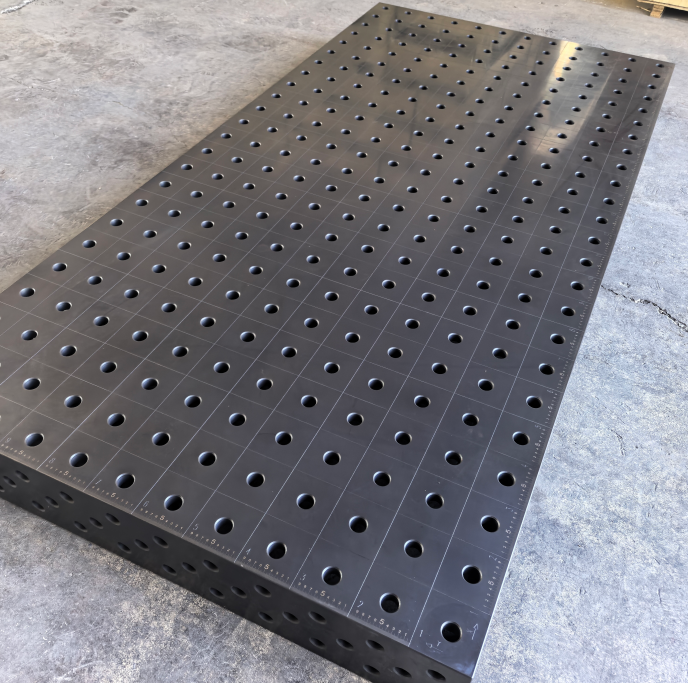
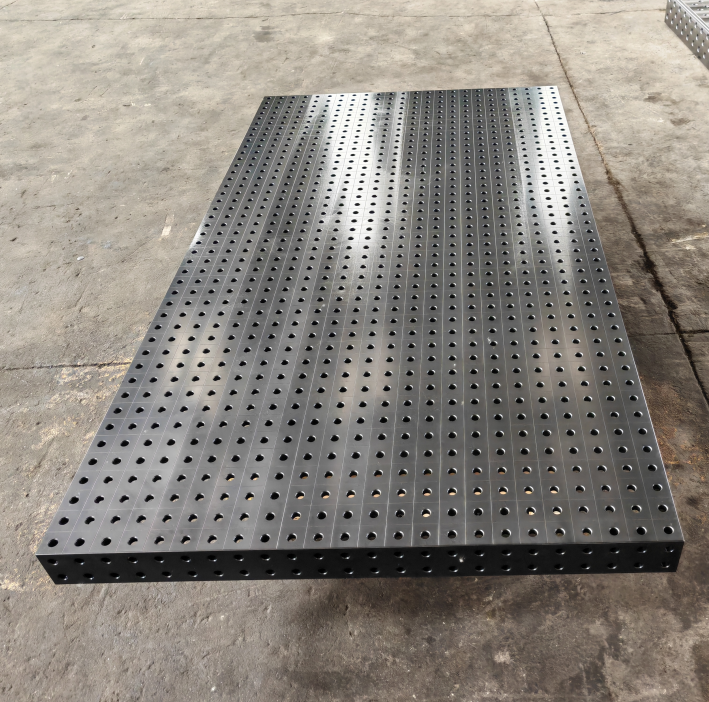
The core identity of a modular welding table lies in its standardized hole pattern. Typically arranged in a precise grid, these holes accept a vast ecosystem of compatible tooling, including stops, clamps, angles, and pins. This design transforms a static surface into a dynamic fabrication platform.
Traditional welding tables often rely on flat surfaces where workers must manually measure, tack, and adjust parts using external C-clamps or makeshift blocks. In contrast, the modular approach integrates positioning directly into the table structure. The holes are machined to tight tolerances, ensuring that any tool inserted fits securely without play.
Key characteristics include:
- Precision Grid: Holes spaced at consistent intervals (commonly 100mm or 50mm) across the entire surface.
- Material Integrity: Constructed from high-grade steel capable of withstanding intense heat and heavy impact.
- Versatile Fixturing: Compatibility with a wide range of accessories for holding, aligning, and rotating workpieces.
- Scalability: Multiple tables can be bolted together to create larger work areas while maintaining hole alignment.
This fundamental shift from “holding down” to “locking in” represents the evolution of modern metal fabrication. It allows operators to focus on the weld itself rather than struggling to keep components stationary.
The Critical Role of Precision in Modern Fabrication
In today’s competitive manufacturing landscape, tolerance stacking is a significant enemy of productivity. When parts are not held perfectly square during tacking, subsequent assembly steps compound these errors, leading to scrapped materials or hours of corrective grinding.
A modular welding table addresses this by providing a known reference plane. Because the table surface is machined flat and the holes are perpendicular to the surface, any tooling inserted creates a guaranteed 90-degree angle or a precise offset. This eliminates the guesswork associated with traditional methods.
Industry professionals recognize that time spent setting up a job is non-value-added time. However, with modular systems, setup becomes a rapid, repeatable process. Once a fixture is designed for a specific part, it can be recreated instantly for future batches. This consistency is vital for shops handling custom orders alongside production runs.
Furthermore, the ability to verify dimensions directly on the table reduces the need for post-weld inspection failures. Welders can measure against the grid lines or use pinned stops to ensure length and width specifications are met before the first arc is struck.
Modular vs. Traditional Solid-Top Tables: A Detailed Comparison
Understanding the tangible differences between modular systems and conventional solid-top tables helps justify the investment. While solid tables have served the industry for decades, they lack the adaptability required for complex modern projects.
The following table highlights the operational distinctions between the two approaches:
| Feature |
Modular Welding Table |
Traditional Solid-Top Table |
| Clamping Flexibility |
Infinite positions via grid holes; access from top and sides. |
Limited to table edges; requires C-clamps or magnetic bases. |
| Setup Speed |
Rapid; uses quick-release pins and pre-set stops. |
Slow; requires manual measuring and tightening for each job. |
| Repeatability |
High; fixtures can be saved and reused exactly. |
Low; relies on operator memory and manual re-measurement. |
| Squareness Assurance |
Built-in via perpendicular hole machining. |
Dependent on external squares and operator skill. |
| Surface Damage |
Localized; holes absorb spatter, surface remains usable. |
Global; spatter and arcs damage the entire working plane. |
| Expansion Capability |
Tables link seamlessly to expand work area. |
Different heights and levels make joining difficult. |
As shown, the modular system excels in scenarios requiring precision and repetition. Traditional tables may suffice for rough structural work where tolerances are loose, but they become bottlenecks in high-mix or high-precision environments.
Core Advantages of Adopting a Modular Workflow
Transitioning to a modular welding table delivers immediate benefits that impact the bottom line. These advantages extend beyond mere convenience, influencing material usage, labor costs, and final product quality.
Drastic Reduction in Setup Time
The most noticeable improvement is the speed of job preparation. Instead of spending twenty minutes squaring a frame with a carpenter’s square and multiple clamps, a welder can drop pins into the grid, slide stops against the workpiece, and lock it in seconds. This efficiency compounds over a workday, allowing for more completed units.
Enhanced Weld Quality and Consistency
When parts are held rigidly in the correct position, distortion during cooling is easier to manage. The massive thermal mass of the table also acts as a heat sink, drawing heat away from the weld zone and reducing warping. This results in straighter assemblies and less need for post-weld straightening.
Versatility Across Projects
One table can handle vastly different tasks. By changing the arrangement of stops and clamps, the same surface can accommodate small bracket fabrication one hour and large structural frames the next. There is no need for dedicated fixtures for every single part number, saving valuable floor space.
Improved Ergonomics and Safety
Modular tables are typically designed with optimal working heights. The ability to clamp workpieces securely at waist level reduces the need for bending or awkward positioning. Furthermore, secure clamping minimizes the risk of parts shifting unexpectedly during welding, enhancing overall shop safety.
Essential Components of the Modular Ecosystem
To fully leverage the potential of a modular welding table, understanding the available tooling is crucial. The table is merely the foundation; the accessories provide the functionality. Leading manufacturers like Botou Haijun Metal Products Co., Ltd. have specialized in refining this ecosystem, offering comprehensive solutions that bridge the gap between theoretical precision and practical application.
Haijun Metal focuses on the research, development, and production of high-precision flexible modular fixtures tailored for the modern manufacturing industry. Their core product line features robust 2D and 3D flexible welding platforms, which have become preferred jigging equipment in demanding sectors such as machining, automotive, and aerospace. What sets their offerings apart is the seamless integration of the platform with a vast array of complementary components.
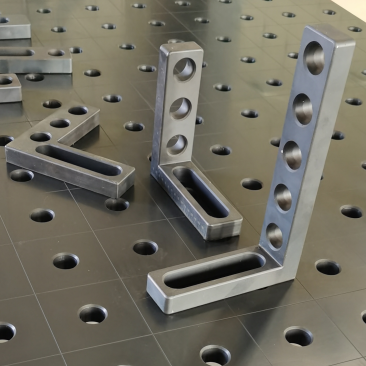
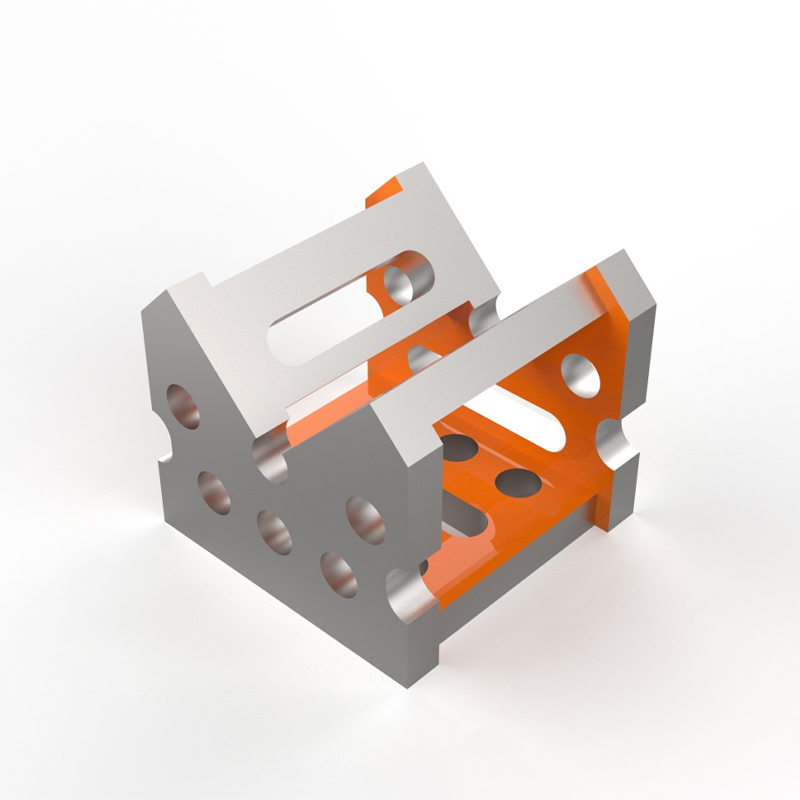
Stops and Angles: These are the most common tools. L-stops, U-stops, and adjustable angle stops allow users to create corners and edges quickly. Haijun Metal enhances this category with multi-purpose square boxes (U-shaped and L-shaped) and 200-series support angle irons, designed to slide effortlessly into the grid and lock via lever or screw mechanisms.
Clamps: Specialized toggle clamps and pneumatic clamps designed for the grid system offer superior holding power compared to standard C-clamps. They often feature swivel pads to accommodate uneven surfaces, ensuring rigid fixation regardless of workpiece geometry.
Pins and Bushings: Hardened steel pins act as locators. They can define the boundary of a part or serve as pivot points for rotation. Bushings protect the table holes from wear when frequent sliding occurs. Precision is paramount here, and companies like Haijun ensure their pins maintain tight tolerances to prevent play.
Advanced Measurement and Connection: Beyond basic clamping, the ecosystem includes tools like 0-225° universal angle gauges and professional cast iron angle connection blocks. These accessories enable complex 3D positioning and ensure exceptional durability and stability, even under heavy load.
Investing in a comprehensive set of tooling from experienced suppliers ensures that the workshop can tackle any geometry. With years of industry experience serving customers both domestically and internationally, trusted providers continue to deliver high-quality production machinery tool series that empower fabricators to achieve machine-like consistency.
Step-by-Step Guide to Setting Up a Repeatable Fixture
Creating a reusable fixture on a modular table is a straightforward process that yields long-term dividends. Follow these steps to establish a reliable setup for batch production.
- Step 1: Analyze the Part Geometry. Review the blueprint or sample part to identify critical datums. Determine which surfaces need to be held square and where clamping forces should be applied to avoid distortion.
- Step 2: Clear and Clean the Surface. Remove any spatter or debris from the table grid. Ensure the holes are free of obstruction so tools seat fully and accurately.
- Step 3: Establish the Primary Datum. Insert a long stop or a series of pins along one edge of the table to serve as the primary reference line. Lock these tools securely.
- Step 4: Position Secondary Stops. Add perpendicular stops to define the corner or width of the assembly. Use a precision square if necessary, though the table grid usually guarantees 90 degrees.
- Step 5: Place the Workpiece. Slide the raw materials against the stops. Apply clamps to hold the pieces firmly against the table surface and the stops simultaneously.
- Step 6: Verify Dimensions. Measure the diagonal distances or use a calibrated gauge to confirm the assembly is square and to size before tacking.
- Step 7: Document the Layout. Take a photo or sketch the position of the stops relative to the grid coordinates. This allows the fixture to be rebuilt identically in the future.
By following this structured approach, workshops can transition from one-off fabrication to streamlined production lines without expensive custom jigging.
Ideal Applications for Modular Welding Tables
While beneficial for almost any metalworking task, certain industries and applications derive exceptional value from modular welding tables.
Custom Automotive and Motorcycle Fabrication
Builders of roll cages, exhaust systems, and custom frames require extreme precision. The ability to tack tubes in perfect alignment prevents fitment issues during final assembly. The modular grid allows for complex 3D positioning that solid tables cannot support.
Architectural Metalwork
Gates, railings, and staircases demand aesthetic perfection. Any deviation in squareness is visually obvious. Modular tables ensure that every section matches the others, facilitating seamless installation on-site.
Robotics and Automation Integration
Modern workshops increasingly integrate collaborative robots (cobots) for welding. Modular tables provide the rigid, repeatable mounting points necessary for robot end-effectors and part positioners, enabling automated cells to function reliably.
Prototyping and R&D
Research departments often deal with one-off designs. The flexibility to reconfigure the workspace instantly makes modular tables ideal for testing new concepts without committing to permanent tooling.
Maintenance and Longevity Considerations
To maintain the authoritativeness and precision of a modular welding table, proper care is essential. Although built for durability, neglect can degrade performance over time.
Spatter Management: While the holes can tolerate some spatter, excessive buildup can prevent tools from seating correctly. Regular cleaning with a wire brush or specialized anti-spatter spray is recommended. Some users apply ceramic coatings to the surface to facilitate easier cleaning.
Hole Inspection: Periodically check the condition of the holes. If a hole becomes ovalized due to abuse or excessive force, it may need to be reamed or replaced depending on the table design. Using the correct size pins and avoiding hammering tools into the holes preserves their integrity.
Surface Flatness: Avoid dropping heavy objects from significant heights, which could dent the surface. If dents occur, they can often be ground flat, but prevention is preferable. Keeping the table level on the shop floor is also critical for accurate measurements.
With routine maintenance, a high-quality modular table can serve as the centerpiece of a workshop for decades, retaining its value and utility.
Common Misconceptions About Modular Systems
Despite their growing popularity, several myths persist regarding modular welding tables. Addressing these clarifies their true value proposition.
Myth: They are too expensive for small shops.
Reality: While the upfront cost is higher than a basic steel plate, the reduction in labor hours and material waste often provides a return on investment within months. For small shops doing high-margin custom work, the precision justifies the cost immediately.
Myth: The holes weaken the table structure.
Reality: Engineering analysis shows that the grid pattern distributes stress effectively. These tables are designed to handle substantial loads, often exceeding the capacity of equivalent solid plates due to the ribbed construction underneath.
Myth: Tooling is proprietary and limiting.
Reality: The industry has largely standardized around specific hole patterns (such as the 16mm or 28mm systems). This means users can mix and match tools from various reputable manufacturers, ensuring a broad selection without vendor lock-in.
Myth: They are only for CNC or robotic welding.
Reality: Manual welders benefit the most from the ergonomic and setup advantages. The system empowers individual craftsmen to achieve machine-like consistency.
Frequently Asked Questions (FAQ)
Can I weld directly on the surface of a modular table?
Yes, the surfaces are made of weldable steel. However, it is best practice to use copper backing plates or spatter shields to protect the finish and prevent spatter from clogging the holes. Direct welding is acceptable for tacking, but prolonged arcing on the surface may cause local hardening or pitting.
How do I choose the right hole size for my needs?
The choice depends on the scale of your work. Smaller hole patterns (e.g., 100mm spacing with 16mm holes) are ideal for light fabrication, tubing, and detailed work. Larger patterns (e.g., 200mm spacing with 28mm holes) suit heavy structural steel and large-scale assemblies. Consider the weight of your typical projects and the size of clamps required.
Is it possible to connect multiple tables together?
Absolutely. Most modular tables feature machined edges with bolt holes specifically designed for linking. When connected properly, the grid aligns seamlessly, creating a larger continuous work surface. This scalability allows workshops to adapt their floor plan as project sizes change.
Do modular tables require special training to use?
No special certification is needed. The learning curve is minimal, especially for experienced welders. The intuitive nature of the grid system means operators can become proficient after a few projects. Manufacturers often provide guides and videos to accelerate the onboarding process.
What is the expected lifespan of a modular welding table?
With proper maintenance, these tables are built to last indefinitely. The steel construction resists wear, and individual components like stops and pins can be replaced if worn. Unlike wooden or lightweight benches, a modular table is a permanent asset that retains functional value over time.
Conclusion: Elevating Your Workshop Standards
The adoption of a modular welding table represents a strategic move toward higher efficiency, precision, and professionalism in metal fabrication. By replacing ad-hoc clamping methods with a systematic, grid-based approach, workshops can significantly reduce setup times, minimize errors, and enhance the overall quality of their output.
This technology is particularly essential for businesses focused on custom fabrication, architectural metalwork, and low-to-medium volume production where flexibility and accuracy are paramount. While the initial investment involves both the table and the accompanying tooling, the long-term gains in labor savings and material conservation make it a compelling choice for forward-thinking operations.
For shop owners and fabricators looking to stay competitive, the question is no longer whether to upgrade, but how soon. Evaluating your current workflow constraints and identifying the bottlenecks caused by traditional fixturing is the first step. Exploring the specific models and tooling packages that align with your project scale—such as the comprehensive 2D/3D platforms and precision accessories offered by industry leaders like Botou Haijun Metal Products—will pave the way for a more streamlined and profitable future.
Embracing the modularity of modern welding tables is not just about buying new equipment; it is about adopting a mindset of precision and continuous improvement that defines the leading workshops of tomorrow.