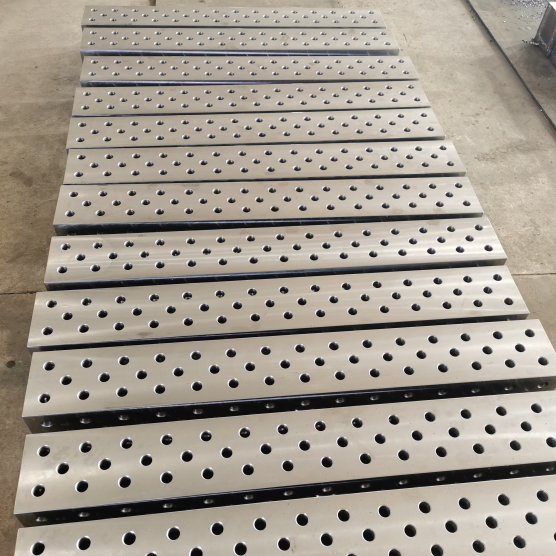
A heavy duty welding table is a precision-engineered work surface designed to withstand extreme thermal stress, high-impact loads, and continuous industrial use. Unlike standard fabrication benches, these tables feature thick steel tops (typically 12mm to 50mm), robust leg structures, and integrated fixturing systems like precision hole patterns or T-slots. In 2026, the top industrial models prioritize flatness tolerance within ±0.5mm over the entire surface, ensuring repeatable accuracy for complex assemblies. Selecting the right unit involves evaluating load capacity, material grade (usually S355JR or equivalent), and surface treatment to prevent warping under intense heat cycles.
Defining the Heavy Duty Welding Table in Modern Fabrication
The evolution of metal fabrication has shifted from simple joinery to complex, modular assembly. A heavy duty welding table serves as the foundational platform for this process. It is not merely a place to rest metal; it is an active tool that influences weld quality, dimensional accuracy, and operator safety.
In professional environments, the definition extends beyond weight capacity. True heavy-duty classification requires resistance to thermal distortion. When arcs strike near the surface, localized heating can cause standard steel to cup or bow. Industrial-grade tables utilize stress-relieved steel plates and engineered ribbing underneath to dissipate heat and maintain geometric stability.
- Structural Integrity: Designed to support loads exceeding 2,000 kg without deflection.
- Thermal Resistance: Capable of withstanding direct arc strikes and spatter without compromising flatness.
- Modularity: Equipped with standardized hole patterns (e.g., D16, D28) or T-slots for versatile clamping.
- Grounding Efficiency: Provides reliable electrical grounding points to ensure arc stability and safety.
For facilities operating in 2026, the expectation is zero downtime due to equipment failure. The table must endure years of abrasive cleaning, chemical exposure, and mechanical impact. This durability reduces the total cost of ownership, making the initial investment in a premium unit more economical than replacing lighter alternatives every few years.
Core Construction Standards and Material Specifications
Understanding the metallurgy behind a heavy duty welding table is critical for procurement managers and shop floor supervisors. The performance lifecycle of the table depends heavily on the grade of steel used and the manufacturing processes applied during fabrication.
Steel Grade and Plate Thickness
Most high-end industrial tables utilize low-carbon structural steel, such as S355JR or ASTM A36. These materials offer an optimal balance between tensile strength and weldability. The tabletop thickness is a primary indicator of duty rating.
Tables intended for light fabrication may use 10mm to 12mm plates. However, true heavy duty applications demand thicknesses ranging from 16mm up to 50mm. Thicker plates provide greater thermal mass, which absorbs heat energy more effectively, reducing the risk of localized warping. For automated robotic welding cells, where precision is paramount, 30mm+ plates are often the standard to ensure the robot’s end-effector maintains consistent contact points.
Stress Relief and Flatness Tolerance
Raw steel plates contain internal stresses from the rolling mill. If machined without treatment, these stresses release over time, causing the table to twist. Premium manufacturers employ vibratory stress relief or thermal oven treatments before final machining.
The resulting flatness tolerance is a key specification. While general-purpose tables might claim “flat enough,” industrial specifications require documented tolerances. A common standard for 2026 models is ±0.5mm across the entire working surface. This level of precision allows fabricators to assemble large structures without needing excessive shimming or force-fitting, which introduces residual stress into the final product.
Surface Treatments and Coatings
Bare steel is prone to rapid oxidation, leading to rust that can contaminate welds. Conversely, thick paint layers can burn off, creating toxic fumes and uneven surfaces. The industry standard for heavy-duty tables involves specialized treatments:
- Machined Bare Surface: Often coated with a thin layer of oil or wax for storage. Users must apply their own anti-spatter spray.
- Nitriding or Hardening: Some advanced tables undergo surface hardening to resist scratching from dragged components.
- Ceramic-Based Coatings: Emerging in 2026, these coatings withstand higher temperatures than traditional paints and facilitate easier spatter removal.
Selecting the appropriate surface finish depends on the specific welding processes used. MIG/MAG operations generate significant spatter, requiring a surface that allows easy chipping. TIG welding demands a cleaner surface to prevent tungsten contamination.
Top Industrial Models and Configuration Types for 2026
The market for heavy duty welding table solutions has diversified to meet specific sector needs. In 2026, buyers generally choose between three primary configurations based on their workflow requirements: Precision Fixture Tables, Modular T-Slot Systems, and Custom Heavy-Plate Benches.
Precision Fixture Tables (Hole Pattern Systems)
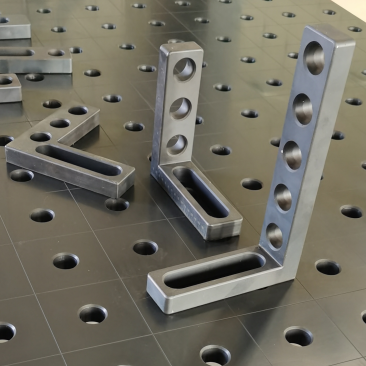
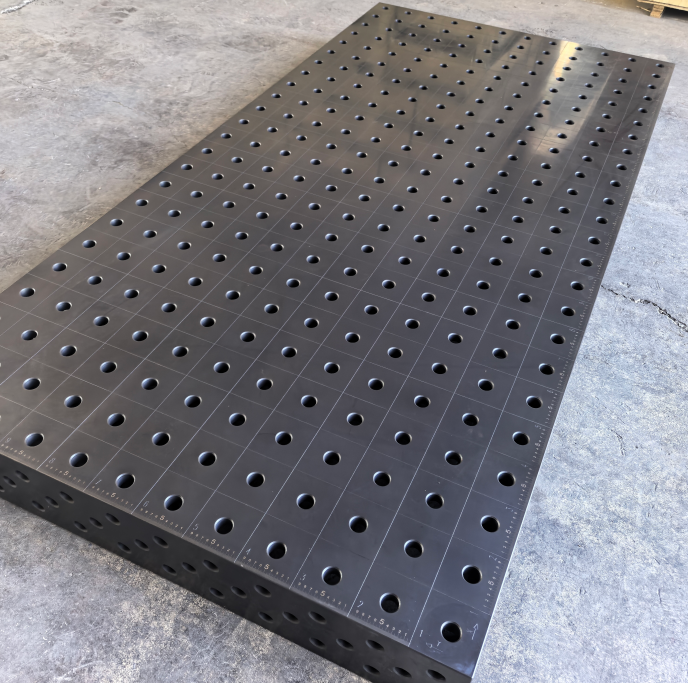
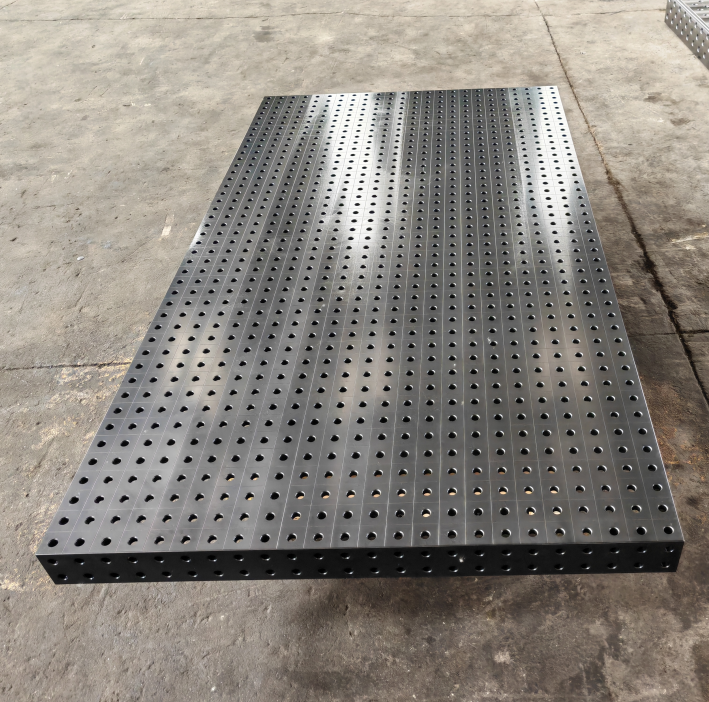
These tables feature a grid of precisely drilled holes with tight tolerances. They are the preferred choice for shops utilizing 3D welding fixtures. The holes allow for the insertion of stops, clamps, and angle brackets at any point on the surface.
The advantage lies in repeatability. Once a fixture setup is proven, it can be replicated instantly on another identical table. This is essential for batch production where consistency is key. The hole pattern also facilitates easy cleaning, as debris falls through or can be blown out with compressed air.
Modular T-Slot Welding Tables
T-slot tables utilize channels machined into the surface, allowing bolts to slide freely along the axis. This design offers superior flexibility for holding odd-shaped or very large components that do not align with a fixed grid pattern.
While slightly less rigid than solid plate tables due to the material removed for slots, modern engineering has mitigated this with reinforced webbing underneath. T-slot systems are ideal for structural steel fabrication, shipbuilding components, and heavy machinery repair where clamp positioning varies wildly between jobs.
Solid Plate Heavy-Duty Benches
For the most extreme applications, such as forging support or massive pipe fitting, solid plate tables without holes or slots are utilized. These provide the maximum possible surface area and structural continuity.
They are often custom-built to specific dimensions. Without perforations, there is no risk of molten metal dripping onto underlying structures or flooring. These tables rely on edge clamping or magnetic fixtures rather than through-bolting. They represent the pinnacle of load-bearing capacity, often supporting upwards of 5,000 kg.
Comparative Analysis: Heavy Duty vs. Standard Fabrication Tables
Deciding between a standard bench and a heavy duty welding table often comes down to long-term operational costs versus initial purchase price. The following comparison highlights the technical divergences that impact productivity and safety.
| Feature |
Standard Fabrication Table |
Heavy Duty Welding Table |
| Top Thickness |
6mm – 10mm |
16mm – 50mm+ |
| Flatness Tolerance |
±2.0mm or unspecified |
±0.5mm or better |
| Load Capacity |
500kg – 1,000kg |
2,000kg – 10,000kg+ |
| Leg Structure |
Light gauge tubing, bolted |
Heavy rectangular tube, welded & gusseted |
| Thermal Distortion |
High risk of warping |
Engineered for thermal stability |
| Fixturing Options |
Limited to edge clamping |
Full surface modularity (Holes/Slots) |
| Lifespan |
3-5 years in heavy use |
15-20+ years |
The data indicates that while standard tables suffice for hobbyists or occasional repair work, they fail under the rigors of continuous industrial production. Warping in a standard table leads to cumulative errors in assembly, requiring rework that erodes profit margins. The heavy-duty alternative acts as an insurance policy against quality drift.
Key Selection Criteria for Industrial Procurement
When sourcing a heavy duty welding table for a facility upgrade or new line installation, several critical factors must be evaluated to ensure the asset meets future demands.
Load Distribution and Center of Gravity
It is not enough to know the maximum static load. Consider how the weight will be distributed. Will the table support a concentrated point load from a heavy vice, or a distributed load from a large sheet assembly? Heavy-duty tables are engineered with leg placement and cross-bracing to handle both scenarios without racking.
Furthermore, the height of the table affects the center of gravity for tall assemblies. Adjustable feet are a mandatory feature to compensate for uneven factory floors, ensuring the table remains level regardless of the underlying surface conditions.
Compatibility with Automation
In 2026, many welding operations involve collaborative robots (cobots) or gantry systems. The welding table must serve as a stable base for these machines. Vibration damping becomes crucial. A table that resonates under the movement of a robotic arm can degrade weld bead consistency.
Look for designs that incorporate vibration-dampening materials in the leg structure or allow for anchoring directly to the concrete foundation. The surface must also be compatible with robot mounting plates, often requiring specific thread pitches or adapter interfaces.
Ergonomics and Workflow Integration
Operator fatigue is a hidden cost. A table that is too low forces welders to hunch, while one that is too high reduces leverage. The ideal working height places the weld joint at elbow level for the average operator. Some heavy-duty models offer hydraulic lift capabilities or modular extensions to adapt to different tasks and user heights.
Additionally, consider cable management. Integrated channels or hooks for grounding cables and torch leads keep the workspace tidy and reduce trip hazards, a common OSHA violation in busy shops.
Application Scenarios Across Industries
The versatility of a heavy duty welding table makes it indispensable across various sectors. Its role changes slightly depending on the industry-specific challenges faced.
Structural Steel and Construction
In this sector, components are massive and often irregular. T-slot tables are predominantly used here. Fabricators assemble beams, columns, and trusses. The ability to lock down heavy sections quickly using sliding bolts accelerates the tack-welding process. The table’s mass absorbs the shock of fit-up adjustments, keeping the assembly stable.
Precision Machinery and Aerospace
Tolerances in aerospace are measured in fractions of a millimeter. Here, precision fixture tables with hardened, ground surfaces are the norm. The focus is on repeatability. Jigs are built once and used thousands of times. Any deviation in the table’s flatness translates directly to non-conforming parts. Cleanliness is also paramount, necessitating tables that resist spatter adhesion.
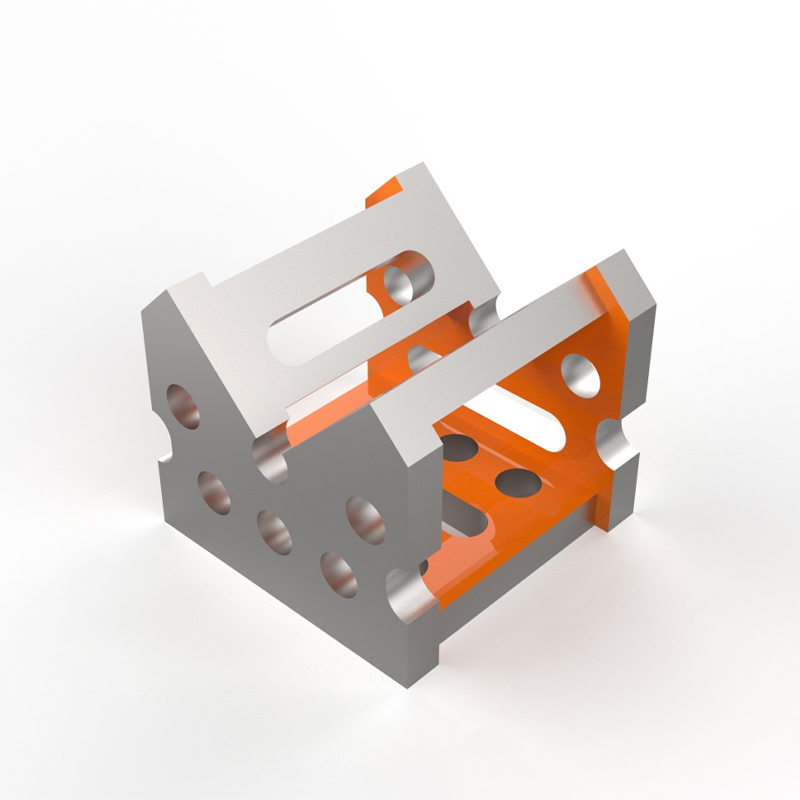
Leading manufacturers like Botou Haijun Metal Products Co., Ltd. have recognized these stringent requirements, specializing in the R&D and production of high-precision flexible modular fixtures tailored for such demanding environments. Their core product line includes advanced 2D and 3D flexible welding platforms, which have become the preferred jigging equipment in the machining, automotive, and aerospace industries due to their exceptional versatility and precision. By integrating comprehensive complementary components—such as U-shaped and L-shaped multi-purpose square boxes, 200-series support angle irons, and 0-225° universal angle gauges—Haijun Metal ensures that every platform enables rapid workpiece positioning and clamping. Furthermore, their professional cast iron 3D welding platforms and angle connection blocks deliver the exceptional durability and stability required for high-stakes aerospace applications.
Energy and Pipeline Fabrication
Pipe spools and pressure vessels require rotation and complex angular positioning. Heavy-duty tables in this sector often integrate with positioners and turntables. The table itself must anchor these dynamic loads securely. Resistance to high heat is critical, as pre-heating of thick-walled pipes is common practice before welding begins.
Operational Best Practices and Maintenance Protocols
Investing in a premium table is only the first step. Maximizing its lifespan and maintaining its precision requires adherence to strict operational protocols. Neglect can render even the most expensive table useless within a few years.
Spatter Management Strategies
Weld spatter is the enemy of flatness and modularity. If spatter builds up in hole patterns or T-slots, fixtures will no longer seat correctly. Implement a routine cleaning schedule.
- Preventative Coating: Apply ceramic anti-spatter sprays before starting work. These create a barrier that allows spatter to chip off easily.
- Regular Scraping: Use dedicated scraping tools to remove buildup daily. Avoid using the table surface as an anvil for hammering, as this creates dents that trap spatter.
- Thermal Cleaning: For severe buildup, controlled heating followed by quenching can sometimes loosen scale, though this should be done cautiously to avoid warping.
Corrosion Prevention
Even treated steel can rust in humid environments or when exposed to certain coolants. A light application of machine oil or a dedicated rust inhibitor should be part of the weekly shutdown procedure. If the table is stored outdoors or in an unheated warehouse, heavy-duty covers are essential to prevent moisture accumulation.
Periodic Flatness Verification
Over time, even heavy-duty tables can experience minor shifts due to extreme abuse or foundation settling. Schedule an annual inspection using a precision straightedge and feeler gauges. Document the flatness readings. If deviations exceed the manufacturer’s tolerance, professional resurfacing may be required to restore the table to its original specification.
Common Mistakes in Welding Table Utilization
Despite their robustness, heavy duty welding table units are often misused, leading to premature degradation. Awareness of these pitfalls can save significant replacement costs.
Mistake 1: Using the Table as a Cutting Board. Plasma cutting or oxy-fuel cutting directly on the table surface gouges the steel. These gouges become traps for spatter and disrupt the flatness required for precision work. Always use sacrificial slats or cutting bars placed across the table.
Mistake 2: Overloading Beyond Design Limits. While rated for heavy loads, dropping a 5-ton component from a crane onto the center of the table can cause immediate plastic deformation. Loads should be lowered gently and distributed evenly whenever possible.
Mistake 3: Ignoring Grounding Connections. Failing to establish a clean, tight ground connection to the table forces the welding current to seek alternative paths, potentially damaging bearings in adjacent machinery or causing arc instability. Dedicated ground studs should be used and kept free of paint and rust.
Frequently Asked Questions (FAQ)
What is the minimum thickness for a heavy duty welding table?
For genuine heavy-duty industrial applications, the minimum recommended thickness is 16mm (5/8 inch). Thicknesses below this, such as 10mm, are generally considered medium-duty and may warp under high-heat, continuous welding cycles. For robotic cells or extreme precision, 30mm or thicker is preferred.
Can I drill my own holes in a solid heavy duty table?
While physically possible, it is not recommended. Drilling into a stress-relieved plate can reintroduce local stresses and compromise the heat treatment. Furthermore, achieving the precise perpendicularity and tolerance required for fixturing pins is difficult without CNC equipment. It is better to purchase a table with a pre-machined hole pattern or use T-slot adapters.
How do I clean welding spatter from a precision table?
Avoid aggressive grinding which removes base material. Use a pneumatic needle scaler or a dedicated spatter scraper. Applying an anti-spatter compound before welding significantly reduces adhesion. For stubborn residue, a localized application of spatter remover gel followed by gentle scraping is effective.
Is a T-slot table stronger than a hole-pattern table?
Generally, a solid hole-pattern table retains more structural integrity because less material is removed from the top plate. T-slots require deep machining that can reduce the moment of inertia of the plate. However, modern T-slot tables compensate with thicker overall profiles and reinforced substructures. The choice should depend on fixturing needs rather than raw strength alone.
What type of steel is best for welding tables?
Low-carbon structural steels like S355JR (European standard) or ASTM A36 (US standard) are the industry standards. They offer excellent weldability and strength. High-carbon steels should be avoided as they are prone to cracking under thermal cycling and are difficult to machine for hole patterns.
Conclusion and Strategic Recommendations
The heavy duty welding table is the cornerstone of a productive and safe fabrication environment. As we move through 2026, the demands for precision, durability, and adaptability continue to rise. Investing in a high-specification table is not merely a purchase of furniture; it is a strategic decision that impacts weld quality, throughput speed, and long-term operational costs.
For enterprises focused on high-mix, low-volume production, a modular T-slot system offers the necessary flexibility. Conversely, facilities dedicated to high-volume batch production will find greater value in precision hole-pattern tables that guarantee repeatability. Regardless of the configuration, prioritizing material thickness, stress-relief processing, and flatness tolerance ensures the asset serves the company for decades.
Choosing the right model requires a clear understanding of your specific load requirements, thermal inputs, and fixturing strategies. Do not compromise on the foundation of your workshop. A warped table leads to warped products, rework, and lost reputation.
To explore our range of engineered heavy duty welding table solutions tailored to your specific industrial needs, contact our technical team today. We provide detailed load analysis and custom configuration advice to ensure your next investment drives immediate efficiency gains.