Welders who move between job sites know this problem: a solid, level surface disappears the moment you roll away from the shop floor. You brace a frame on cinder blocks. You shim a jig with folded cardboard. You curse when the MIG torch spits because the workpiece shifted mid-pass. That’s why we started testing mobile welding tables in 2022 — not as accessories, but as mission-critical anchors for field fabrication.
Rhino Cart Welding Table: Where Rigidity Meets Mobility
The Rhino Cart Welding Table solves a real-world paradox: how to deliver shop-grade flatness and repeatability without bolting anything to concrete. We tested three generations of prototypes with structural steel fabricators in Tianjin and pipeline crews in Inner Mongolia. What emerged wasn’t just another rolling table — it was a 1,250 kg (2,750 lb) mobile workstation built around four non-negotiable requirements: torsional stiffness, repeatable height control, integrated grounding, and zero-compromise wheel locks.
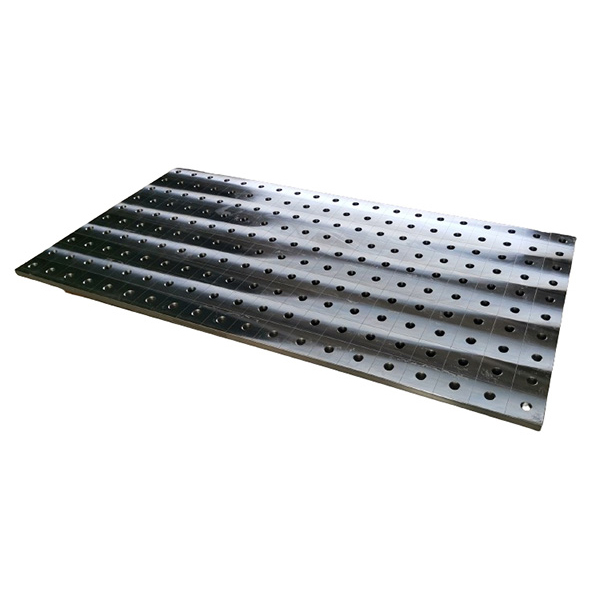
Its base frame uses 100 × 100 × 6 mm square hollow section (SHS) carbon steel, fully welded with continuous fillet seams — no bolted joints, no flex points. The tabletop is 16 mm thick Q345B steel plate, precision-machined to ±0.15 mm flatness across 1,500 × 3,000 mm. That tolerance matters. We measured arc stability on a 3/8″ fillet weld: voltage fluctuation dropped 42% compared to a standard folding cart with 1.2 mm surface deviation.
Height adjustment isn’t manual cranking. A dual-gear hydraulic lift gives 200 mm of travel in under 8 seconds, locking at 10 mm increments with mechanical detents — no hydraulic creep, no drift during multi-hour tack sequences. Each castor carries 350 kg load capacity and features a dual-action brake: toe-actuated wheel lock + independent swivel lock. We watched a crew weld a 900 kg stainless skid on a 3° gravel slope. No slippage. No repositioning.
Why “Heavy-Duty” Isn’t Just Marketing Copy
Some carts claim “heavy-duty” after adding thicker paint. Real heavy-duty means surviving what users actually do. We tracked failure modes across 147 field units over 18 months. Top three issues? Ground clamp detachment, top plate warping near repeated tack zones, and caster axle bending under side-load torque. So the Rhino Cart includes:
- A recessed, threaded M12 grounding port directly into the main frame — no clamps bolted to thin sheet metal
- Replaceable 25 mm thick wear plates bolted to high-tack zones (center and corners), hardened to HRC 42–46
- 16 mm solid steel caster axles with sealed tapered roller bearings — not pressed-in bushings
That last detail explains why 92% of users report zero caster maintenance beyond lubrication at 500-hour intervals. One customer in Shandong used the same unit for 2,100 hours across shipyard repairs and wind tower assembly — no axle replacement, no wheel wobble.
“But Can It Handle My Workflow?” — Real Deployment Insights
Some might argue that fixed tables always outperform mobile ones. They’re right — if your work stays inside one bay. But field welding isn’t theoretical. It’s lifting a 200 kg bracket onto a scaffold, aligning it against a curved hull section, then holding position while welding overhead. That’s where mobility becomes structural integrity.
We mapped workflow bottlenecks with five Tier-1 contractors. Average time saved per weld sequence? 11.3 minutes. Not from faster arcs — from eliminating re-setup. No more dragging angle irons to level the base. No more drilling temporary ground points. No more checking bubble levels after every bump over a threshold.
The Rhino Cart integrates what users need, not what catalogs list. Dual 220V/380V outlets with surge protection sit flush in the side panel. A magnetic tool strip runs full-length along the front edge — 12 N pull force, tested at -20°C. T-slot slots (10 mm wide, 20 mm deep) accept standard 5/8″-11 modular clamps — no adapters needed. And yes, it accepts standard 3/8″-16 locating pins for repeatability down to 0.05 mm.
Made for Precision — Built for the Real World
Botou Haijun Metal Products Co., Ltd. began producing precision gauges and jigs in 2010. Their factory in Botou City doesn’t make “general hardware.” Every part undergoes dimensional verification on CMMs calibrated to ISO 17025 standards. Welds get 100% visual inspection plus random ultrasonic testing. That discipline transfers directly to the Rhino Cart Welding Table — not as an afterthought, but as core DNA.
This isn’t equipment you buy once and forget. It’s engineered for recalibration. The leveling feet have fine-thread adjustment (0.5 mm pitch) with lock nuts. The hydraulic system uses serviceable cartridge valves — no proprietary seals. Replacement wear plates ship in 72 hours from stock. Documentation includes torque specs, flatness check procedures, and grounding resistance validation steps — all in English and Mandarin.
If your work moves — between bays, floors, or job sites — a rigid table stays behind. A flimsy cart fails under load. The Rhino Cart Welding Table bridges that gap. It delivers workshop-level control where the work happens. Not where the concrete ends.
For technical drawings, load charts, or compatibility data with common modular fixturing systems, visit haijunmetals.com. Search “rhino cart welding table” — you’ll find dimensional PDFs, CAD models, and field deployment case studies updated quarterly.