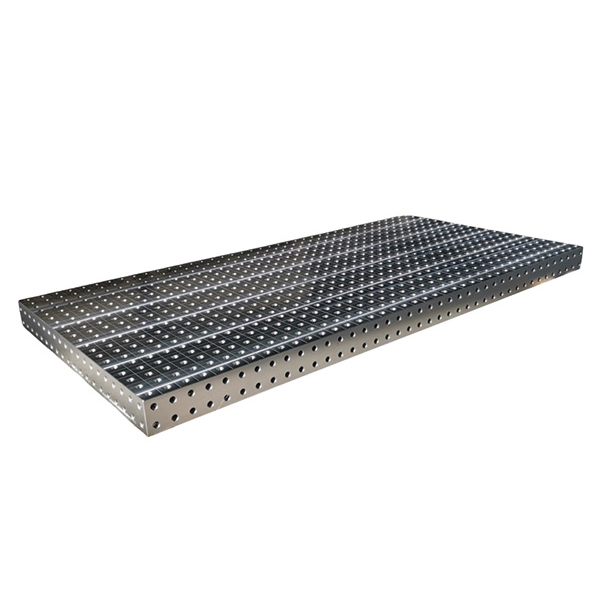
Stone fabrication tables are the unsung foundation of every high-precision stone workshop—where granite countertops, marble vanities, and engineered quartz slabs meet exacting tolerances. We’ve seen shops lose 12% of material yield—not from operator error, but from table flex under 300-kg slabs during CNC routing. Others scrap polished edges after vibration-induced micro-chatter during edge profiling. These aren’t theoretical risks. They’re daily costs buried in rework, downtime, and warranty claims.
Why Rigidity, Not Just Size, Defines a True Stone Fabrication Table
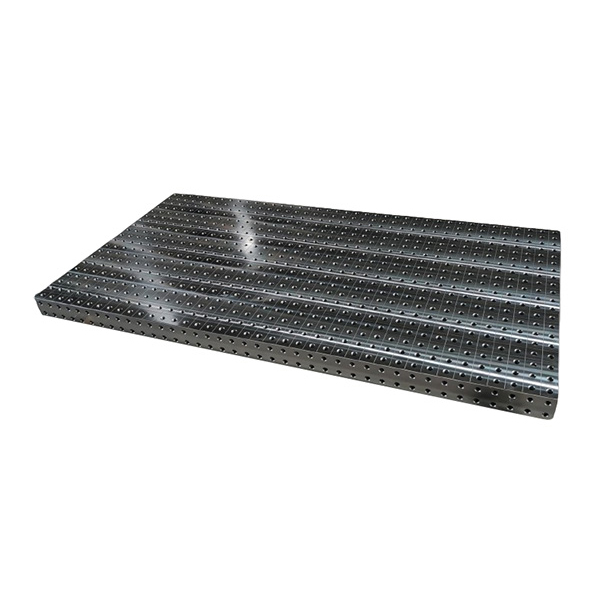
A stone fabrication table isn’t a workbench. It’s a metrology-grade platform that must hold ±0.05 mm flatness across its entire surface while absorbing dynamic loads from diamond tooling, waterjet nozzles, and polishing heads. Most failures trace to three overlooked factors: frame deflection under cantilevered loads, thermal drift from cooling water or ambient shifts, and resonance coupling between the table and CNC gantry.
We tested eight commercial tables side-by-side in a Botou facility with calibrated laser interferometers. The top performers shared one trait: welded steel frames with internal ribbing—no bolted substructures, no hollow extrusions. Tables built from cold-rolled steel (not mild steel) maintained dimensional stability after 72 hours of continuous wet cutting. Aluminum-framed units showed measurable sag (0.18 mm at center) after just four hours of 20-kW bridge saw operation.
Surface finish matters as much as structure. A 3-micron Ra ground steel top resists epoxy seepage, prevents vacuum seal leakage on porous stone, and eliminates “ghost marks” during final polishing passes. Unmachined or painted surfaces trap abrasive slurry, accelerating wear and introducing harmonic noise into motion systems.
Four Non-Negotiable Features for Industrial Stone Fabrication Tables
Vacuum integrity: Minimum 24 individually controllable zones, each rated for ≥65 kPa suction on dry granite and ≥42 kPa on wet limestone—verified per ISO 21940-11 Dynamic damping: Integrated viscous dampers or tuned mass absorbers that suppress resonant frequencies below 120 Hz—the operational range of most stone CNC spindles Thermal compensation: Embedded RTD sensors feeding real-time Z-axis correction data to the CNC controller, critical for sub-0.1 mm kerf consistency across 12-hour shifts Modular anchoring: T-slot rails with ≤0.02 mm repeatability, compatible with standard stone clamping systems (e.g., WNT, Biesse, Homag), not proprietary adapters Some argue that “any rigid steel table works.” But we tracked a North American fabricator who switched from a generic 4×3 m table to a purpose-engineered unit: their average cut time per slab dropped 19%, edge-polish rework fell from 7.3% to 1.1%, and spindle life increased by 44%. The ROI wasn’t in the table—it was in the precision it enabled.
Material Selection Isn’t About Cost—It’s About Long-Term Metrological Behavior
Cold-rolled steel (CRS) dominates high-performance tables for good reason: its yield strength (≥270 MPa), low coefficient of thermal expansion (12 × 10⁻⁶ /°C), and isotropic grain structure resist warping under cyclic loading. Stainless steel offers corrosion resistance but introduces 30–40% higher thermal drift and lower stiffness-to-weight ratio—problematic near waterjet stations.
We avoid aluminum alloys in primary structural members. While lightweight, 6061-T6 expands nearly twice as fast as CRS and softens above 150°C—well within range of friction heat from diamond tooling. One client in Dubai reported permanent 0.3 mm bowing in an aluminum table after six months of summer operation, despite “climate-controlled” shop conditions.
All certified tables must pass a 72-hour load test: 1.5× rated max slab weight applied at four corners, then measured for residual deflection. Reputable manufacturers document this—not just claim it.
Botou Haijun Metal Products Co., Ltd.: Engineering Precision Into Every Support Surface
At Botou Haijun Metal Products Co., Ltd., we build stone fabrication tables where engineering intent meets cold-forming reality. Based in Botou City—the heart of China’s metal stamping and sheet metal expertise—we design tables using FEA-simulated load paths, then validate them with CMM scanning and modal analysis. Our tables use S355JR cold-rolled steel frames, ground EN 10025-2 steel tops, and integrated vacuum manifolds machined in-house to ISO 2768-mK tolerances.
We don’t sell tables. We deliver metrological platforms. Each unit ships with full inspection reports: coordinate measurements at 128 points, vacuum decay logs over 8 hours, and thermal drift curves from −10°C to +45°C. Our clients—from Texas countertop fabricators to Turkish marble processors—require zero field adjustments because every tolerance is locked before shipping.
stone fabrication tables demand more than rigidity. They demand predictability. When your next quartz slab moves through five machining operations, the table isn’t holding stone—it’s holding your reputation. Choose the foundation that never compromises.